
SpaceX Bonds Slide as Investors Brace for Massive AI Spending
Just weeks after completing one of the largest corporate debt offerings in recent history, SpaceX bond yields are climbing as investors demand higher returns amid concerns over the company’s enormous future capital spending requirements.
While SpaceX remains one of the world’s strongest technology franchises, bond investors are becoming increasingly cautious as analysts project several years of negative free cash flow and hundreds of billions of dollars in additional borrowing to finance artificial intelligence infrastructure and space expansion.
Bond Prices Fall After Highly Anticipated Offering
Following its blockbuster initial public offering, SpaceX issued $25 billion in investment-grade bonds across five maturities ranging from five years to thirty years.
The offering was heavily oversubscribed, with demand reportedly exceeding three times the amount available. Investors initially accepted relatively tight spreads over U.S. Treasury bonds, reflecting strong confidence in the company.
That optimism has faded.
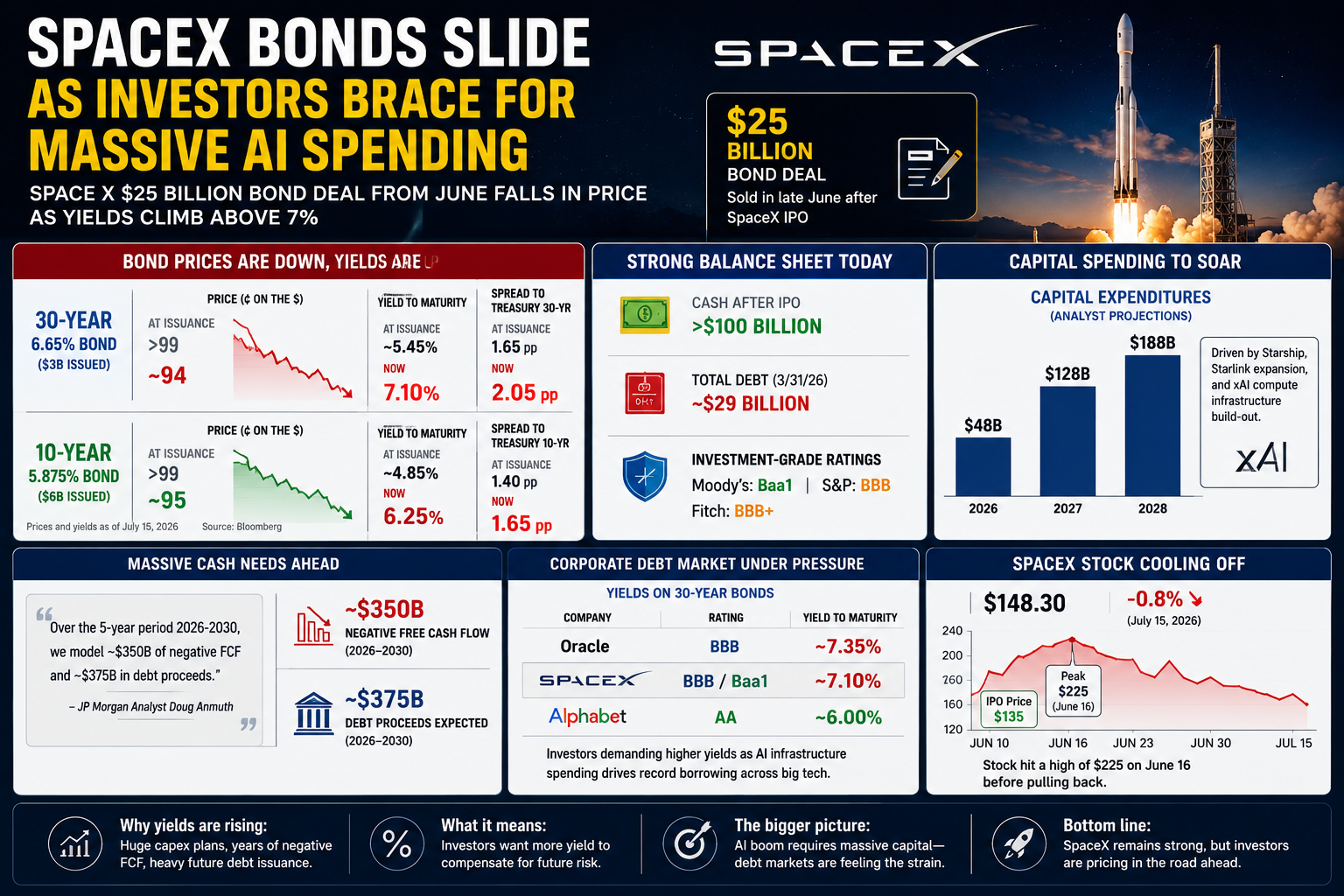
Since the offering, bond prices have declined while SpaceX bond yields have moved sharply higher. The company’s 30-year 6.65% bonds now trade near 94 cents on the dollar, down from more than 99 at issuance, pushing the yield above 7.1%.
Meanwhile, the 10-year 5.875% bonds now yield approximately 6.25%, reflecting a widening spread over comparable Treasury securities.
Why Investors Are Demanding Higher Yields
The concern isn’t SpaceX’s current financial health.
Following its IPO, the company holds more than $100 billion in cash while carrying approximately $29 billion in debt, leaving it with one of the strongest balance sheets in corporate America.
Instead, investors are focusing on what comes next.
Analysts expect SpaceX to dramatically increase spending over the next several years as it builds out:
- Starship launch infrastructure
- Starlink satellite expansion
- xAI data centers and compute infrastructure
- Artificial intelligence hardware
- Future space exploration initiatives
Those investments are expected to require substantial additional borrowing even after the company’s record-breaking IPO.
Capital Spending Set to Explode
According to S&P Global Ratings, SpaceX’s capital expenditures could increase dramatically:
- 2026: Approximately $48 billion
- 2027: Approximately $128 billion
- 2028: Approximately $188 billion
Much of that increase is expected to come from rapid expansion of the company’s artificial intelligence infrastructure, including investments supporting its xAI business.
JP Morgan estimates that SpaceX could generate nearly $350 billion of negative free cash flow between 2026 and 2030 while raising approximately $375 billion through additional debt issuance.
Heavy Supply Pressures Corporate Bond Market
SpaceX is not alone in tapping debt markets to finance AI infrastructure.
Technology giants including Alphabet, Meta Platforms, and Oracle have all increased borrowing to fund massive investments in artificial intelligence data centers and computing capacity.
With so many large issuers competing for investor capital, buyers are beginning to demand higher yields before committing new money.
Even so, SpaceX continues to borrow at rates below many similarly rated corporate issuers.
For comparison:
- SpaceX 30-year bonds yield approximately 7.10%
- Oracle 30-year bonds yield approximately 7.35%
- Alphabet 30-year bonds yield approximately 6.00% due to its higher credit rating
Credit Ratings Remain Investment Grade
Despite investor concerns, rating agencies continue to view SpaceX as investment grade.
The company currently holds ratings of:
- Moody’s: Baa1
- S&P Global: BBB
- Fitch Ratings: BBB+
Moody’s cited SpaceX’s dominant position as the world’s leading orbital launch provider and operator of the largest low-Earth-orbit satellite broadband network as key strengths supporting its credit profile.
Management has also indicated it intends to maintain a debt-to-EBITDA ratio consistent with investment-grade ratings.
Trading Implications
Rising SpaceX bond yields do not necessarily signal financial distress. Instead, they reflect investors demanding additional compensation for what could become one of the largest corporate borrowing programs ever undertaken.
Equity investors should recognize that heavy capital spending may pressure free cash flow for several years, even if long-term growth prospects remain attractive.
The broader takeaway is that the AI infrastructure boom continues to require extraordinary amounts of capital. Companies building next-generation compute capacity—from SpaceX and xAI to Alphabet, Meta, Oracle, and semiconductor suppliers—are increasingly relying on debt markets to finance expansion.
Bottom Line
Although SpaceX remains financially strong, investors are adjusting to the reality that the company may spend hundreds of billions of dollars building AI infrastructure and expanding its space business over the remainder of the decade.
Higher SpaceX bond yields reflect that growing financing burden rather than weakening operations. For long-term investors, the key question is whether those massive investments ultimately generate the earnings growth needed to justify today’s elevated spending and continued reliance on debt markets.