
Market Insight | August 26, 2026
Hotter-Than-Expected PCE Inflation Raises the Stakes for the Fed — and for Traders
Inflation did not suddenly surge in July, but it also did not deliver the improvement the Federal Reserve has been waiting for. That leaves interest-rate expectations unusually sensitive to every new piece of economic data — and makes the next several trading sessions potentially important for stocks, bonds, the dollar, and market volatility.
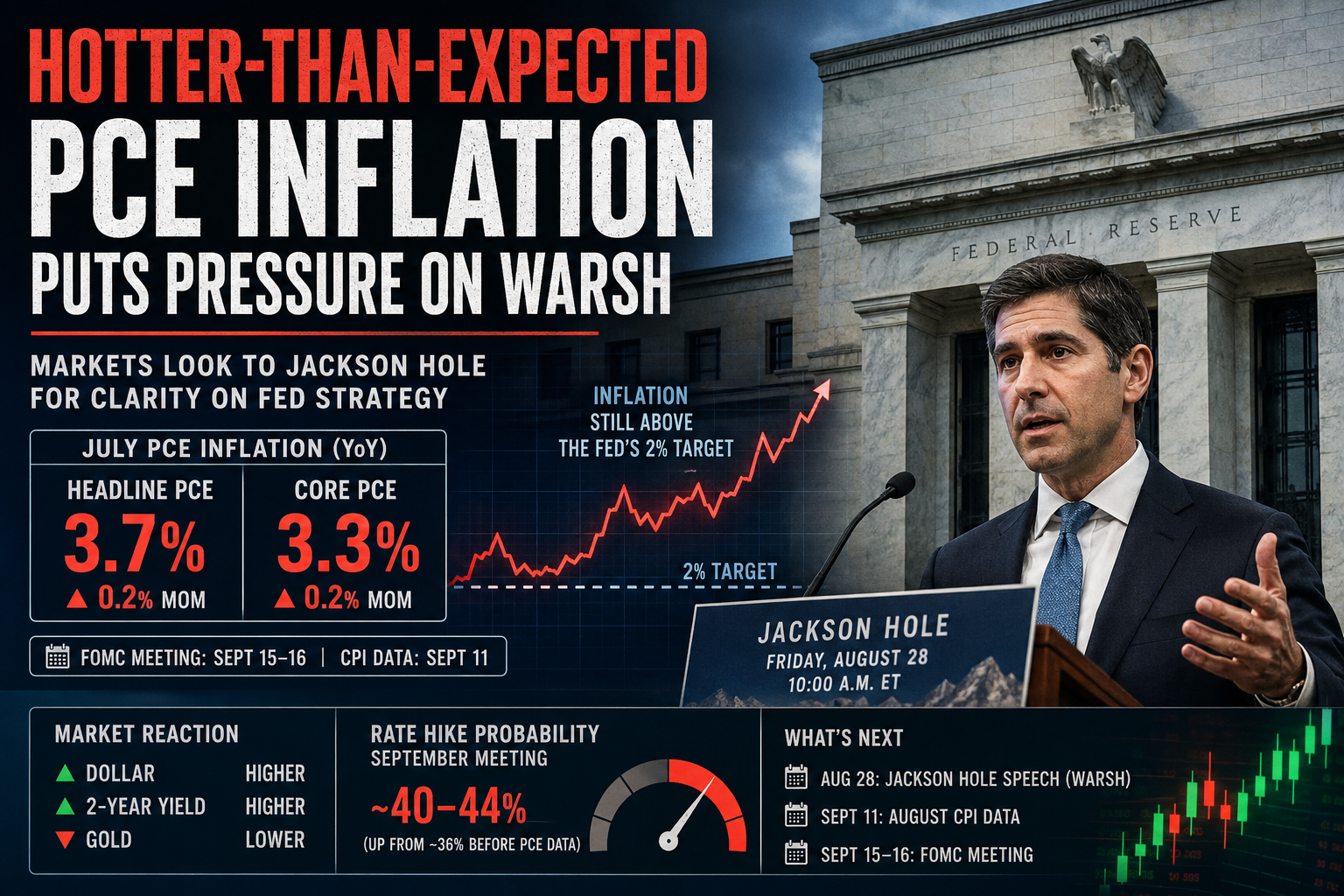
The latest Personal Consumption Expenditures report reminded everyone that the inflation problem is not yet behind the Federal Reserve. The Bureau of Economic Analysis reported that the PCE price index increased 0.2% in July and was 3.7% higher than a year earlier. Core PCE, which excludes food and energy and is closely followed by Federal Reserve policymakers, also increased 0.2% for the month and remained 3.3% above year-ago levels.
The immediate message from the hotter-than-expected PCE inflation report is not necessarily that another rate hike is imminent. Rather, the data make it harder for the Fed to confidently declare that inflation is moving sustainably back toward its 2% objective. That distinction matters enormously for traders because markets are not simply pricing today’s inflation number — they are trying to anticipate what it will prompt policymakers to do next.
Inflation Is Not Reaccelerating Sharply — But It Is Still Too High
The July report has an important nuance. Headline PCE inflation remained at 3.7% year over year, the same rate reported for June. Core PCE remained at 3.3%. In other words, inflation did not materially worsen year over year. But it also did not show the sustained improvement that would make the Federal Reserve comfortable easing policy.
That puts the market in an awkward middle ground. The data are not strong enough to make another hike an obvious conclusion, but they are sufficiently firm to keep a hike on the table. For investors, that means rate expectations can swing much more dramatically in response to speeches, employment data, CPI, Treasury-market movement, or any unexpected economic shock.
It also increases the importance of Federal Reserve Chair Kevin Warsh’s keynote remarks at the Jackson Hole Economic Policy Symposium on Friday, August 28. The Federal Reserve calendar lists his speech for 10:00 a.m. Eastern Time. Markets will be listening closely for any indication of how Warsh weighs persistent inflation against economic growth, productivity, employment, and financial conditions.
Why the Warsh Speech May Matter More Than the PCE Number Itself
Economic reports move markets because they change expectations. Fed communication can move markets even more aggressively because it helps traders understand how policymakers themselves interpret those reports. The hotter-than-expected PCE inflation reading therefore raises the stakes for Jackson Hole considerably.
A hawkish interpretation from Warsh — emphasizing that inflation remains unacceptably high and that policymakers are prepared to tighten further if necessary — would likely push short-term Treasury yields higher and reinforce expectations that rates may remain restrictive for longer. A more patient interpretation, particularly one emphasizing improving inflation momentum, productivity gains, or the lagged effects of previous tightening, could have the opposite effect.
This creates a classic catalyst environment: the market has the data, but it does not yet know exactly how the central bank intends to respond.
Implications for the Broader Stock Market
For the broader equity market, persistent inflation keeps the discount-rate problem alive. Higher expected interest rates generally reduce the present value investors assign to future corporate earnings. That effect is most visible in high-growth, high-multiple stocks, particularly technology companies whose valuations depend heavily on earnings expected well into the future.
Market Areas to Watch
- Nasdaq and growth stocks: potentially the most rate-sensitive if Treasury yields rise.
- Financials: may benefit from higher rates in some circumstances, although the shape of the yield curve and credit conditions matter.
- Small caps: vulnerable if markets conclude financing conditions will remain restrictive for longer.
- Consumer discretionary stocks: may face pressure if sticky inflation continues to squeeze real household purchasing power.
- Gold: sensitive to changes in real yields and the U.S. dollar, making it an important cross-market confirmation tool.
- U.S. dollar: could strengthen if the market increases expectations for tighter Fed policy.
The key intermarket signal is likely to be Treasury yields. If equities sell off while the 2-year Treasury yield and dollar rise, traders have relatively clean confirmation that the market is repricing Fed policy. If yields fade despite the inflation number, however, equity weakness may struggle to sustain itself.
This is why traders should be cautious about interpreting the first stock-index move in isolation. The bond market can tell us whether the inflation narrative is actually gaining traction.
What Day Traders Should Expect Today
For day traders, hotter-than-expected PCE inflation can create opportunity, but the shape of the opportunity matters. The initial economic-data reaction often produces a sharp repricing in index futures, Treasury yields, the dollar, and rate-sensitive stocks. Once the opening bell arrives, however, the market frequently moves into a second phase in which traders decide whether the premarket reaction deserves to continue.
A Practical Day-Trading Framework
Rather than assuming that the first reaction must become the day’s trend, watch whether price can hold beyond important premarket support and resistance, the opening range, VWAP, major volume-by-price clusters, and other clearly defined reference levels.
The strongest trades are likely to occur when the macro narrative and market structure agree. For example, a break of support in the Nasdaq accompanied by rising Treasury yields, a strengthening dollar, expanding downside volume, and weak order flow provides much stronger confirmation than an isolated index move.
Conversely, if the market gaps lower on inflation concerns but fails to attract additional selling after the open, that failure can itself become actionable information. A rejection of the initial bearish narrative can produce powerful reversals as traders who sold the headline are forced to cover.
The objective is therefore not to predict whether inflation is “good” or “bad.” The day trader’s job is to observe how institutions actually respond to the information and then execute around predetermined levels.
What to Expect From Volatility During Today’s Session
Volatility after an important inflation report is often front-loaded, but today’s setup may create several distinct volatility windows.
| Time / Window | What Traders Should Watch | Likely Volatility Character |
|---|---|---|
| Premarket | Treasury yields, index futures, dollar, rate-sensitive technology shares | Fast repricing as algorithms and institutions digest the inflation data |
| 9:30–10:00 a.m. ET | Opening range, overnight highs/lows, VWAP, premarket support/resistance | Potentially wide ranges, false breaks, inventory correction, and rapid reversals |
| Late Morning | Whether yields confirm or reject the opening equity move | Volatility may contract if the market reaches temporary agreement on the inflation narrative |
| Afternoon | Institutional positioning, bond-market direction, important index levels | Possible expansion again if morning support/resistance breaks or rate expectations shift |
| Final Hour | Positioning ahead of additional catalysts and Friday’s Jackson Hole speech | Potential increase in hedging and directional positioning into the close |
One of the biggest mistakes traders can make on a day like this is assuming that elevated volatility means persistent directional movement. Volatility can look like a trend, but it can also look like violent two-way movement. Wider intraday ranges increase opportunity while simultaneously increasing the cost of poor entries, chasing, and oversized positions.
The Next Several Days Could Be More Important Than Today
Today’s PCE release begins a sequence rather than ending one. The market now moves toward Warsh’s Jackson Hole speech on Friday, followed by additional employment and inflation information before the Federal Open Market Committee meets September 15–16.
That means implied and realized volatility may remain elevated even if today’s market settles down after the opening reaction. Traders may repeatedly reposition as each new data point changes the perceived probability of another Fed move.
Friday is particularly important because a central-bank speech can produce a different type of volatility than a scheduled economic release. A data release hits the market at a known instant. A speech unfolds over time. Individual phrases can trigger repeated waves of algorithmic buying and selling as traders interpret language related to inflation, policy restraint, future hikes, growth, productivity, and the Fed’s inflation target.
Day traders should therefore prepare for abrupt shifts around the speech rather than assuming the first move is definitive.
September CPI Becomes the Next Major Inflation Test
The next major inflation checkpoint before the September Fed meeting will be the August Consumer Price Index. That report arrives only days before policymakers meet, giving it unusual potential to shape the market’s final expectations for the decision.
If CPI reinforces the message from the hotter-than-expected PCE inflation report, the market could become substantially more confident that restrictive policy will remain in place — or that another hike may be required. If CPI shows convincing disinflation, today’s concerns could fade quickly.
This binary quality is one reason volatility can remain elevated between reports. Traders are effectively carrying greater uncertainty about the future path of interest rates, and uncertainty is one of the basic ingredients of volatility.
What Would Change the Market Narrative?
Traders should resist becoming anchored to the idea that today’s inflation report permanently changes the market trend. Several developments could quickly alter the narrative.
- A notably hawkish or dovish interpretation from Warsh at Jackson Hole.
- A sharp change in Treasury yields that contradicts the initial equity response.
- Employment data suggesting that economic growth is deteriorating more rapidly than inflation remains elevated.
- August CPI showing either renewed acceleration or meaningful improvement.
- Unexpected geopolitical or economic developments that change growth or inflation expectations.
For active traders, this reinforces the importance of planning around observable market levels rather than committing to a single macro forecast.
The TraderInsight Approach: Plan the Trade, Then Let the Market Confirm It
Macro information provides context. It should not replace execution rules.
In a catalyst-driven session, the best opportunity often emerges when economic information, price structure, volume, volatility, and order flow point in the same direction. A trader can identify key support and resistance before the open, determine where a violation would change the technical picture, define risk in advance, and then wait for the market to confirm.
This is particularly important when hotter-than-expected PCE inflation creates a strong narrative before the bell. Narratives can attract traders into chasing. A plan creates a reason to wait.
If the inflation story produces sustained institutional selling, the market should demonstrate it through price. If the bearish reaction cannot hold, that information is equally valuable. Either way, the trader does not have to predict the Federal Reserve. The trader has to recognize what the market is doing and execute a well-defined plan.
The Bottom Line
July’s PCE report did not show a dramatic new inflation surge, but it did show that inflation remains stubbornly above the Federal Reserve’s target. That keeps another rate hike in the conversation and makes Kevin Warsh’s Jackson Hole speech the next major test for financial markets.
For investors, persistent inflation keeps pressure on valuations and makes Treasury yields increasingly important. For day traders, it creates an environment in which volatility can expand quickly around economic headlines, Fed communication, and breaks of important technical levels.
The key is not predicting the headline. It is planning the trade, identifying the levels that matter, and allowing price, volume, yields, and order flow to confirm the opportunity.
Sources
U.S. Bureau of Economic Analysis, Personal Income and Outlays, July 2026, released August 26, 2026:
BEA July 2026 PCE Release
Board of Governors of the Federal Reserve System, August 2026 calendar:
Federal Reserve August 2026 Calendar
CME Group, FedWatch:
CME FedWatch Tool