
AI Oil And Gas Exploration Could Unlock More Supply — and a New Trading Theme
Artificial intelligence is rapidly changing the energy trade, but perhaps not in the way many investors expected.
Much of Wall Street’s AI-energy discussion has focused on the enormous amount of electricity required to power data centers. A new study, however, highlights another side of the equation: AI in oil and gas could make fossil-fuel companies considerably more productive.
That means cheaper drilling, better exploration, higher recovery rates from existing fields and potentially substantially larger recoverable reserves.
For traders, that creates a much broader investment theme. The AI revolution may benefit not only semiconductor companies and data-center operators, but also oil producers, natural-gas companies, drilling and oilfield-service businesses, utilities and power-infrastructure providers.
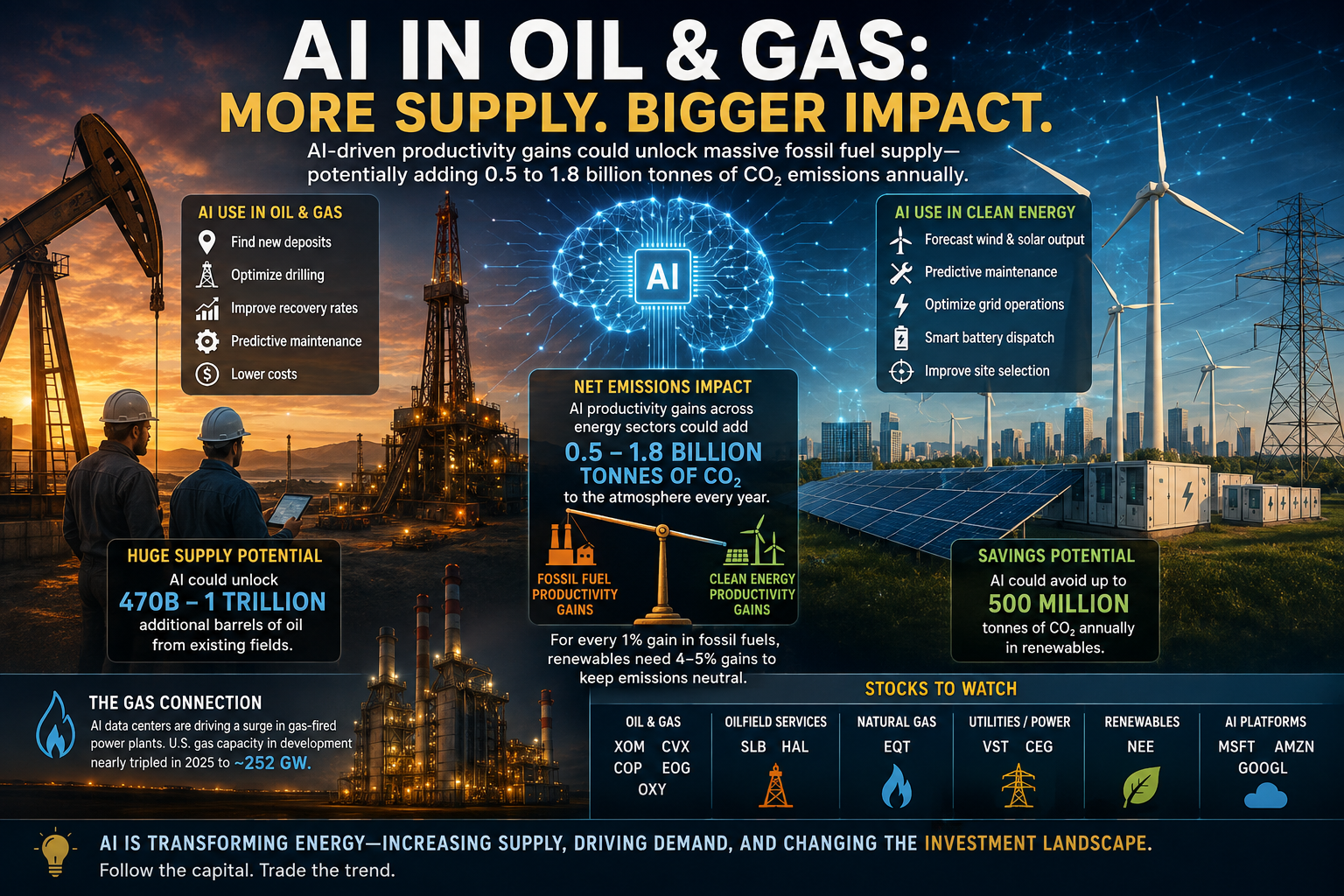
AI Is Becoming an Oil-Production Tool
Artificial intelligence is particularly well suited to the enormous datasets generated by modern oil and gas operations.
Energy companies can apply machine learning and advanced analytics to seismic data, geological models, drilling performance, well histories and production data. The objective is straightforward: find hydrocarbons more efficiently and extract more of what has already been discovered.
That can potentially improve several parts of the upstream business simultaneously.
- Identify promising drilling locations faster
- Reduce unsuccessful or inefficient drilling
- Optimize well placement and drilling trajectories
- Improve equipment maintenance
- Increase recovery from producing fields
- Reduce operating and drilling costs
- Extend the economic life of existing assets
In other words, AI in oil and gas is becoming a productivity technology. Even relatively modest improvements in productivity can have enormous consequences in an industry operating at global scale.
Could AI Unlock Hundreds of Billions of Barrels?
The numbers being discussed are extraordinary.
Wood Mackenzie has estimated that improved analysis and recovery techniques applied to existing fields could identify an additional 470 billion to more than 1 trillion barrels of oil-production potential.
The opportunity does not necessarily depend on discovering entirely new giant oilfields. Much of it could come from increasing recovery rates at fields that already exist.
That matters because a small percentage improvement applied across the world’s enormous installed base of oil fields can translate into massive additional supply.
Artificial intelligence could help operators recognize which techniques have worked elsewhere and determine where those techniques could be economically applied to mature fields.
For investors, this introduces an important possibility: AI in oil and gas could effectively increase the world’s economically recoverable energy inventory without the discovery of an equivalent amount of new acreage.
AI Could Also Change the Economics of U.S. Shale
The implications could be particularly important for shale producers.
Unlike large conventional projects that may require many years of development, shale operations function almost like manufacturing systems. Producers repeatedly drill similar wells across enormous acreage positions.
That makes shale especially suitable for data-driven optimization.
AI can analyze differences in geology, lateral placement, completion design, pressure, drilling speed and production history across thousands of wells. Each new well provides additional information that can improve the next one.
If the technology meaningfully reduces drilling costs while increasing recovery rates, the economic break-even price for some acreage could fall.
For traders, that raises a critical second-order question: Could AI eventually increase oil supply enough to place downward pressure on long-term crude prices?
That would create a very different trading environment from the simple assumption that AI-driven electricity demand is uniformly bullish for the entire energy complex.
The Climate Paradox of AI in Oil and Gas
The new research examines what its authors describe as enabled emissions — emissions made possible because AI improves the productivity of energy-producing industries.
The researchers estimate that widespread AI productivity improvements throughout the energy sector could ultimately add approximately 0.5 billion to 1.8 billion tonnes of carbon dioxide annually under the scenarios they modeled.
Artificial intelligence can also improve renewable-energy production.
Wind and solar operators can use AI for weather and generation forecasting, predictive maintenance, grid optimization, battery-storage dispatch, equipment monitoring and improved site selection.
The study estimates those efficiencies could potentially avoid as much as roughly 500 million tonnes of CO2 annually.
But the researchers conclude that fossil-fuel productivity improvements could outweigh those benefits.
Their modeling suggests that for every 1% productivity improvement in fossil fuels, renewable-energy productivity would need to improve roughly 4% to 5% to keep the resulting emissions impact neutral.
The Bigger AI Energy Story May Be Natural Gas
Meanwhile, the electricity needed to operate AI infrastructure is creating another powerful energy theme.
Utilities and technology companies are planning large additions of gas-fired generating capacity as data centers increase electricity demand. In some cases, data-center developers are also turning to on-site gas and diesel generation because of long waits for new grid connections.
This creates an unusual feedback loop.
AI requires enormous quantities of electricity. Natural gas is increasingly being considered as a relatively fast way to provide that power. At the same time, AI in oil and gas can improve the efficiency of finding and producing the fuel feeding those generators.
That means the AI-energy trade could potentially reinforce itself:
More AI → more electricity demand → more gas infrastructure → better AI-assisted energy production → potentially more available supply.
Why Data-Center Emissions May Be Only Part of the Story
Much of the environmental debate surrounding artificial intelligence has centered on the power consumed by massive data centers.
The new research argues that this may overlook a potentially larger indirect effect.
If AI allows energy producers to extract fossil fuels more cheaply and efficiently, the resulting additional production could have a substantially larger emissions impact than the electricity consumed directly by AI computing infrastructure.
This distinction is important for investors as well.
Wall Street has spent several years identifying the companies selling the picks and shovels of artificial intelligence: chips, networking equipment, servers, cooling systems and electricity.
The next phase may involve identifying the industries whose underlying economics are being transformed by the technology.
Energy may be near the top of that list.
Trading Ideas: How Traders Can Approach the AI Energy Theme
The key for traders is not to assume that every company connected to AI or energy will automatically benefit. Instead, watch for price action confirming where capital is actually flowing.
1. Integrated Oil Producers — XOM and CVX
Exxon Mobil (XOM) and Chevron (CVX) provide traders with liquid exposure to global oil and gas production.
If AI-driven improvements increase recovery rates, improve exploration success or lower extraction costs, large producers with enormous datasets and extensive asset bases may be well positioned to take advantage.
Watch how these stocks behave relative to crude oil itself. If producers begin outperforming crude, the market may be pricing stronger operating efficiency rather than simply higher commodity prices.
2. Exploration and Production — COP, EOG and OXY
ConocoPhillips (COP), EOG Resources (EOG) and Occidental Petroleum (OXY) offer more direct exposure to upstream production economics.
The important trading question is whether AI in oil and gas can materially lower the marginal cost of producing another barrel.
If that happens, companies with large inventories of drilling locations could potentially convert acreage that once looked marginal into economically attractive production.
3. Oilfield Services — SLB and HAL
SLB (SLB) and Halliburton (HAL) may offer another angle.
Oilfield-service companies increasingly combine physical drilling technology with software, digital modeling, automation and production optimization.
If producers spend more heavily on technology designed to improve field performance, service providers supplying the infrastructure and expertise could benefit even when crude itself is range-bound.
4. Natural Gas Producers — EQT
EQT (EQT) is one of the names traders can watch as the AI data-center buildout increases expectations for U.S. electricity demand.
The natural-gas trade has two separate AI catalysts: increased gas demand from power generators and possible productivity improvements from AI-assisted exploration and production.
That makes natural gas one of the most interesting intersections between AI infrastructure and traditional energy.
5. Power and Utilities — VST and CEG
Vistra (VST) and Constellation Energy (CEG) have become important stocks for traders following the AI electricity-demand theme.
They represent a different part of the chain. Instead of producing the underlying commodity, they provide exposure to the increasingly valuable electricity required to operate data centers and other high-load infrastructure.
Watch these names alongside natural gas, regional electricity prices and announcements involving new hyperscale data-center projects.
6. AI Platforms — MSFT, AMZN and GOOGL
The major cloud providers remain important because they supply much of the computing infrastructure and artificial-intelligence technology being deployed throughout industry.
Microsoft (MSFT), Amazon (AMZN) and Alphabet (GOOGL) therefore sit on both sides of the story.
They are major consumers of electricity because of their data centers, but their AI and cloud platforms can also help energy companies become more productive.
Investors should watch whether this creates greater political or regulatory scrutiny around what the researchers call enabled emissions.
7. Renewable Energy — NEE
NextEra Energy (NEE) provides another way to monitor the competition for capital between conventional and renewable power generation.
AI can improve renewable forecasting, maintenance and battery dispatch, but the new study argues that those gains must be considerably larger than fossil-fuel productivity improvements to offset their emissions impact.
From a trading perspective, relative strength between renewable-energy stocks, natural-gas infrastructure and conventional utilities can provide useful clues about which energy solution investors believe will satisfy AI’s rapidly increasing power requirements.
The Contrarian Possibility: AI Could Be Bearish for Oil Prices
One of the most interesting implications for traders may actually be bearish.
If AI allows producers to extract significantly more oil from existing fields while reducing drilling costs, the technology could increase available supply.
Everything else being equal, greater supply creates downward pressure on prices.
That does not necessarily mean oil stocks decline.
A producer capable of lowering its production cost faster than crude prices decline could actually improve margins or take market share from higher-cost competitors.
This is why traders should separate three different variables:
- The price of crude oil
- The cost of producing crude oil
- The profitability of individual producers
AI could affect all three differently.
TraderInsight: Follow the Capital, Not the Narrative
There is a natural temptation to reduce the AI-energy story to a simple narrative: AI needs more electricity, therefore energy prices and energy stocks must rise.
Markets are rarely that simple.
AI in oil and gas could simultaneously increase energy demand and increase energy supply.
It could help natural-gas producers supply data-center power while allowing oil companies to extract more hydrocarbons from existing reservoirs. It could improve wind and solar production while also lowering drilling costs for fossil-fuel producers.
Those competing forces are exactly what can create trading opportunity.
Rather than predicting which narrative ultimately wins, traders can watch relative strength, volume, order flow and important technical levels across the groups affected by the trend.
Keep XOM, CVX, COP, EOG, OXY, SLB, HAL and EQT on one screen. Watch VST, CEG and NEE on another. Then compare those stocks with crude oil, natural gas and the broader technology sector.
If institutional money begins consistently favoring one part of the chain, price will usually reveal that shift before the long-term economic debate is settled.
The Bottom Line
The next major chapter of the artificial-intelligence boom may not take place entirely inside a data center.
It may take place thousands of feet underground.
AI in oil and gas has the potential to improve exploration, reduce drilling costs, increase recovery rates and expand economically recoverable reserves on an enormous scale.
At the same time, AI is accelerating electricity demand and encouraging a major buildout of power infrastructure.
The environmental consequences will remain heavily debated, and the new study represents a modeled assessment rather than a certainty about future emissions. But the economic implication is already worth watching.
AI is moving beyond the companies building the technology and into the industries that use it.
For traders, that means the AI trade may be broadening again — and energy could become one of its most important battlegrounds.
TraderInsight educational content is provided for informational and educational purposes only and is not investment advice. Trading and investing involve risk, and past performance is not indicative of future results.