
The AI Profitability War: Why China’s Low-Cost Models Could Reshape the Entire AI Trade
 For nearly three years, investors have focused on one question: Who will build the most powerful artificial intelligence models?
That question is beginning to change.
The next phase of the AI revolution may not be determined by who has the smartest model, but by who can actually make money from it. The battle over AI profitability is rapidly becoming one of Wall Street’s most important investment themes, as inexpensive Chinese models threaten the pricing power that has fueled trillion-dollar valuations across the U.S. technology sector.
At the same time, economists are warning that the AI trade has become deeply intertwined with virtually every corner of the financial markets—from corporate bonds to venture capital to foreign investment flows. If investors begin questioning AI returns, the consequences could extend well beyond the technology sector.
The AI Race Has Entered a New Phase
The first phase of the artificial intelligence boom centered on infrastructure.
Investors rewarded companies building semiconductor capacity, constructing data centers, purchasing graphics processors, and training increasingly sophisticated foundation models.
Nvidia became the face of the movement, while Microsoft, Alphabet, Amazon, Meta Platforms and OpenAI collectively committed hundreds of billions of dollars toward AI infrastructure.
Today, however, Wall Street is beginning to ask a much harder question.
Can these investments actually generate acceptable returns?
That question lies at the heart of the growing debate surrounding AI profitability.
China Is Attacking Where It Hurts Most
The newest competitive threat isn’t necessarily superior technology.
It’s dramatically lower prices.
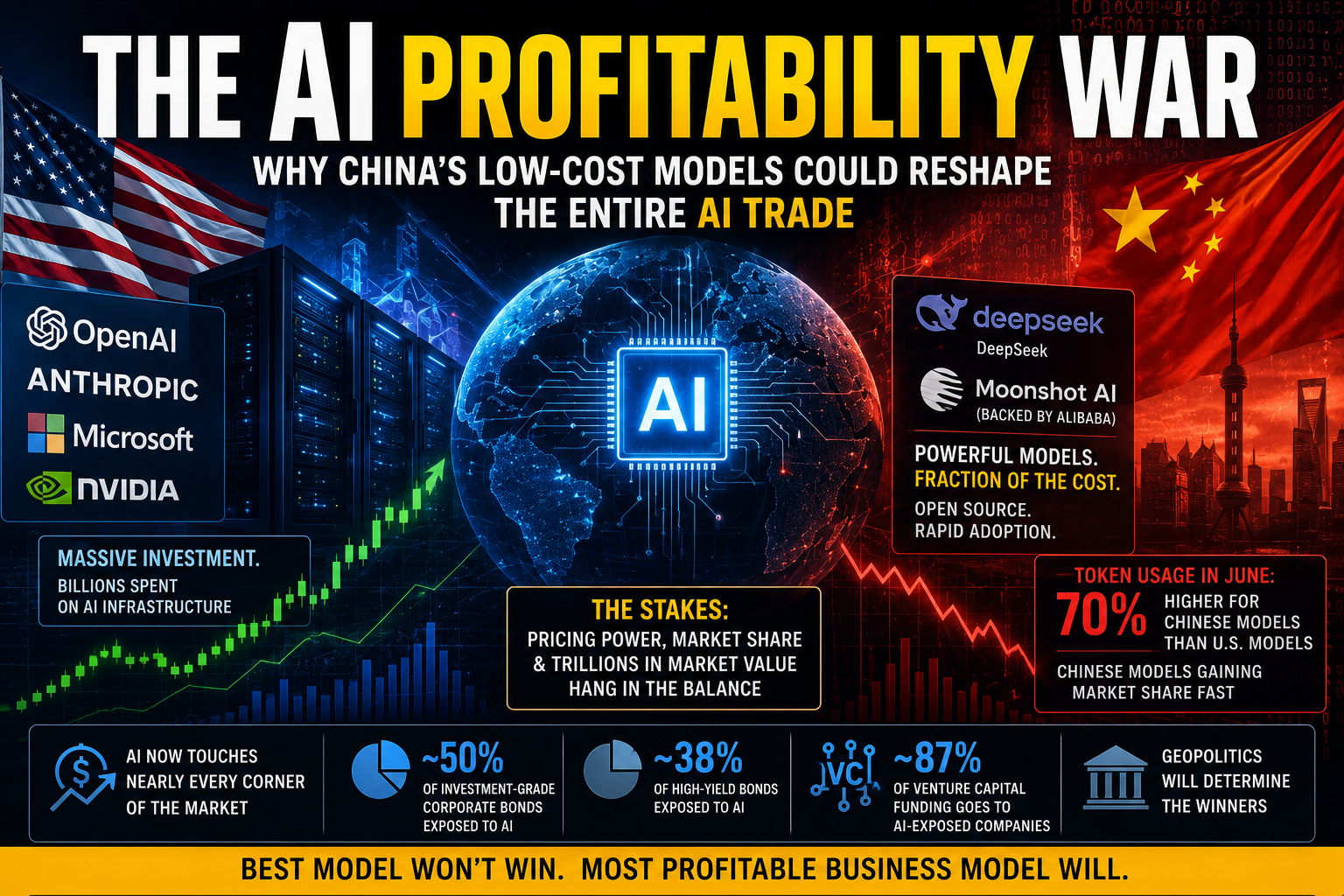
Chinese developers including Moonshot AI and DeepSeek have released increasingly capable large language models that are available at a fraction of the cost charged by leading American AI companies.
Many of these models are released under open-weight or open-source licensing structures, allowing businesses to deploy them locally or through cloud providers without paying ongoing licensing fees.
That creates a potentially serious challenge for premium AI providers.
If customers conclude that lower-cost Chinese models perform “well enough” for most commercial applications, the pricing power enjoyed by companies like OpenAI and Anthropic could begin to erode.
For investors, this represents a classic commoditization risk.
Token Usage Suggests Adoption Is Accelerating
The competitive threat isn’t theoretical.
According to Apollo Chief Economist Torsten Sløk, monthly token usage for Chinese AI models exceeded usage of U.S. models by approximately 70% during June, reflecting rapid adoption across developers and enterprise customers.
Usage growth matters because AI economics ultimately depend on recurring consumption.
The more businesses build applications around a model, the more difficult it becomes for competitors to displace it later.
Chinese developers appear to be pursuing a strategy similar to earlier software companies: maximize adoption first, monetize later.
If successful, that approach could fundamentally alter assumptions surrounding long-term AI profitability.
The Pricing Power Problem
The technology industry has experienced this pattern before.
Cloud computing eventually became a scale business.
Internet search became dominated by advertising economics.
Streaming video evolved into a content arms race.
Artificial intelligence may now face its own pricing battle.
If comparable models become widely available at dramatically lower prices, premium providers may struggle to maintain current margins.
That doesn’t necessarily mean revenues disappear.
It may simply mean the industry earns lower returns on the extraordinary capital currently being invested.
Geopolitics Could Determine the Winners
The AI battle is no longer simply technological.
It has become geopolitical.
Washington is increasingly debating whether Chinese AI models should face restrictions similar to those imposed on advanced semiconductor exports.
Supporters argue that limiting Chinese AI adoption would protect American innovation and preserve domestic leadership.
Critics warn that such restrictions could unintentionally raise costs for U.S. businesses while allowing European and other international competitors continued access to lower-cost alternatives.
Either outcome carries significant investment implications.
If restrictions tighten, American AI leaders may preserve pricing power but potentially slow enterprise AI adoption.
If restrictions remain limited, competition could intensify much faster than many investors currently expect.
America Still Holds Important Advantages
Despite growing concern, the United States continues to maintain meaningful leadership in several critical areas.
Advanced semiconductor production remains dominated by American companies and their allies.
Nvidia continues to lead AI accelerator design, while hyperscalers possess enormous computing capacity unavailable to most competitors.
Analysts estimate U.S. companies currently maintain a substantial advantage in deployable AI compute compared with China’s domestic capabilities.
That lead, however, may not remain permanent.
Several industry observers believe China could substantially reduce its dependence on foreign AI hardware later this decade through domestic semiconductor development.
The Bigger Risk Isn’t Technology
Perhaps the greatest risk facing investors isn’t whether Chinese models catch American models.
It’s whether the economics of AI disappoint.
Apollo’s Torsten Sløk argues that AI has become deeply embedded throughout the financial system.
Nearly half of the investment-grade corporate bond market now has meaningful exposure to AI-related companies or infrastructure spending.
Approximately 38% of the high-yield bond market is similarly connected.
Even more striking, roughly 87% of venture capital funding now flows into businesses with significant AI exposure.
That means the success—or failure—of AI profitability could influence far more than technology stocks.
Foreign Capital Raises the Stakes
International investors have poured hundreds of billions of dollars into U.S. equities over the past year, largely to gain exposure to America’s AI leadership.
Should confidence begin to weaken, those flows could reverse.
Foreign selling would not only pressure equity valuations but could also weaken the U.S. dollar while increasing financing costs for corporations already spending aggressively on AI infrastructure.
Markets rarely struggle because of one isolated problem.
They struggle when multiple risks begin reinforcing one another.
Today those risks include AI monetization uncertainty, elevated capital expenditures, geopolitical tensions, inflation concerns, and higher financing costs.
Why Nvidia Investors Should Pay Attention
Nvidia remains the dominant supplier of AI accelerators, and demand for its chips continues to exceed supply.
But Nvidia’s long-term valuation ultimately depends on customers continuing to expand AI infrastructure spending.
If enterprises begin achieving acceptable results using significantly cheaper AI models, they may require less compute than investors currently anticipate.
Likewise, if competition compresses software margins, hyperscalers may become more selective about future capital expenditures.
Neither scenario represents an immediate threat to Nvidia.
However, both illustrate why investors should monitor the broader economics of AI rather than focusing solely on semiconductor demand.
What Traders Should Watch
The coming months could prove critical for the AI investment narrative.
Investors should monitor:
- Enterprise adoption of Chinese open-weight AI models.
- Potential U.S. restrictions on Chinese AI software.
- Comments from OpenAI, Anthropic and Microsoft regarding pricing trends.
- Hyperscaler capital expenditure guidance.
- Nvidia demand forecasts.
- Corporate AI monetization metrics.
- Gross margin trends among leading AI companies.
- Developments ahead of expected U.S.-China AI discussions later this year.
Perhaps most importantly, traders should watch whether Wall Street begins shifting its focus from AI capability toward AI cash flow.
The Bottom Line
The AI boom isn’t ending.
It’s maturing.
The market’s first question was whether artificial intelligence would change the world.
Most investors now answer that with a resounding yes.
The second question is proving much more difficult:
Who will actually earn the profits?
As Chinese developers introduce increasingly capable low-cost models, investors may be forced to reconsider assumptions that premium AI providers will enjoy years of pricing power.
The companies that ultimately dominate this next phase may not simply build the smartest models—they may build the most profitable business models.
For traders, that makes AI profitability one of the most important themes to watch over the next several years. It will influence valuations across semiconductors, cloud computing, software, venture capital, and potentially the broader equity market itself.