
Anthropic IPO Could Reach $2 Trillion — What It Means for AI Stocks
Wall Street may be about to get its biggest test yet of just how much investors are willing to pay for artificial intelligence growth.
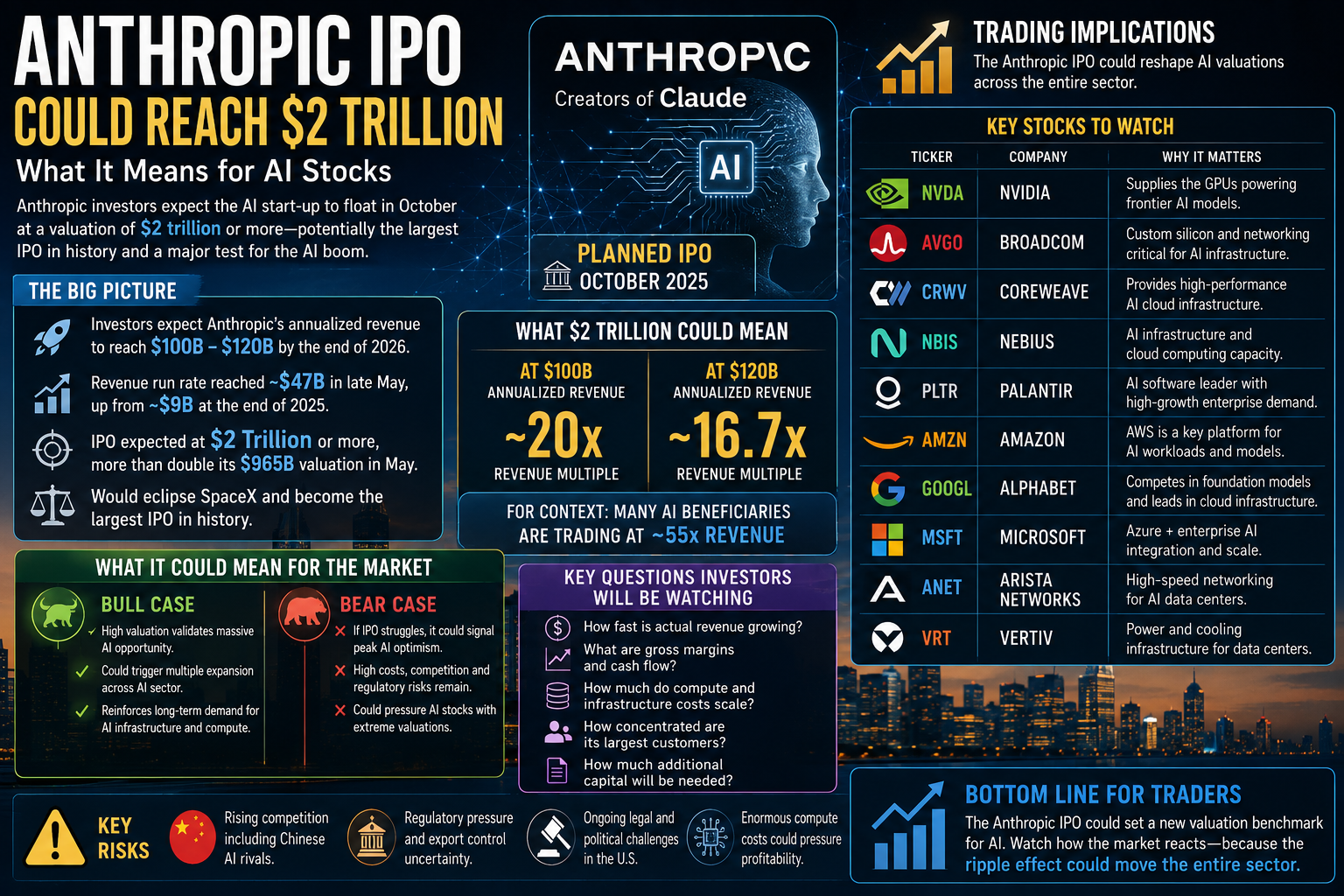
Investors in Anthropic expect the AI company behind Claude to pursue an October stock-market listing at a valuation of $2 trillion or more, potentially creating the largest initial public offering in history.
The number is staggering. Anthropic was valued at approximately $965 billion after its latest private financing round in May, meaning a $2 trillion flotation would more than double the company’s valuation in just a matter of months. Anthropic itself has not publicly established a $2 trillion IPO target, and the figure currently reflects expectations among some of its investors rather than formal guidance from the company. :contentReference[oaicite:0]{index=0}
But for traders, the importance of the Anthropic IPO extends well beyond whether the eventual valuation is $1.5 trillion, $2 trillion or $3 trillion.
If public markets accept anything close to those numbers, Anthropic could establish an entirely new valuation benchmark for artificial-intelligence companies — potentially affecting everything from Palantir and CoreWeave to Nvidia, Nebius, Amazon, Alphabet and Microsoft.
Why Investors Think Anthropic Could Be Worth $2 Trillion
The bullish case starts with revenue growth.
Anthropic investors expect the company’s annualized revenue to reach approximately $100 billion to $120 billion by the end of 2026. That measure takes the company’s more recent sales pace and extrapolates it across a full year rather than representing recognized full-year revenue.
Anthropic’s reported revenue run rate had already reached approximately $47 billion by late May, up dramatically from roughly $9 billion at the end of 2025, driven in part by strong enterprise adoption and demand for products such as Claude Code. :contentReference[oaicite:1]{index=1}
If Anthropic reaches a $100 billion annualized revenue rate, a $2 trillion valuation would represent approximately 20 times revenue.
At $120 billion, the multiple falls to roughly 16.7 times revenue.
Those numbers are still extremely high by traditional standards, but AI stocks have already demonstrated that investors are willing to pay extraordinary multiples for companies showing exceptional growth.
The Anthropic IPO Could Become the AI Sector’s New Measuring Stick
The most important implication may be what happens to comparable public companies.
The problem is that Anthropic does not really have a perfect publicly traded peer.
It combines elements of a software company, enterprise technology platform, cloud-computing customer, artificial-intelligence research laboratory and foundation-model provider.
That means investors are likely to compare the Anthropic IPO against several different categories of AI stocks.
Those comparisons could create significant trading opportunities.
If Anthropic receives an enormous valuation and trades higher after its debut, investors may become more willing to pay elevated multiples elsewhere in the AI sector.
If the IPO struggles, however, it could become evidence that public-market enthusiasm for extreme AI valuations has reached its limit.
A $2 Trillion IPO Would Put the AI Boom on Trial
There is an important distinction between private-market valuations and public-market valuations.
Private investors can accept limited liquidity and long investment horizons. Public markets provide a price every second.
That means Anthropic’s valuation will immediately be tested by hedge funds, institutional investors, retail traders, quantitative strategies and short sellers.
The result could become one of the most important sentiment indicators for the entire artificial-intelligence trade.
If investors willingly assign Anthropic a valuation approaching or exceeding $2 trillion, the message would be powerful:
Wall Street still believes extraordinary AI growth deserves extraordinary valuation multiples.
But the opposite is also true.
If investors question the economics, profitability or sustainability of Anthropic’s growth, the IPO could pressure highly valued AI stocks throughout the market.
The Biggest Risk: Revenue Growth Is Not Profit
The enormous projected revenue numbers naturally attract attention, but traders should remember that revenue and profit are very different things.
Frontier artificial intelligence requires huge amounts of computing power.
Training advanced models requires enormous clusters of specialized processors. Operating those models for millions of customers creates additional inference costs. Anthropic must also continue spending aggressively on researchers, software engineers, data centers and computing infrastructure if it wants to remain at the technological frontier.
The eventual IPO documents should therefore be particularly important.
Investors will finally get a much deeper look at several questions:
- How quickly is actual revenue growing?
- How much does it cost to generate that revenue?
- What are Anthropic’s gross margins?
- How much cash does the company consume?
- How rapidly are computing expenses increasing?
- How concentrated are its largest customers?
- How much additional capital will Anthropic require?
A company can grow extremely quickly and still destroy shareholder value if the cost of generating that growth rises just as quickly.
That makes profitability and cash generation critical issues surrounding the Anthropic IPO.
Trading Implications: Stocks to Watch Ahead of the Anthropic IPO
The Anthropic listing could create a major read-through across the AI sector. Traders should watch several groups rather than treating this as a single-stock event.
1. Palantir — PLTR
Palantir Technologies (PLTR) may be one of the most interesting stocks to watch because investors already treat it as a premium public-market AI software company.
Although Palantir’s business model differs significantly from Anthropic’s, both companies benefit from investor enthusiasm surrounding enterprise adoption of artificial intelligence.
If the market accepts a very high revenue multiple for Anthropic, investors may use that valuation to justify continued premium multiples for other rapidly growing AI software businesses.
That could become supportive for PLTR.
But the reverse could also happen.
If Anthropic’s IPO struggles because investors become more valuation-sensitive, stocks already carrying unusually high sales multiples could be among the first places traders look for multiple compression.
2. CoreWeave — CRWV
CoreWeave (CRWV) gives traders exposure to another side of the same AI ecosystem: the enormous computing infrastructure required to operate frontier models.
The recent acceleration in AI infrastructure demand has already made CoreWeave one of the stocks traders use to gauge appetite for AI compute spending.
An enthusiastic Anthropic IPO could reinforce the argument that demand for frontier AI remains extraordinarily strong.
That would matter for companies supplying the computing capacity required by AI developers.
Traders should pay particular attention to CRWV’s relative strength as Anthropic’s IPO approaches. If Anthropic valuation headlines improve while CRWV begins outperforming the broader market, that could indicate investors are expanding their exposure to the AI infrastructure theme.
3. Nebius — NBIS
Nebius Group (NBIS) offers another public-market vehicle tied to AI infrastructure and computing capacity.
Companies building specialized AI cloud infrastructure may receive renewed attention if Anthropic’s financial disclosures demonstrate that computing demand continues to increase at extraordinary rates.
For traders, NBIS can be monitored alongside CRWV as a higher-beta gauge of investor enthusiasm toward AI infrastructure.
4. Nvidia — NVDA
Nvidia (NVDA) remains one of the most important stocks in virtually every major AI investment story.
Whether Anthropic ultimately becomes worth $1 trillion, $2 trillion or substantially more, building increasingly powerful models requires extraordinary amounts of accelerated computing.
That makes the scale of Anthropic’s growth important to the semiconductor sector.
The more revenue AI companies generate, the easier it becomes for them to justify additional spending on computing infrastructure.
For NVDA traders, the important question is therefore not simply the Anthropic valuation. It is whether Anthropic’s eventual filings show that AI-model demand remains strong enough to sustain enormous capital spending throughout the ecosystem.
5. Broadcom — AVGO
Broadcom (AVGO) gives traders another angle on the expansion of large-scale AI computing.
As AI clusters become larger, custom accelerators, networking and connectivity become increasingly important.
If the Anthropic IPO reinforces investor confidence that frontier-AI spending will remain elevated for years, the read-through can extend beyond GPU suppliers into the broader semiconductor and networking infrastructure complex.
6. Amazon — AMZN
Amazon (AMZN) is especially important to watch because the AI model race is increasingly intertwined with the cloud-computing industry.
Large AI developers require enormous amounts of data-center capacity, and cloud platforms compete aggressively to become the infrastructure layer supporting enterprise adoption.
Anthropic’s growth therefore offers investors another way to assess just how large the enterprise-AI opportunity may ultimately become.
If Anthropic’s revenue trajectory remains as powerful as investors expect, that strengthens the broader argument that AI workloads can become an increasingly important long-term source of cloud demand.
7. Alphabet — GOOGL
Alphabet (GOOGL) sits on both sides of the AI competition.
Google operates enormous cloud and AI infrastructure while simultaneously competing at the foundation-model level through Gemini.
A blockbuster Anthropic valuation could therefore have conflicting implications.
It would validate the enormous potential value of advanced AI models while also highlighting how much competition exists for enterprise AI customers.
For traders, relative strength between GOOGL and the broader AI complex may offer clues about whether investors view Anthropic primarily as validation of the AI opportunity or as a competitive threat.
8. Microsoft — MSFT
Microsoft (MSFT) provides another important comparison because Azure is deeply exposed to enterprise AI adoption.
The Anthropic offering could force investors to re-evaluate the value being created throughout the entire AI stack — from foundational models to cloud infrastructure and enterprise applications.
If Wall Street decides foundation-model companies deserve trillion-dollar valuations, investors may begin looking more closely at how much AI value is embedded inside Microsoft’s broader business.
The Most Interesting Trade May Be Relative Valuation
The best opportunity surrounding the Anthropic IPO may not necessarily be buying Anthropic itself.
It may be comparing Anthropic’s valuation with existing public companies.
Suppose Anthropic comes public around $2 trillion while generating an annualized revenue rate near $100 billion.
That implies roughly 20 times annualized revenue.
Traders can then ask:
Which existing AI stocks suddenly look cheap relative to Anthropic — and which look expensive?
That comparison can create sector rotation.
Money may move toward companies with comparable growth but lower valuations. Alternatively, Anthropic’s IPO could provide investors with justification for expanding multiples across the entire sector.
This is why relative strength will matter enormously as the listing approaches.
Watch the AI Infrastructure Basket
A useful trading approach is to create an AI infrastructure watchlist ahead of the offering.
Consider monitoring:
- NVDA — accelerated computing
- AVGO — custom silicon and networking
- CRWV — AI cloud infrastructure
- NBIS — AI infrastructure and cloud computing
- ANET — high-speed data-center networking
- VRT — data-center power and cooling infrastructure
- AMZN — hyperscale cloud computing
- GOOGL — cloud infrastructure and foundation models
- MSFT — enterprise cloud and AI
- PLTR — enterprise AI software
Watch which stocks begin outperforming before the IPO.
Institutional investors often position themselves around major thematic events before retail attention reaches its peak.
A pattern of improving relative strength across several AI infrastructure names could signal that investors are using the Anthropic offering as another reason to increase exposure to the theme.
Could Anthropic Trigger an AI Multiple Expansion?
This is the bullish scenario traders should consider.
If Anthropic lists near $2 trillion and immediately trades higher, investors may conclude that public markets remain willing to reward exceptional AI growth aggressively.
That could generate renewed multiple expansion throughout the sector.
Stocks such as PLTR, CRWV, NBIS, NVDA and AVGO could attract additional momentum capital simply because investors suddenly have a much larger valuation reference point.
It is similar to what happens when an acquisition establishes a new valuation for an industry.
Once one asset changes hands at a significantly higher multiple, investors immediately begin recalculating the potential value of comparable assets.
The Anthropic IPO could perform the same function for artificial intelligence.
But the IPO Could Also Mark Peak AI Optimism
There is an equally important bearish scenario.
A $2 trillion IPO could arrive precisely when investors begin questioning whether AI valuations have become detached from future profits.
Anthropic faces intense competition, enormous infrastructure costs, regulatory uncertainty and rapidly changing technology.
Competition is not limited to OpenAI and Google. Lower-cost Chinese AI models have increased pressure across the industry, while government restrictions and regulatory disputes have created additional uncertainty around model availability and international distribution.
Anthropic has also experienced political and regulatory friction in the United States, illustrating how quickly government policy can become a material business risk for frontier AI developers. :contentReference[oaicite:2]{index=2}
If public investors look at those risks and refuse to support the valuation expected by private investors, the consequences could extend across the entire AI sector.
Highly valued stocks would suddenly face an uncomfortable question:
If one of the fastest-growing AI companies in the world cannot support an extreme valuation, why should every other AI company?
One of the Biggest Signals Will Come After the First Day
IPO headlines naturally focus on the opening price.
Traders should watch what happens after that excitement fades.
A stock that opens dramatically higher but then consistently sells off may indicate that early investors are using public-market liquidity to monetize enormous private gains.
On the other hand, an Anthropic stock price that establishes support above its offering price and attracts continued institutional buying could become powerful confirmation that investor appetite for AI remains intact.
The first few weeks of trading may therefore matter more than the initial opening print.
The Anthropic IPO Could Change the AI Trade
For several years, traders looking for exposure to the artificial-intelligence boom have primarily focused on the companies providing the infrastructure.
Nvidia supplied the processors.
Broadcom and Arista supplied critical networking technology.
CoreWeave and other cloud providers supplied compute capacity.
Microsoft, Amazon and Google supplied massive cloud platforms.
Now Wall Street may finally get direct exposure to one of the companies producing the frontier AI models themselves.
That could change how the entire sector is valued.
TraderInsight: Don’t Predict the IPO — Watch the Reaction
The $2 trillion number will generate enormous attention, but traders do not need to decide in advance whether Anthropic is worth that amount.
Let the market answer the question.
Watch how the broader AI sector behaves as the offering approaches.
Does NVDA outperform?
Does CRWV attract aggressive buyers?
Does PLTR expand its multiple?
Do NBIS and other higher-beta AI infrastructure stocks begin showing relative strength?
And once Anthropic begins trading, watch whether institutional investors defend the offering price or sell into the excitement.
The reaction is more important than the prediction.
If Anthropic’s debut produces sustained buying across the AI complex, the IPO could become another major catalyst for the sector.
If Anthropic struggles and highly valued AI stocks begin breaking support simultaneously, the listing could instead become an important warning that the market’s tolerance for AI valuations is changing.
The Bottom Line
The potential Anthropic IPO represents far more than another technology company coming to market.
A valuation of $2 trillion or more would establish a new benchmark for what investors are willing to pay for artificial-intelligence growth.
Anthropic’s supporters point to extraordinary revenue expansion and rapid enterprise adoption as justification for the valuation. Critics will focus on enormous computing costs, fierce competition, regulatory uncertainty and the still-unanswered question of how much long-term profit today’s AI investment will ultimately generate.
That tension is exactly what makes the offering so important for traders.
If Anthropic succeeds, it could reset AI valuations higher across the stock market.
If it struggles, it could force investors to rethink some of the most aggressive multiples in the sector.
Either way, traders should be watching far more than Anthropic.
NVDA, AVGO, CRWV, NBIS, PLTR, AMZN, GOOGL, MSFT, ANET and VRT could all provide clues about what institutional investors believe the next stage of the AI trade is worth.
TraderInsight educational content is provided for informational and educational purposes only and is not investment advice. Trading and investing involve risk, and past performance is not indicative of future results.