
Big Tech AI Investment Tops $1.1 Trillion as Investors Demand Returns
Big Tech AI investment has crossed a staggering new threshold as Google, Amazon, Microsoft and Meta commit unprecedented amounts of capital to data centers, advanced chips, cloud infrastructure and the electricity required to power artificial intelligence.
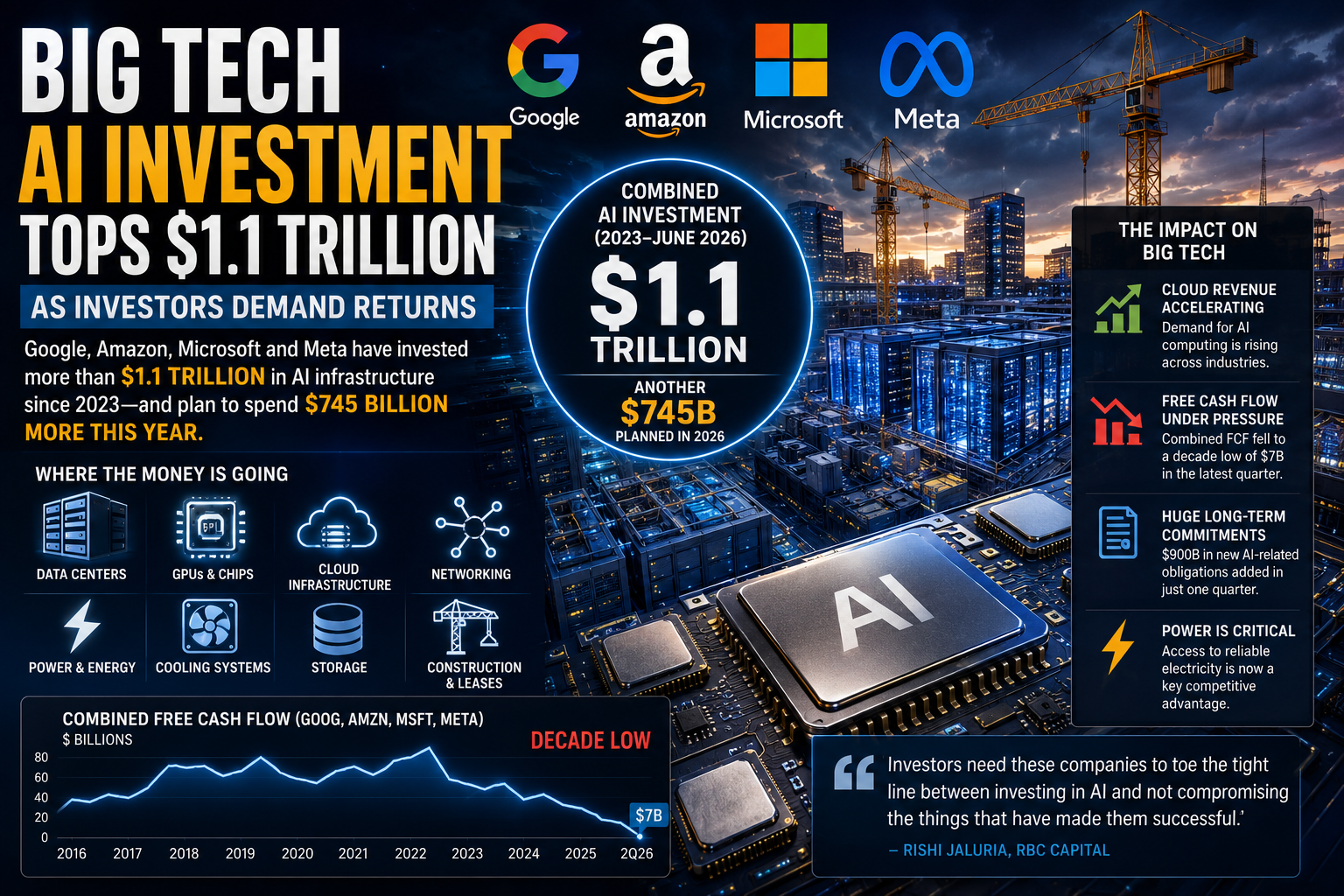
Combined capital spending by the four largest US hyperscalers reached approximately $1.1 trillion from the beginning of the current AI boom in 2023 through the end of June.
The companies are expected to spend another $745 billion this year, primarily on data centers, servers, networking equipment, advanced processors and power infrastructure.
The scale of the Big Tech AI investment boom is fundamentally changing the business models of America’s largest technology companies.
For decades, these firms were valued as relatively capital-light businesses capable of generating extraordinary margins from software, advertising and digital services. They are now becoming some of the world’s largest investors in physical infrastructure.
That transformation may create enormous long-term opportunities. It is also placing growing pressure on free cash flow, margins and corporate balance sheets.
For investors, the question is no longer whether artificial intelligence will change the economy.
The question is whether Big Tech can earn attractive returns on the trillions of dollars it is spending to build the infrastructure behind it.
How Big Tech AI Investment Reached $1.1 Trillion
The AI spending race accelerated after generative AI tools demonstrated the commercial potential of large language models.
Google, Amazon, Microsoft and Meta quickly increased spending to ensure they had enough computing capacity to train increasingly powerful models and deliver AI services to customers.
The resulting Big Tech AI investment has flowed into several major areas:
- Advanced graphics processing units and custom AI chips
- Data-center construction
- Cloud-computing infrastructure
- High-speed networking equipment
- Memory and data-storage systems
- Cooling technology
- Electricity generation and transmission
- Long-term power-purchase agreements
- Land, buildings and data-center leases
This is no longer simply a software investment cycle.
Artificial intelligence requires factories filled with servers, specialized chips, cooling equipment and electrical infrastructure. The companies competing to dominate AI must secure all of those resources before they can sell the resulting computing power or intelligence.
Big Tech Is Becoming an Infrastructure Business
For much of the past two decades, the largest technology companies enjoyed exceptional economics.
Once a software platform, search engine or social network was developed, it could often be distributed to millions of additional users at relatively low incremental cost.
AI changes that equation.
Training and operating advanced models requires continuous investment in expensive physical assets. Each increase in computing demand can require more chips, more servers, more data-center space and more electricity.
That means the Big Tech AI investment cycle may make technology companies look increasingly like utilities, telecommunications companies and industrial infrastructure operators.
This transformation affects several important financial metrics:
- Capital expenditures increase
- Depreciation expenses rise
- Free cash flow declines
- Long-term lease obligations expand
- Energy costs become more important
- Returns depend on sustained utilization
The AI opportunity remains enormous, but the economics are becoming more capital intensive.
Investors Are No Longer Accepting Growth at Any Cost
During the early stages of the AI boom, investors largely rewarded companies for announcing ambitious spending plans.
The belief was that the companies building the most computing capacity would be positioned to dominate the next major technological platform.
That attitude is beginning to change.
Investors now want evidence that Big Tech AI investment is translating into measurable revenue growth, higher productivity and sustainable profits.
The market is increasingly distinguishing between companies that can show direct financial returns from AI spending and those still asking investors to wait.
Google, Amazon and Microsoft all reported accelerating growth in their cloud-computing divisions, suggesting that demand for AI computing capacity remains strong.
Meta, however, does not operate a traditional public cloud platform. Its AI investments are primarily intended to improve advertising, engagement and future consumer products.
That makes it more difficult for investors to connect Meta’s capital spending directly to revenue.
Cloud Revenue Is Beginning to Accelerate
The strongest argument supporting the Big Tech AI investment cycle is that cloud revenue is beginning to respond.
Google Cloud, Amazon Web Services and Microsoft Azure all reported improving growth as companies increased their use of AI applications and computing services.
These hyperscalers are selling computing capacity to:
- AI developers such as OpenAI and Anthropic
- Large corporations building internal AI tools
- Software companies adding generative AI features
- Governments and research institutions
- Start-ups training specialized models
Google’s cloud business added approximately $11 billion in revenue compared with the same period a year earlier.
Microsoft and Amazon also showed strengthening cloud demand, helping support their share prices following earnings.
This revenue acceleration suggests that at least part of the massive infrastructure buildout is already being monetized.
The challenge is whether revenue can continue growing fast enough to justify the extraordinary level of capital spending.
Free Cash Flow Has Collapsed
The most concerning financial consequence of the Big Tech AI investment race is the pressure on free cash flow.
Combined free cash flow among Google, Amazon, Microsoft and Meta reportedly fell to approximately $7 billion during the quarter, the lowest level in a decade.
Only Microsoft and Meta generated more cash than they spent during the period.
Free cash flow represents the money remaining after a company pays its operating expenses and capital expenditures. It can be used to:
- Repurchase shares
- Pay dividends
- Reduce debt
- Fund acquisitions
- Build cash reserves
When capital spending rises faster than operating cash flow, the amount available for shareholders declines.
This does not necessarily mean the spending is unwise. It does mean investors are sacrificing cash today in exchange for the possibility of greater earnings in the future.
Google Reported Negative Free Cash Flow
Google reported approximately negative $6 billion in free cash flow for the quarter, its first cash-burning quarter since becoming a public company more than two decades ago.
The company also disclosed a dramatic increase in future financial commitments tied to AI infrastructure.
Those obligations reportedly increased by approximately $500 billion in only three months.
The commitments include long-term agreements involving:
- Technical infrastructure
- Data-center capacity
- Servers and computing equipment
- Electricity for data centers
- Other AI-related resources
Google’s cloud business is growing, but its enormous Big Tech AI investment commitments are forcing investors to evaluate whether future revenue will arrive quickly enough to support the spending.
Meta Added Hundreds of Billions in Obligations
Meta reportedly signed approximately $233 billion of new commitments during the quarter.
Those commitments included:
- $96 billion in data-center and network infrastructure leases
- $112 billion in purchase commitments, including third-party cloud capacity and servers
- $25 billion in new debt
Meta then added another $68 billion in data-center leases during July.
The company’s revenue increased 28% to approximately $61 billion during the quarter, with management crediting AI for improving advertising targeting and engagement.
That provides evidence that the Big Tech AI investment is contributing to current results.
However, Meta’s spending plans remain enormous, and investors continue to question how the company will monetize all of the computing capacity it is building.
Could Meta Become a Cloud Provider?
Meta chief executive Mark Zuckerberg indicated that the company has received numerous offers from outside parties interested in renting its excess computing capacity.
That raises the possibility that Meta could lease data-center capacity to other companies.
However, Zuckerberg also acknowledged an important economic distinction:
Selling intelligence should generate significantly higher margins than simply selling computing capacity.
Renting servers may help Meta recover some of its infrastructure costs, but it would likely produce lower margins than using the same computing resources to improve advertising, build AI assistants or create valuable consumer products.
This is one reason investors may remain cautious about Meta’s Big Tech AI investment strategy.
The company has demonstrated that AI can improve advertising performance, but it has not yet provided a fully developed plan for monetizing all of its future computing capacity.
Microsoft Is Locking In Data-Center Capacity
Microsoft reportedly signed more than $130 billion of new data-center leases during the second quarter.
The company has become one of the biggest beneficiaries of the AI boom through its relationship with OpenAI and the integration of AI tools across Azure, Microsoft 365, GitHub and other products.
Microsoft’s cloud platform provides a clearer path from AI infrastructure spending to revenue than many of its competitors.
Customers pay for computing capacity, software subscriptions and access to AI models.
Even so, the size of Microsoft’s long-term commitments means the company must continue generating strong demand to justify its infrastructure expansion.
Amazon Warns of a Two-Year Revenue Lag
Amazon chief executive Andy Jassy warned investors that the company will face free-cash-flow pressure while it builds multiple data centers simultaneously.
According to Jassy, there can be a roughly two-year period between commissioning a data center and installing enough servers to begin generating meaningful customer revenue.
This delay is one of the most important risks in the Big Tech AI investment cycle.
The hyperscalers must spend enormous amounts of money upfront, but the resulting assets may not produce revenue for several years.
During that period, several assumptions could change:
- AI demand could slow
- Chip efficiency could improve
- Competitors could lower prices
- Power costs could increase
- Customers could build their own infrastructure
- New models could require less computing power
The investment case depends on demand remaining strong long enough for the new capacity to come online and achieve attractive utilization.
OpenAI and Anthropic Are Critical to the Investment Cycle
Some of the success of the Big Tech AI investment boom depends on OpenAI and Anthropic continuing to raise capital.
Both AI laboratories have entered multiyear agreements to purchase enormous amounts of computing power.
These commitments help support the data-center construction plans of Microsoft, Amazon, Google and specialized cloud providers such as CoreWeave.
However, the AI laboratories themselves require ongoing financing to meet those obligations.
If OpenAI or Anthropic were unable to raise sufficient capital, reduced spending or renegotiated computing agreements, the financial effects could spread throughout the AI infrastructure ecosystem.
This creates a chain of dependency:
- AI laboratories need investor capital
- They use that capital to purchase computing power
- Cloud companies build data centers to provide that capacity
- Chipmakers and power companies expand to support the cloud providers
As long as capital continues flowing through the system, the AI buildout can continue.
If financing tightens, the entire chain may face pressure.
AI Spending Is Straining Supply Chains
The enormous scale of Big Tech AI investment has created shortages and price increases across the technology supply chain.
Memory chips, advanced processors, networking equipment, transformers and electrical components are all experiencing elevated demand.
Apple, which has not matched the infrastructure spending of the four hyperscalers, warned that component cost increases could reduce sales and profit margins.
Its shares fell after the warning.
This illustrates how the AI buildout can affect companies even when they are not leading the spending race.
The hyperscalers’ enormous purchasing power can absorb available supplies, raise component prices and increase costs throughout the technology sector.
The Power Requirement Is Becoming a Market of Its Own
AI data centers require far more than chips.
They require reliable electricity every hour of every day.
That is turning energy into one of the most important components of the Big Tech AI investment theme.
Technology companies are entering long-term agreements involving:
- Nuclear power
- Natural gas generation
- Renewable energy
- Battery storage
- Grid expansion
- Dedicated transmission systems
This trend is creating potential opportunities across utilities, uranium producers, reactor developers, turbine manufacturers and electrical-equipment companies.
The AI boom is no longer confined to Silicon Valley.
It is becoming a broad industrial investment cycle involving construction, power generation, manufacturing and infrastructure finance.
Big Tech Has Added Nearly $900 Billion in New Obligations
Google, Microsoft and Meta reportedly agreed to nearly $900 billion in new AI-related obligations during a single quarter.
Amazon had not yet released comparable disclosures.
These commitments will bind corporate balance sheets to the AI infrastructure race for years.
Unlike discretionary spending that can be reduced quickly, long-term leases and purchase commitments may continue even if demand slows.
That makes the quality of future AI revenue increasingly important.
Investors must evaluate not only how much money the companies are spending, but how much of that spending is already contractually locked in.
The AI Race Is Creating a New Valuation Framework
The traditional valuation framework for Big Tech focused heavily on revenue growth, operating margins and earnings per share.
The Big Tech AI investment cycle adds several new considerations:
- Return on invested capital
- Data-center utilization
- Depreciation expense
- Power costs
- Long-term lease obligations
- Customer concentration
- Free-cash-flow conversion
A company can report strong revenue growth and still disappoint investors if the cash required to generate that growth rises even faster.
This is why free cash flow may become one of the most important metrics in the next phase of the AI cycle.
What Traders Should Watch
The Big Tech AI investment boom is likely to remain one of the most important market themes for years.
Traders should monitor several key indicators.
1. Capital-Spending Guidance
Any increase or reduction in projected AI spending could move technology, semiconductor, data-center and power stocks.
2. Cloud Revenue Growth
Google Cloud, Amazon Web Services and Microsoft Azure must continue producing strong growth to justify ongoing infrastructure expansion.
3. Free Cash Flow
Investors will watch whether operating cash flow begins catching up with capital spending.
4. Data-Center Utilization
New capacity must remain highly utilized to produce attractive returns.
5. AI Pricing
Falling prices for computing power or AI services could pressure returns even if demand remains strong.
6. Power Availability
Access to electricity may determine how quickly new data centers can come online.
7. OpenAI and Anthropic Financing
The ability of major AI developers to raise capital remains essential to the broader infrastructure ecosystem.
8. Semiconductor Supply
Memory, GPUs and networking equipment remain critical bottlenecks.
9. Depreciation and Margins
As data-center assets enter service, depreciation expenses may rise and pressure reported earnings.
10. Long-Term Contract Commitments
Investors should watch whether future obligations continue increasing faster than revenue.
The Four Phases of the AI Investment Cycle
The AI boom has developed in stages.
The first phase rewarded companies that could build powerful models.
The second phase rewarded companies selling advanced semiconductors.
The third phase is rewarding companies building data centers, power systems and physical infrastructure.
The next phase may reward the companies that prove they can earn attractive returns on the capital already committed.
That is why the Big Tech AI investment story is entering a more demanding period.
Investors are no longer impressed by spending alone.
They want evidence that spending will produce revenue, cash flow and long-term shareholder value.
The Bigger Market Message
The $1.1 trillion already invested by Google, Amazon, Microsoft and Meta shows that these companies view AI as an existential competitive priority.
None wants to risk falling behind in what may become the most important technology platform since the internet.
But the investment race is changing the financial profile of Big Tech.
The companies are becoming more capital intensive, more dependent on energy and more exposed to long-term infrastructure commitments.
The opportunity is enormous, but so is the financial risk.
For traders, the next stage of the Big Tech AI investment cycle will be defined by a simple question:
Can the hyperscalers turn unprecedented spending into returns large enough to justify the cost?
The answer will influence not only Google, Amazon, Microsoft and Meta, but also semiconductor companies, utilities, nuclear developers, data-center operators and the broader stock market.
Key Takeaways
- Big Tech AI investment has reached approximately $1.1 trillion since 2023.
- Google, Amazon, Microsoft and Meta plan to spend about $745 billion this year.
- The companies are shifting from capital-light digital businesses toward physical infrastructure operators.
- Combined free cash flow fell to approximately $7 billion during the quarter.
- Google reported negative free cash flow as AI spending accelerated.
- Google, Microsoft and Meta added nearly $900 billion in new AI-related obligations during one quarter.
- Cloud growth is improving, but investors now want evidence of sustainable returns.
- OpenAI and Anthropic remain important sources of demand for computing capacity.
- Power availability, semiconductor supply and data-center utilization will determine future returns.
- The next phase of the AI boom will reward companies that convert infrastructure spending into durable cash flow.
This article is for educational and informational purposes only and should not be considered investment advice. Trading and investing involve substantial risk, including the possible loss of principal.