
Understanding Cognitive Dissonance and the Hidden Science of Self-Deception
Mental Insight explores the psychology, neuroscience, and behavioral science behind consistent performance under pressure. These articles explain why we think, learn, decide, and perform the way we do—and how understanding those processes can help us become more consistent in trading, work, relationships, and life.
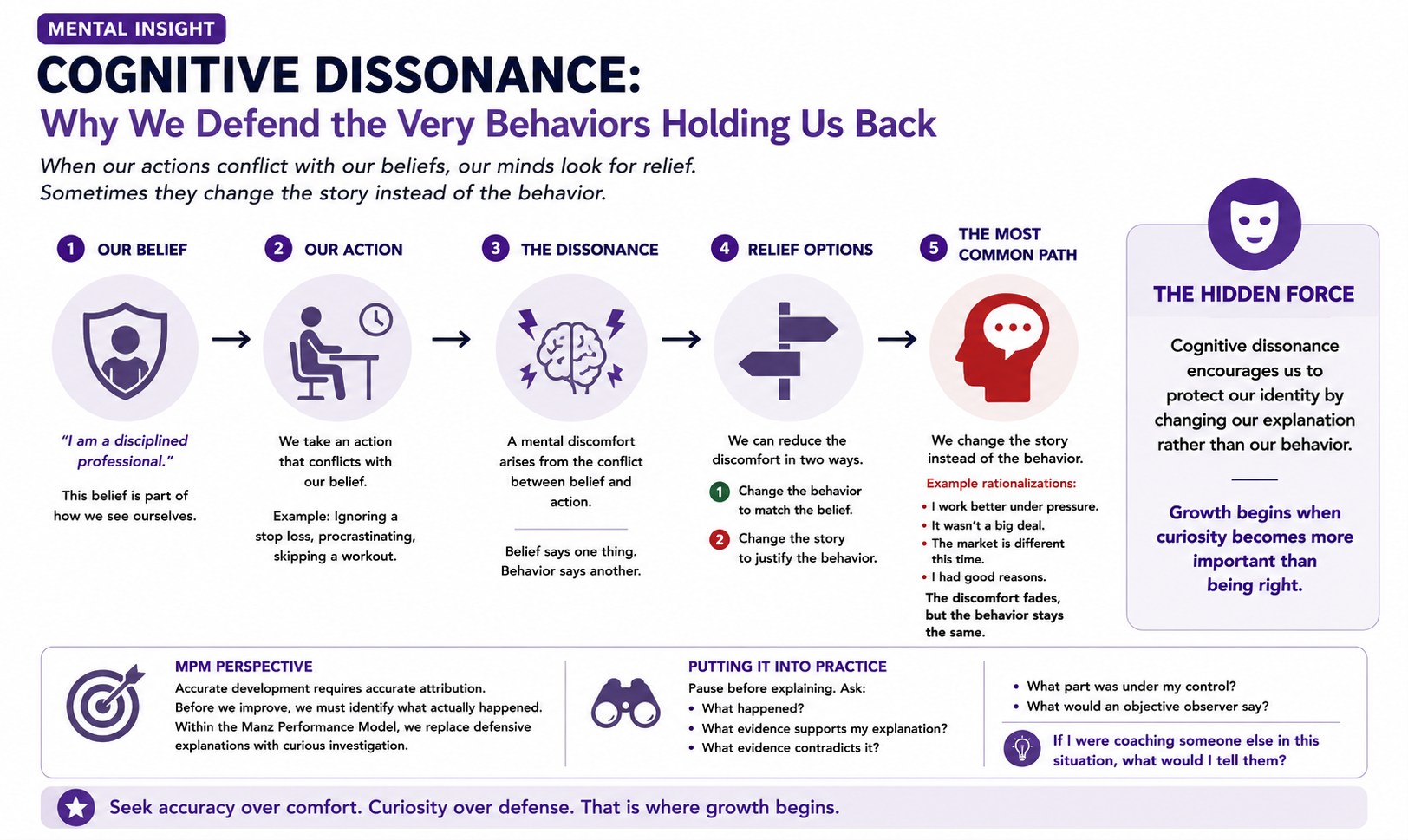
Have you ever caught yourself explaining away a mistake, even while quietly knowing you could have handled the situation better?
Maybe you blamed a difficult conversation on the other person’s attitude. Perhaps you justified skipping a workout because you were simply too busy. Or maybe you held onto a losing trade longer than your plan allowed because you were convinced the market would eventually come back.
Most of us like to think of ourselves as reasonably objective. We believe that when presented with evidence, we evaluate it fairly and adjust our thinking accordingly. But one of the most influential ideas in social psychology suggests that human beings are not quite that simple.
When our behavior conflicts with what we believe about ourselves, the resulting discomfort can be surprisingly powerful. Rather than immediately changing the behavior, we may change the explanation. We reinterpret what happened, minimize its importance, blame circumstances, or find another way to preserve the image we already have of ourselves.
Psychologists call this cognitive dissonance.
Understanding cognitive dissonance in trading is especially important because traders constantly make decisions that become visible almost immediately. Every trade provides an opportunity to evaluate what we did, why we did it, and whether we followed our process. It also gives us an opportunity to explain away behavior we would rather not examine too closely.
The Science of Cognitive Dissonance
In 1957, social psychologist Leon Festinger introduced the theory of cognitive dissonance. The basic idea is surprisingly simple: people are motivated to maintain some degree of consistency among their beliefs, attitudes, and behavior. When those things conflict, psychological discomfort arises.
Imagine someone who genuinely believes, “I am a disciplined professional.” Now imagine that same person procrastinating on an important project, ignoring a well-established rule, or acting impulsively under pressure.
Two incompatible ideas are now present at the same time:
I am disciplined.
and
I just behaved in a way that was not disciplined.
That contradiction creates discomfort. Something has to give.
The most obvious solution would be to acknowledge the behavior and change it. But that is not the only way to reduce dissonance. We can also change the story we tell ourselves about what happened.
Instead of saying, “I procrastinated,” we might say, “I work better under pressure.”
Instead of admitting, “I ignored my trading plan,” we might say, “This situation was different.”
Instead of acknowledging, “I didn’t want to take the loss,” we might say, “I was giving the trade enough room to work.”
The emotional discomfort becomes smaller, but the underlying behavior remains unchanged.
That is what makes cognitive dissonance such an important performance issue. The explanation can feel satisfying while quietly preventing development.
Why Cognitive Dissonance Matters for Performance
Cognitive dissonance appears anywhere people care about competence, identity, or status.
A physician may become attached to an initial diagnosis and discount contradictory evidence. A business leader may continue supporting a strategy because admitting that it is failing would mean acknowledging an earlier mistake. An athlete may blame equipment rather than examine preparation. A student may decide a test “didn’t really matter” after receiving a disappointing grade.
None of those explanations are necessarily false. Equipment really can fail. Other people really can contribute to problems. Market conditions really do change. The problem arises when the first explanation we reach for is the one that best protects us rather than the one best supported by the evidence.
That distinction becomes particularly important in cognitive dissonance in trading. A trader may blame the market, volatility, an algorithm, a news headline, an execution platform, or another external factor for a loss. Any of those things may genuinely have contributed. But they can also become convenient explanations that prevent the trader from asking whether preparation, risk management, patience, or execution played a role.
The opposite mistake is equally possible. Traders can over-personalize an outcome and assume every loss is evidence of personal inadequacy when the trade was actually executed correctly and simply did not work.
The objective is not to blame ourselves more often.
It is to become more accurate.
Cognitive Dissonance in Trading
Trading creates an especially fertile environment for cognitive dissonance because decisions are made under uncertainty, outcomes are emotionally meaningful, and feedback is immediate.
Imagine a trader whose plan requires exiting a position at a predetermined stop. Price reaches the stop, but the trader decides not to exit. Perhaps they tell themselves the market is “just shaking people out” or that the stock has strong support nearby.
A few minutes later, price continues falling.
Now the trader faces two uncomfortable realities. The position is losing money, and the trader knowingly violated the plan.
That creates powerful dissonance.
One way to resolve it is to exit, acknowledge the violation, and examine what happened. Another is to construct an explanation that makes staying in the position feel reasonable.
“The market makers are running the stops.”
“The stock is oversold.”
“I’m trading the larger time frame now.”
“It’ll come back.”
Any one of those statements could theoretically be true. But the important question is whether the explanation emerged from new evidence or from the emotional need to justify a decision already made.
This is one of the reasons cognitive dissonance in trading can be so difficult to recognize from the inside. A rationalization does not usually feel like a rationalization. It feels like reasoning.
The MPM Perspective
One of the central ideas in the Manz Performance Model is that accurate development requires accurate attribution.
Before we can improve a performance, we have to understand what actually produced it. Was the problem psychological? Did we lack information? Was the process itself flawed? Did technology or equipment fail? Was the outcome simply influenced by uncertainty?
If we make the wrong attribution, we are likely to prescribe the wrong solution.
Cognitive dissonance interferes with that diagnostic process because it encourages us to protect our identity before examining the evidence. If acknowledging an error threatens the way we see ourselves, we become more motivated to find an explanation that makes the behavior seem reasonable.
This is why review within MPM is not meant to be an exercise in blame. Blame often makes dissonance worse because it increases the threat to identity.
Instead, the objective is curiosity.
Rather than asking:
Who is at fault?
ask:
What is the most accurate explanation for what happened?
That subtle shift is enormously important. It allows a performer to acknowledge an error without turning the error into an identity statement.
“I made an undisciplined decision” is very different from “I am an undisciplined person.”
The first provides information.
The second creates a threat.
When review feels less threatening, honest learning becomes easier.
Accurate Attribution Instead of Comfortable Attribution
This is where cognitive dissonance connects directly to attribution theory, another important piece of the Mental Insight framework.
After an outcome, our minds naturally ask:
Why did this happen?
The answer we choose matters because it determines what we do next.
Suppose a trader misses an entry and immediately thinks, “I always hesitate.”
That explanation places the problem inside the individual. But what if the actual reason was a delayed data feed or a frozen execution platform?
The attribution is wrong, and therefore the intervention will be wrong.
Now imagine the opposite. The trader says, “My platform was slow,” when the platform worked perfectly and the real problem was fear.
Again, the attribution is wrong.
The goal is neither relentless self-criticism nor relentless externalization. The goal is accurate attribution.
Understanding cognitive dissonance in trading helps us recognize why accurate attribution can be difficult. We are not simply analyzing causes. We are also protecting an identity while we do it.
That is why curiosity is such an important performance skill.
Putting It Into Practice
The next time something goes wrong, try resisting the urge to explain it immediately.
Give yourself a little distance before deciding why it happened. Begin with the facts. What actually occurred? What did you know at the time? What did you do? What happened afterward?
Then examine your explanation. What evidence supports it? What evidence contradicts it? What part of the situation was under your control, and what part was not? Is there another explanation that fits the facts equally well—or better?
One particularly useful question is:
If I were coaching someone else in exactly this situation, what would I tell them?
We often become more objective when our identity is no longer the thing being evaluated.
Another useful question is:
What explanation would I consider if I did not need to defend myself?
That can be uncomfortable.
It can also be incredibly revealing.
The Hidden Force
Cognitive dissonance encourages us to protect our identity by changing our explanation rather than our behavior. Growth begins when curiosity becomes more important than being right.
The hidden danger is not simply that we make mistakes. Everyone makes mistakes. The danger is that we become so good at explaining them that the behavior never has to change.
This is why cognitive dissonance in trading can quietly slow development for years. The trader continues experiencing the same problem, but each new occurrence receives a different explanation.
Eventually, the explanations become more sophisticated while the behavior remains remarkably similar.
One Thing to Think About
The greatest obstacle to improvement is not making mistakes.
It is protecting ourselves from learning why we made them.
Think about a recent situation in which you immediately knew why something went wrong. Now ask yourself a slightly uncomfortable question:
How certain am I that my explanation is actually true?
Sometimes the answer will remain exactly the same.
Other times, you may discover that what felt like certainty was really self-protection.
Performance Challenge
For the next seven days, pay attention to moments when you hear yourself thinking or saying phrases such as “Yeah, but…,” “The real reason was…,” “Normally I would have…,” or “If only…”
These phrases are not automatically signs of rationalization. Sometimes they introduce important context. But they can also signal that the mind is trying to reduce discomfort.
When you notice one, pause before continuing the explanation and ask:
Is this helping me understand what happened, or is it helping me feel better about what happened?
Sometimes the answer will be both.
But not always.
At the end of the week, look for recurring themes. Do you tend to blame yourself too quickly? Do you tend to blame circumstances? Are there particular behaviors you repeatedly defend? Are there certain situations in which your explanations become especially elaborate?
The goal is not to catch yourself doing something wrong.
The goal is to become more aware of how your mind protects you—and whether that protection is helping or interfering with development.
Julie’s Book Corner
Mistakes Were Made (But Not by Me)
Carol Tavris and Elliot Aronson
Few books make cognitive dissonance as accessible and relevant to everyday life as Mistakes Were Made (But Not by Me). Tavris and Aronson explore self-justification, belief perseverance, and the remarkable ways intelligent people can defend decisions even when new evidence suggests that those decisions should be reconsidered.
For anyone interested in understanding why people sometimes double down instead of changing course, it is an excellent companion to this Mental Insight topic.
Julie’s Toolbox
One of the most useful tools for reducing self-deception is a simple structured reflection journal. The goal is not to record every thought you had during the day. It is to create enough separation between facts and interpretation that you can examine your explanation rather than automatically accepting it.
After an important performance, divide your reflection into four areas: Facts, My Interpretation, Alternative Explanations, and What I’ll Test Next Time.
Begin by recording only what you know happened. Then write down your initial explanation. After that, force yourself to generate at least one plausible alternative explanation, even if you do not ultimately believe it. Finally, identify something you can observe or test during the next performance.
This simple structure is particularly useful for recognizing cognitive dissonance in trading, because it makes it harder to confuse an emotionally satisfying explanation with an established fact.
As an Amazon Associate, we may earn from qualifying purchases. These recommendations include products we genuinely use, value, or believe may benefit our readers. Thank you for supporting our work.
Final Thought
One of the great ironies of human performance is that the mind sometimes protects confidence by protecting mistakes.
That protection makes sense. No one enjoys discovering that a decision was poor, a belief was mistaken, or a behavior was inconsistent with the person they want to be.
But protecting ourselves from that discomfort can also protect the very behavior that is holding us back.
The performers who improve most rapidly are not necessarily those who make the fewest errors. They are the ones who become increasingly willing to look at their errors without allowing those errors to define them.
Excellence does not require perfection.
It requires the ability to exchange a comforting explanation for a more accurate one—and then use what you learn to perform differently the next time.