
Economic Calendar This Week: Jobless Claims, Housing Data and Energy Inventories in Focus
The U.S. economic calendar is relatively light during the week of July 20–24, 2026, with no major inflation report, Federal Reserve rate decision or monthly employment report scheduled.
That does not mean the week will be quiet. Traders will still receive important updates on the labor market, housing activity, consumer conditions and energy inventories. Treasury auctions and Federal Reserve liquidity operations may also influence interest rates and market positioning throughout the week.
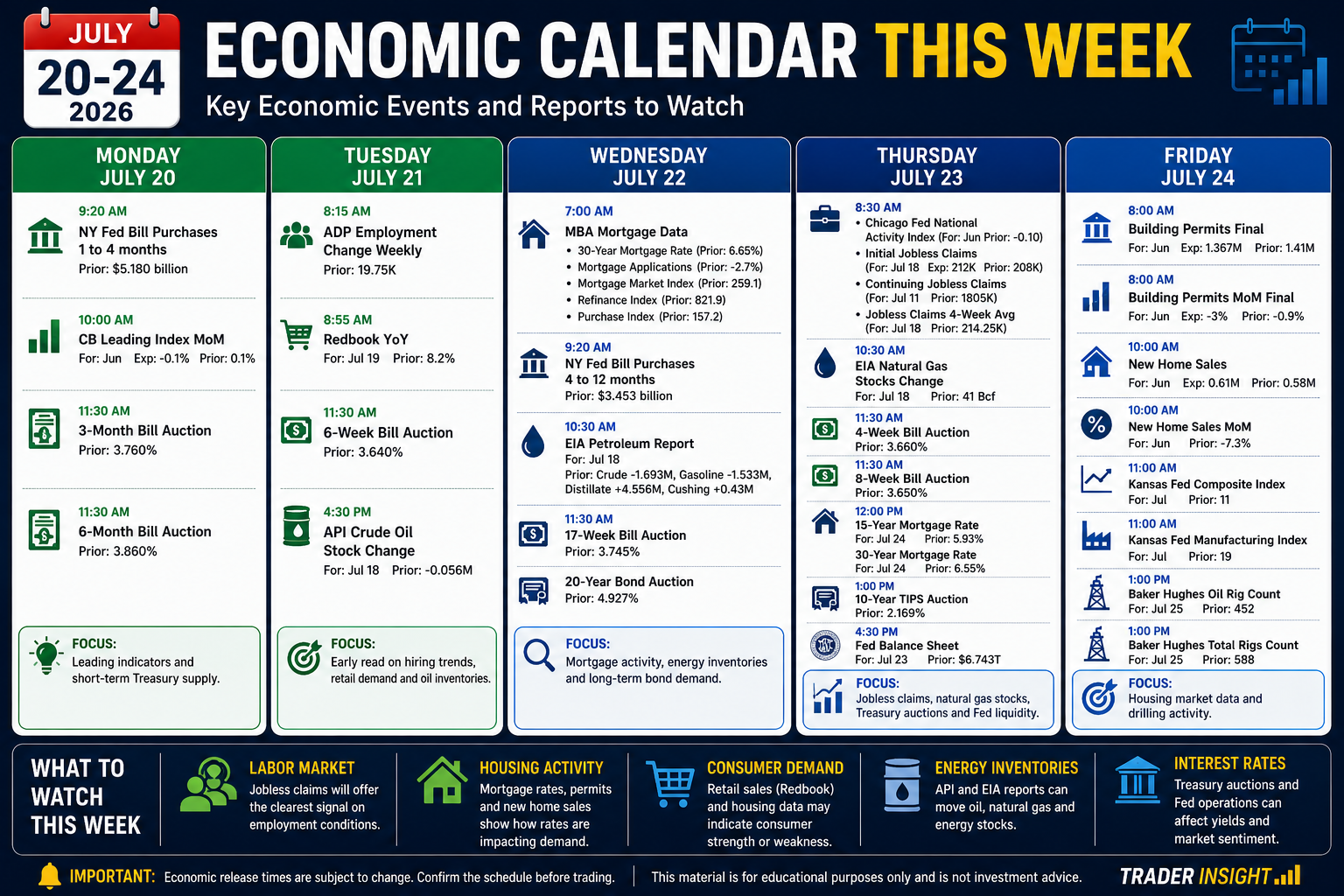
Monday, July 20: Leading Indicators and Treasury Auctions
Monday’s principal economic release is the Conference Board Leading Economic Index at 10:00 a.m.
The index is expected to decline 0.1% in June after increasing 0.1% previously. The report combines several forward-looking economic measures and is intended to provide a broader indication of where economic activity may be heading.
A weaker-than-expected reading could reinforce concerns about slowing growth. A stronger result may support the view that the economy remains resilient despite elevated borrowing costs.
Monday’s schedule also includes:
- 9:20 a.m.: New York Fed purchases of Treasury bills with maturities of one to four months
- 11:30 a.m.: Three-month Treasury bill auction
- 11:30 a.m.: Six-month Treasury bill auction
Although short-term bill auctions rarely generate an immediate equity-market reaction, traders should monitor auction demand and yields for signs of changing expectations surrounding Federal Reserve policy and short-term interest rates.
Tuesday, July 21: Employment, Retail Demand and Oil Inventories
Tuesday begins with the weekly ADP Employment Change at 8:15 a.m. The previous reading showed an increase of approximately 19,750 jobs.
This newer weekly employment measure may receive increasing attention as traders look for more timely evidence of changes in hiring conditions. A meaningful slowdown could raise concerns about labor-market weakness, while a stronger number may support consumer-spending expectations.
The Redbook retail-sales index is scheduled for 8:55 a.m. The previous year-over-year reading was 8.2%. Redbook data tracks sales at a selection of large U.S. retailers and can offer a timely indication of consumer demand.
Tuesday’s remaining scheduled releases include:
- 11:30 a.m.: Six-week Treasury bill auction
- 4:30 p.m.: American Petroleum Institute crude-oil inventory report
The API report may create after-hours movement in crude oil and energy-related stocks ahead of Wednesday’s official government inventory data.
Wednesday, July 22: Mortgage Activity, Oil Inventories and the 20-Year Bond Auction
Wednesday begins with a group of weekly mortgage-market indicators at 7:00 a.m.
The previous average rate for a 30-year mortgage was 6.65%, while total mortgage applications declined 2.7%. Traders will be watching for evidence that borrowing costs are continuing to restrain home purchases and refinancing activity.
The Mortgage Bankers Association will release:
- 30-year mortgage rate
- Mortgage applications
- Mortgage Market Index
- Mortgage Refinance Index
- Mortgage Purchase Index
EIA Petroleum Report
At 10:30 a.m., the Energy Information Administration will release its official weekly petroleum report.
The previous report showed:
- Crude-oil inventories declined by approximately 1.69 million barrels
- Gasoline inventories declined by approximately 1.53 million barrels
- Distillate inventories increased by approximately 4.56 million barrels
- Cushing crude inventories increased by approximately 430,000 barrels
The relationship between crude production, refinery activity and product demand can affect oil prices, energy equities, transportation companies and inflation expectations.
Long-Term Treasury Supply
Wednesday also includes a 20-year Treasury bond auction at 1:00 p.m. The prior auction produced a yield of approximately 4.927%.
Demand for the auction may influence longer-term Treasury yields. A poorly received auction could push yields higher and create pressure on rate-sensitive growth stocks, while strong demand could support bonds and interest-rate-sensitive areas of the equity market.
Thursday, July 23: Jobless Claims Take Center Stage
Thursday contains the week’s most important group of economic releases.
At 8:30 a.m., traders will receive:
- Chicago Fed National Activity Index
- Initial jobless claims
- Continuing jobless claims
- Four-week average of jobless claims
Initial jobless claims are expected to rise to 212,000 from the previous reading of 208,000. Continuing claims previously stood at approximately 1.805 million.
The weekly claims data will be closely examined for evidence that employers are beginning to reduce staffing. A modest increase would not necessarily indicate serious labor-market deterioration, but a sustained rise in both initial and continuing claims could influence expectations for economic growth and Federal Reserve policy.
Natural Gas and Mortgage Rates
The EIA will release its weekly natural-gas storage report at 10:30 a.m. The prior report showed an inventory increase of 41 billion cubic feet.
Updated 15-year and 30-year mortgage rates are scheduled for noon. Previous readings were approximately:
- 15-year mortgage: 5.93%
- 30-year mortgage: 6.55%
Additional Thursday events include four-week and eight-week Treasury bill auctions, a 10-year Treasury Inflation-Protected Securities auction and the Federal Reserve’s weekly balance-sheet update.
Friday, July 24: Building Permits and New-Home Sales
Housing data will be the primary focus Friday morning.
Building Permits
Final June building-permit data is scheduled for 8:00 a.m. Permits are expected to be confirmed at an annualized pace of approximately 1.367 million, compared with the prior reading of 1.41 million.
Building permits are expected to have declined 3.0% during the month following a previous decline of 0.9%.
Because permits typically precede actual construction, the release can provide an important indication of future homebuilding activity.
New-Home Sales
June new-home sales will be released at 10:00 a.m. Sales are expected to rise to an annualized pace of approximately 610,000 from the prior reading of 580,000.
A stronger report could support homebuilders and housing-related companies, particularly if the increase reflects genuine demand rather than discounting or temporary incentives. A weaker report could renew concerns about affordability and the effect of mortgage rates on potential buyers.
Regional Manufacturing and Drilling Activity
At 11:00 a.m., the Kansas City Federal Reserve will release its regional composite and manufacturing indexes. The previous manufacturing reading was 19, while the broader composite index stood at 11.
The week concludes with the Baker Hughes rig count at 1:00 p.m. The previous report showed:
- Oil rigs: 452
- Total rigs: 588
What Traders Should Watch This Week
The calendar may lack a single dominant event, but several recurring themes could influence trading:
- Labor-market resilience: Initial and continuing jobless claims will provide the clearest employment signal of the week.
- Housing affordability: Mortgage rates, applications, building permits and new-home sales will show how the housing market is responding to current financing costs.
- Consumer demand: Redbook retail sales and housing activity may offer clues about household confidence and spending capacity.
- Energy volatility: API and EIA inventory reports could move crude oil, natural gas and energy-sector stocks.
- Interest rates: Treasury auctions may influence yields, particularly Wednesday’s 20-year bond auction and Thursday’s 10-year TIPS auction.
A Light Calendar Can Still Produce Significant Moves
Weeks without a Federal Reserve decision, inflation report or monthly payroll release can still generate meaningful volatility. Markets may react more strongly to secondary indicators when traders are searching for confirmation of the prevailing economic narrative.
This week, the key question is whether the data continue to support a resilient economy or begin to reveal more meaningful weakness in employment, housing and consumer demand.
Traders should note the scheduled release times, identify important index and Treasury-yield levels, and avoid initiating positions immediately before reports capable of changing interest-rate expectations.
Know the calendar. Map the levels. Prepare for the reaction.
Economic release times, estimates and prior readings are subject to revision. Confirm the schedule before trading. This material is provided for educational purposes only and is not individualized investment advice.