
EV Batteries Are Going the Distance—and That Could Reshape the Used-Car Market
A study covering more than 500,000 battery tests suggests that one of the electric-vehicle market’s most persistent fears may have been overstated. The larger opportunity, however, may lie in proving the condition of each individual battery.
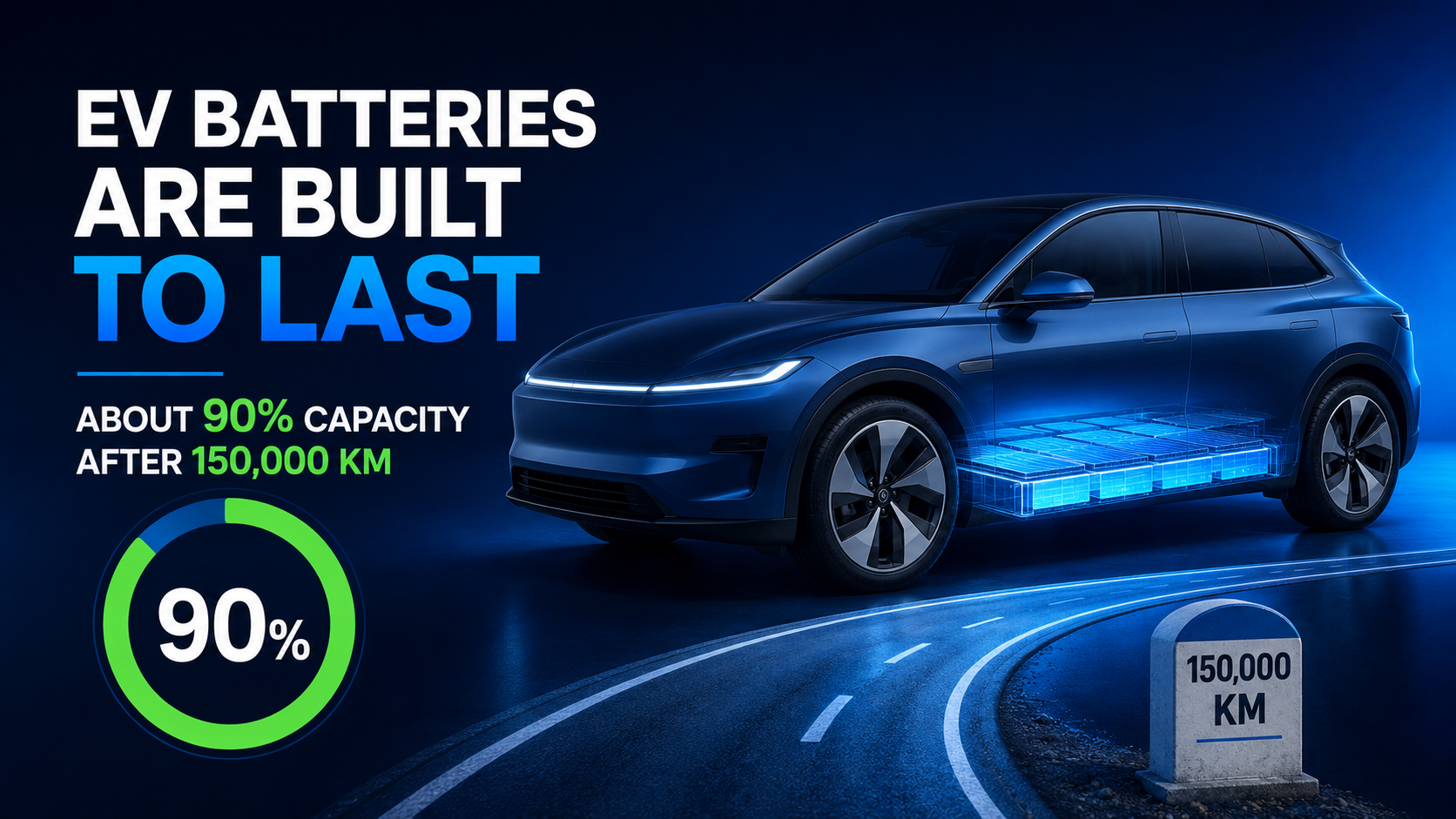
Electric-vehicle batteries appear to be aging considerably better than many prospective buyers expected. New data from Austrian battery-diagnostics company AVILOO indicates that the median battery state of health among 20 popular EV models remained between 87% and 94% after 150,000 kilometers, or roughly 93,000 miles.
That finding matters well beyond the range displayed on a dashboard. Battery life influences used-car values, lease economics, warranty reserves, consumer confidence and ultimately the pace of EV adoption. If a vehicle can retain close to nine-tenths of its usable battery capacity after substantial mileage, the economic life of the car may be longer—and the residual value more defensible—than skeptical buyers have assumed.
The Data Challenge the Battery-Replacement Narrative
The analysis drew on more than 500,000 tests conducted globally between 2022 and 2026 across vehicles that included the Tesla Model Y and Volkswagen ID.4. Chinese models were not included because the researchers lacked sufficient data, an important limitation when applying the findings to the entire global EV market.
Most EV battery warranties run for approximately eight years or 100,000 miles, with a commonly used capacity threshold of 70%. The medians in the AVILOO dataset remain well above that level at approximately 93,000 miles. That does not eliminate the possibility of defects or unusually rapid deterioration, but it weakens the broad assumption that high-mileage EVs are necessarily approaching an expensive battery replacement.
The Median Does Not Tell the Whole Story
Battery degradation varied substantially within individual models. Climate, battery chemistry and size, charging frequency, time spent at very high or low charge levels, thermal management and parking habits can all affect long-term capacity.
The Nissan Leaf ZE1 produced the widest spread in the study at 150,000 kilometers: 13.5 percentage points of state of health, equivalent to approximately 29 kilometers of real-world range per charge. Its relatively small battery requires more charging cycles to cover the same distance, illustrating why mileage alone is an incomplete measure of EV condition.
This dispersion is commercially important. The average EV battery may be durable, while an individual used vehicle can still be a poor purchase. Independent diagnostics can help close that information gap by allowing buyers, dealers, lenders and insurers to price the actual battery rather than relying on age and mileage as rough proxies.
Why Certification Could Unlock the Used-EV Market
Three UK electric-vehicle organizations have called for mandatory battery state-of-health certificates for dealer-sold used EVs. Their argument is straightforward: consumers routinely receive mileage, service and inspection information for conventional vehicles, but often lack an independently comparable measure for the most valuable component in an electric car.
Tesla UK has also voiced support for a nationally recognized state-of-health standard, according to reporting on the proposal. Standardization could reduce uncertainty, reward owners who maintain batteries well and help dealers distinguish a healthy high-mileage vehicle from a poorly treated low-mileage one.
| Stakeholder | Potential effect of battery-health transparency |
|---|---|
| Consumers | Less uncertainty and a more objective basis for comparing used EVs. |
| Dealers and marketplaces | Higher buyer confidence, faster inventory turnover and more precise pricing. |
| Automakers and lessors | Stronger residual values can improve leasing economics and reduce depreciation pressure. |
| Lenders and insurers | Better collateral assessment and more accurate estimates of repair, warranty and resale risk. |
| Diagnostics providers | A larger addressable market if testing becomes standard or mandatory. |
Implications for Automakers and EV Stocks
For manufacturers including Tesla, Volkswagen, General Motors, Ford, Hyundai and others, evidence of durable batteries can reduce a key obstacle to purchase. The benefit may be especially meaningful for companies with large lease portfolios or established certified pre-owned programs, because improved confidence in future resale values can support more attractive monthly lease payments today.
There is also a strategic tension. Longer-lasting packs are favorable for the overall EV category, but slower replacement cycles may temper some long-range expectations for aftermarket battery demand. Meanwhile, diagnostics companies, used-car platforms, fleet managers and battery-analytics providers could gain a new role as the market moves toward vehicle-specific health scoring.
Battery manufacturers may benefit indirectly if real-world durability strengthens consumer adoption. Yet investors should avoid treating a broad fleet study as proof that every chemistry, pack design or manufacturer performs equally. Warranty costs, recalls, thermal-management systems and model-specific results remain more important for valuing an individual company.
What It Means for the Broader Market
Potentially positive: EV manufacturers, leasing companies and used-car platforms could benefit if better battery information supports demand and residual values.
Emerging opportunity: Independent testing, battery analytics, certification and warranty products may become an essential infrastructure layer for the secondary EV market.
Important counterweight: The study excludes Chinese models and reports ranges of median outcomes, not a guarantee for any vehicle. Competitive pricing, tariffs, interest rates and policy incentives will still exert greater short-term influence on auto stocks.
Day-Trading and Volatility Implications
This research is more likely to shape the industry narrative than to trigger a durable one-day repricing by itself. For traders, the strongest price response would probably occur when battery-health data are paired with company-specific news—such as a new certified pre-owned program, lower warranty provisions, improved lease residuals, a regulatory mandate or a diagnostics partnership.
- Watch the open: EV names can produce sharp sentiment-driven gaps, but a sector-wide study without new guidance may fade after the first hour.
- Look for confirmation: Relative volume, premarket support or resistance, opening imbalances and strength versus the broader auto group can distinguish actionable demand from a headline reaction.
- Separate manufacturers: Do not assume identical performance across EV companies. Model-specific battery results and management commentary matter.
- Track policy catalysts: A government move toward mandatory certification could create more persistent momentum in testing, data and used-vehicle platforms than the publication of the study alone.
- Expect event-driven volatility: Near-term moves should remain most sensitive to deliveries, margins, incentives, interest rates and regulation. Battery durability is a potentially constructive longer-term factor.
The Bottom Line
The latest data suggest that battery failure is not the ticking clock many used-EV buyers fear. Most of the vehicles studied retained approximately 90% of usable capacity after 150,000 kilometers. But the variation between apparently similar cars means the market still needs a reliable way to identify which battery is healthy.
That distinction may define the next phase of the EV market. Durability can remove a psychological barrier; certification can turn that reassurance into higher confidence, better pricing and more liquid used-vehicle markets.
Sources
The battery-test findings were reported by the Financial Times. Additional context on the UK certification proposal is available from Electrifying.com, while information about AVILOO’s battery-testing methodology and services is available from AVILOO.
Focus keyphrase: EV battery life
SEO title: EV Battery Life: 90% Capacity After 150,000 Km
Slug: ev-battery-life-used-ev-market
This article is for educational and informational purposes only and does not constitute investment advice. Always evaluate risk and conduct your own research before making trading or investment decisions.