
Global Economic Outlook 2026: Jobs, Inflation, and Oil Shock Risks
Investors around the world are entering a critical week for the global economic outlook in 2026, as traders assess whether the Iran conflict, soaring oil prices, and slowing global demand are beginning to weigh on economic growth.
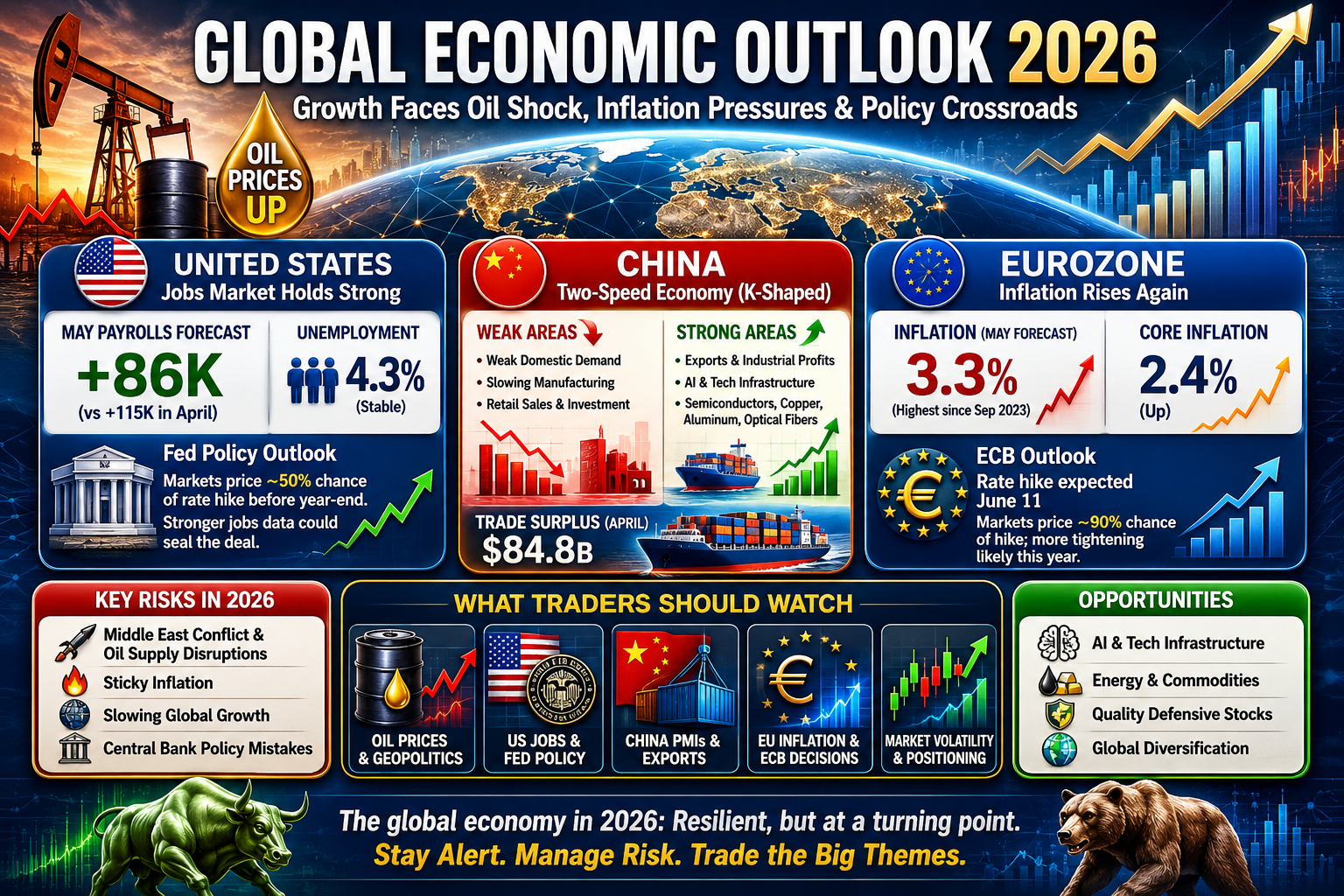
Three major themes are dominating market attention:
- The resilience of the US labor market
- China’s increasingly uneven economic recovery
- Rising inflation pressures in Europe
Together, these developments could shape central bank policy, stock market direction, and trading volatility during the second half of 2026.
Can the US Labor Market Survive Higher Oil Prices?
The US economy has so far appeared remarkably resilient despite the economic uncertainty created by the US-Iran conflict and rising energy prices.
Recent nonfarm payroll reports and unemployment data suggest that hiring has remained stable even as oil prices surged following tensions in the Middle East and the closure of the Strait of Hormuz.
Economists surveyed by Reuters expect the US economy to have added approximately 86,000 jobs in May, slightly below April’s 115,000 gain but still consistent with a relatively healthy labor market. The unemployment rate is expected to remain steady at 4.3%.
The labor market data is even more important because investors are now trying to determine how newly appointed Federal Reserve Chair Kevin Warsh may respond to inflation risks tied to higher oil prices.
Futures markets currently imply roughly a 50% chance that the Federal Reserve could raise interest rates again before year-end.
A stronger-than-expected jobs report could significantly increase those odds.
Implications for Traders: US Markets
For traders, the US jobs report could be a major catalyst for volatility.
If payrolls come in stronger than expected, markets may begin pricing in additional Federal Reserve tightening. That could push Treasury yields higher and pressure high-valuation technology stocks, particularly AI-related names that have led the 2026 rally.
On the other hand, a weaker jobs report could revive expectations for future rate cuts and support growth stocks, especially in semiconductors and software.
Key markets traders should watch include:
- US Treasury yields — especially the 2-year note
- The US dollar — which could strengthen if rate hike odds rise
- Oil prices — which remain highly sensitive to Middle East developments
- Technology stocks — particularly AI and semiconductor shares
Intraday traders should also be prepared for sharp volatility immediately following the payrolls release, especially if the data materially surprises expectations.
Is China Entering a “K-Shaped” Economy?
China’s economy is showing increasingly uneven growth patterns, raising concerns that parts of the economy are weakening even as export-driven industrial sectors continue performing well.
Analysts expect China’s manufacturing purchasing managers’ index to slip below 50 in May, signaling contraction in factory activity. Weak domestic demand and slowing exports remain major concerns.
At the same time, some sectors tied to artificial intelligence infrastructure and industrial commodities continue benefiting from strong global demand.
Industries linked to semiconductors, optical fibers, copper, aluminum, and AI hardware have seen profits surge, helped by global spending on AI infrastructure and high energy prices.
China’s trade surplus remains enormous, while exports of electronic integrated circuits reportedly surged more than 80% during the first four months of the year.
The result is what some economists describe as a “two-speed economy”:
- Export and industrial sectors remain strong
- Domestic consumption and consumer confidence remain weak
Implications for Traders: China and Commodities
China’s economic divergence has major implications for global markets.
Weak consumer demand may pressure retail, real estate, and discretionary spending sectors, while strong industrial demand could continue supporting:
- Semiconductors
- Copper
- Aluminum
- Industrial machinery
- AI infrastructure companies
Commodity traders should pay close attention to Chinese manufacturing data because it often drives short-term moves in copper, steel, and energy markets.
Meanwhile, technology traders should recognize that continued Chinese demand for AI infrastructure components could remain a bullish tailwind for semiconductor stocks globally.
Europe Faces Rising Inflation Pressure
Europe is confronting a different problem entirely: rising inflation.
Economists expect Eurozone inflation to rise to 3.3% in May, the highest level since 2023, largely driven by higher energy prices following disruptions in Middle East oil supply routes.
More concerning for the European Central Bank is the rise in core inflation, which excludes food and energy prices. Core inflation is expected to increase to 2.4%, suggesting that energy costs are beginning to spread through the broader economy.
The ECB is now widely expected to raise interest rates at its June meeting, marking its first rate hike in nearly three years.
Markets are currently pricing in a high probability of additional tightening later this year as policymakers attempt to prevent inflation expectations from becoming entrenched.
Implications for Traders: Europe and Global Risk
Higher European interest rates could create additional pressure on global equities and risk assets.
European banks may benefit from higher rates, while interest-sensitive sectors such as real estate and utilities could face headwinds.
Currency traders should also watch the euro closely. Rising ECB rates could strengthen the euro against the US dollar if European policymakers become more aggressive than the Federal Reserve.
At the same time, higher energy prices continue to heighten the risk of stagflation — an environment in which economic growth slows while inflation remains elevated.
That combination tends to create difficult conditions for both stocks and central banks.
The Bigger Picture for Markets
The global economic outlook 2026 is becoming increasingly dependent on three interconnected forces:
- Oil prices and Middle East geopolitical risk
- Central bank responses to inflation
- The resilience of global economic growth
So far, markets have remained surprisingly calm despite major geopolitical tensions and rising energy costs.
But traders should recognize that the margin for error is narrowing.
If oil prices continue rising while inflation accelerates and economic growth slows, volatility across stocks, bonds, currencies, and commodities could increase sharply during the second half of 2026.
For now, the global economy continues moving forward — but the pressure from energy prices, inflation, and geopolitical uncertainty is beginning to build beneath the surface.