
Google’s $12.2 Billion Marvell Deal Raises the Stakes in the AI Chip Race
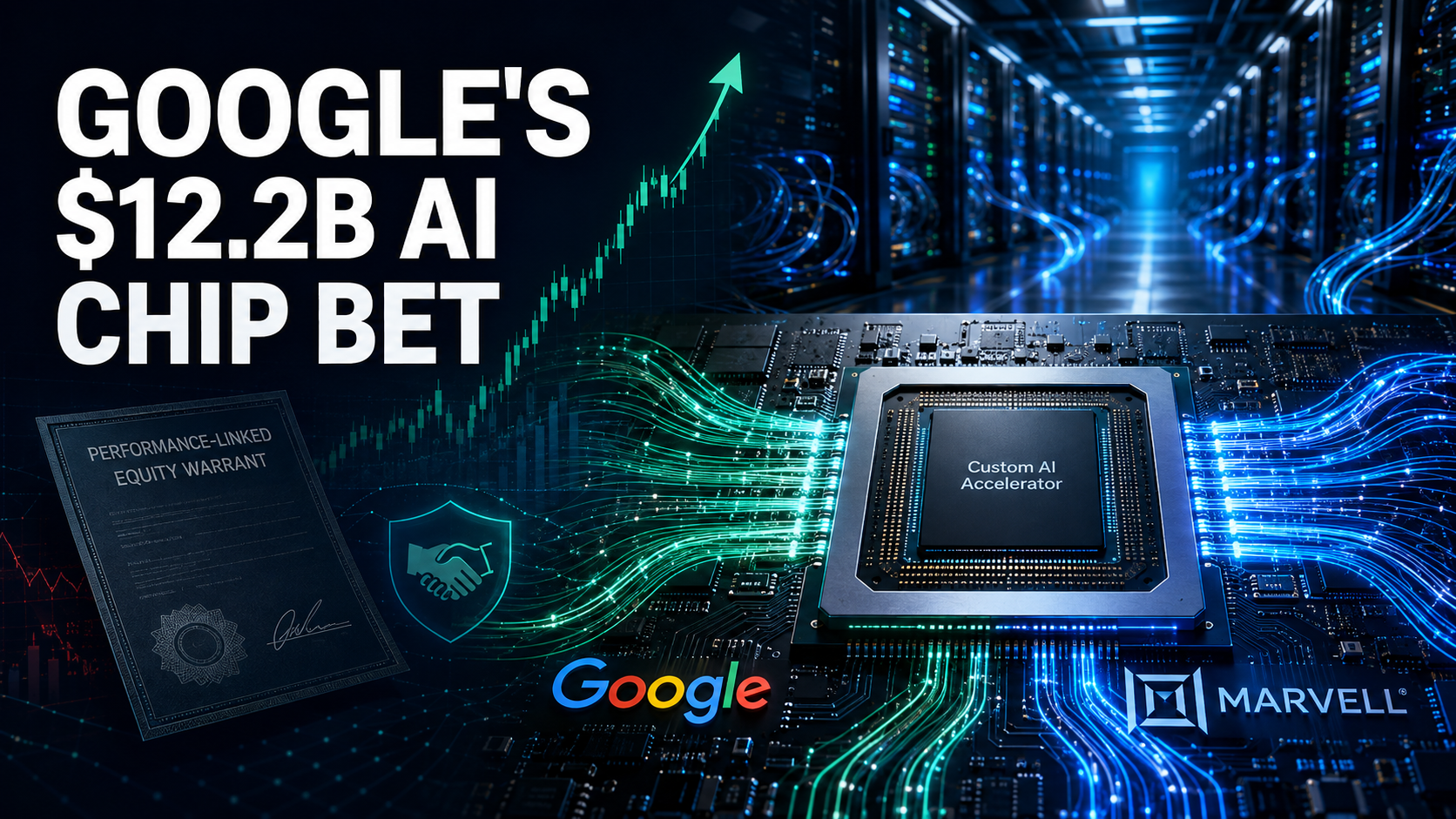
Google is deepening its push into custom artificial intelligence hardware through an expanded partnership with Marvell Technology—one that could give the search giant the right to acquire as much as $12.2 billion in Marvell shares.
The Google-Marvell AI chip deal covers a broad collection of semiconductor products connected to Google’s tensor processing unit, or TPU, ecosystem. These include AI inference accelerators, storage controllers, network interface controllers, memory interface controllers and near-memory computing products.
Marvell shares rose approximately 8% following the announcement, while Broadcom—Google’s principal TPU development partner—fell roughly 5%. The contrasting reactions illustrate how quickly investors recognized the potential transfer of opportunity within the expanding custom-AI-chip market.
However, the headline requires some context. Google is not immediately investing $12.2 billion in Marvell. The agreement gives Google a performance-linked warrant whose ultimate value and vesting depend largely on how much qualifying hardware Google purchases from Marvell through 2033.
What Google and Marvell Actually Agreed To
According to Marvell’s regulatory filing, Google received a warrant to purchase as many as 58,970,907 Marvell shares at an exercise price of $206.58 per share. If every share becomes vested and Google exercises the entire warrant, the purchase price would total approximately $12.18 billion.
Only 1,360,867 of those shares vest according to time. Those shares will vest in equal quarterly installments during the first year following execution of the commercial agreement.
The remaining shares are tied to Google’s purchases of custom Marvell products. They vest in 240 equal tranches, with one tranche earned for each $500 million in qualifying revenue generated from Google and its affiliates between Marvell’s third quarter of fiscal 2027 and the end of fiscal 2033.
That structure is what makes the Google-Marvell AI chip deal potentially transformative.
Multiplying 240 tranches by $500 million indicates that full performance-based vesting could be associated with as much as $120 billion in cumulative qualifying purchases. That figure is not a guaranteed revenue forecast. It represents the purchasing scale required for all the performance-based warrant shares to vest.
A Commercial Incentive, Not a Conventional Investment
The warrant aligns the financial interests of Google and Marvell. As Google purchases more Marvell products, more warrant shares vest. If Marvell’s stock subsequently trades above the $206.58 exercise price, the warrants could become increasingly valuable to Google.
For Marvell, the arrangement provides a powerful incentive for one of the world’s largest cloud and AI companies to direct additional semiconductor business toward its platform.
For Google, the warrant creates potential equity upside while encouraging Marvell to deliver the performance, production capacity and product roadmap required to support Google’s expanding AI infrastructure.
This structure differs from Google simply buying Marvell stock in the open market. It is better understood as a long-term commercial incentive tied to future business volume.
The warrant remains exercisable, subject to its vesting terms, through August 18, 2033.
Why Google Wants More Custom AI Chips
Nvidia’s graphics processing units remain the dominant platform for training and running advanced AI models. GPUs offer flexibility, a mature software ecosystem and enormous computing capacity.
That flexibility also comes at a price.
Companies such as Google, Amazon and Microsoft are developing specialised chips for workloads they can predict and control. A custom accelerator can be optimised for a narrower group of tasks, potentially improving performance per watt and reducing the cost of delivering AI services at enormous scale.
Google has developed TPUs for its internal data centres for years. It is now making that computing capacity more widely available to outside customers through Google Cloud.
This changes the economics of the TPU program. Google is no longer building chips solely to lower its own internal costs. It is turning its custom silicon into a commercial cloud product capable of generating revenue from external AI developers.
The Google-Marvell AI chip deal supports that expansion by adding specialised processors and the surrounding components required to move, store and access data efficiently.
Inference May Be the Next Major AI Battleground
Training a large AI model requires an enormous amount of computing power, but training is only one part of the economic equation. Once a model has been built, it must run every time a customer submits a prompt, generates an image, writes code or requests an analysis.
That process is known as inference.
As AI adoption grows, inference may become a larger and more persistent source of semiconductor demand than model training. Each additional user and each additional query creates another requirement for computing capacity.
Google and Marvell specifically included AI inference accelerators in their agreement. This suggests the partnership is aimed not only at developing future TPUs, but also at constructing a broader hardware architecture capable of running AI applications more efficiently.
Inference chips do not necessarily need to replace Nvidia GPUs to become commercially important. They can win specific workloads where cost, latency, power consumption or integration with Google Cloud matters more than general-purpose flexibility.
The Opportunity Extends Beyond the Main Processor
One of the most important details in the Google-Marvell AI chip deal is its breadth. The partnership extends well beyond a single AI accelerator.
- AI inference accelerators perform the calculations required to run trained AI models.
- Network interface controllers move data between servers and processors.
- Storage controllers manage the enormous datasets used by AI systems.
- Memory interface controllers help processors retrieve data from high-speed memory.
- Near-memory computing places more processing capability close to stored data, reducing the time and energy required to move that data.
This is significant because the performance of an AI data centre is no longer determined by the accelerator alone. Memory bandwidth, networking, storage and optical interconnects can become bottlenecks when thousands of processors operate together.
Marvell’s opportunity is therefore not limited to designing a competitor to an Nvidia GPU. It can provide many of the components that allow Google’s entire TPU system to function at scale.
What the Deal Means for Marvell
For Marvell, the agreement represents both revenue potential and strategic validation.
The company already helps hyperscale cloud operators develop custom silicon and supplies important data-centre connectivity products. Securing a larger role in Google’s TPU ecosystem elevates Marvell’s position alongside the most important providers of AI infrastructure.
The agreement could also diversify Marvell’s custom-silicon customer base. The company has worked with Amazon and other hyperscale operators, but a broader relationship with Google provides another potential source of long-duration demand.
The market’s enthusiastic reaction reflects the size of that opportunity. It also creates several risks.
Marvell must execute complex product roadmaps, meet performance requirements and deliver hardware at scale. The company may need to make substantial investments well before it recognizes the full amount of associated revenue.
The warrant can also create dilution if a large number of shares vest and are eventually exercised. Existing shareholders must therefore weigh the potential dilution against the revenue and earnings that would be required to trigger it.
Why Broadcom Shares Fell
Broadcom has been Google’s principal partner in the development of its TPU architecture. Earlier this year, the companies extended their agreement covering TPUs and other AI-infrastructure components through 2031.
The new Marvell partnership naturally raised concerns that some future Google business could shift away from Broadcom.
That conclusion may be premature.
Google’s AI infrastructure requirements are becoming so large that it may need multiple semiconductor partners. Marvell could develop products that complement Broadcom’s TPU work rather than replace it. Diversifying suppliers also gives Google additional engineering capacity, negotiating leverage and protection against production disruptions.
The immediate decline in Broadcom shares reflects a reduction in perceived certainty, not confirmation that Broadcom has lost its central position.
Future disclosures about Google-related revenue, product responsibilities and design wins will be more informative than the first day’s stock reaction.
Does This Threaten Nvidia?
The expansion of Google’s custom silicon is part of a broader effort by hyperscalers to reduce their dependence on Nvidia. However, that does not necessarily make the relationship between Nvidia and Marvell adversarial.
Nvidia announced a $2 billion investment in Marvell in March and agreed to collaborate on silicon photonics. That technology is intended to increase the speed and efficiency with which data travels through large AI data centres.
Marvell can therefore participate in two apparently competing trends:
- The continued growth of Nvidia-based AI systems.
- The development of custom accelerators intended to handle workloads outside Nvidia’s platform.
This illustrates how interconnected the AI semiconductor market has become. A company can be a supplier, partner, investor and competitor at the same time.
Nvidia’s greatest competitive advantage remains its CUDA software ecosystem and the flexibility of its GPUs. Custom chips do not need to eliminate that advantage to capture a meaningful share of inference and cloud-computing demand.
What the Deal Means for Alphabet
Alphabet is using custom silicon to create a more vertically integrated AI platform. The company develops models, operates data centres, provides cloud services and increasingly controls the processors used to deliver those services.
This can provide several advantages:
- Lower reliance on a single outside chip supplier.
- Greater control over hardware and software optimisation.
- Potentially lower inference costs.
- Improved power efficiency inside Google data centres.
- A differentiated AI-computing product for Google Cloud customers.
The strategy requires enormous capital commitments and carries significant execution risk. Google must persuade customers that its TPU platform offers enough performance, availability and software support to justify moving workloads away from more established GPU infrastructure.
The warrant arrangement gives Marvell a strong incentive to help Google make that transition successful.
Trading Ideas and Stocks to Watch
The Google-Marvell AI chip deal creates several areas for traders to monitor. The first-day reaction provides information, but it does not guarantee the direction of the next sustained move.
Marvell Technology: MRVL
MRVL is the most direct beneficiary. Traders should watch whether the post-announcement gap holds and whether the stock can consolidate above its breakout area without immediately filling the gap.
After a large news-driven advance, chasing strength can expose traders to a reversal as early investors take profits. A controlled pullback, declining volume during consolidation and renewed buying near a clearly defined support level may provide more useful information than the opening surge alone.
Marvell’s next earnings report will be important because management may provide additional context about development expenses, revenue timing and the expected contribution from Google-related programs.
Broadcom: AVGO
AVGO may offer either a continuation or an overreaction trade. If the decline is accompanied by heavy institutional distribution and breaks meaningful support, traders may interpret the agreement as a genuine threat to future growth expectations.
If Broadcom stabilizes quickly and management confirms that its Google roadmap remains intact, the initial decline could prove excessive.
Alphabet: GOOGL and GOOG
The agreement is unlikely to alter Alphabet’s near-term earnings by itself, but it reinforces the company’s vertical-integration strategy. Traders should monitor whether the market begins assigning greater value to Google Cloud’s custom AI infrastructure.
Nvidia: NVDA
NVDA remains the benchmark for the AI semiconductor trade. Weakness following custom-chip announcements can reveal concerns about long-term market share, while relative strength would suggest investors continue to view hyperscaler silicon as complementary rather than immediately disruptive.
Semiconductor ETF: SMH
SMH can help traders determine whether the announcement is producing a rotation within the semiconductor industry or a broader change in sentiment. MRVL strength accompanied by weakness in AVGO and stability elsewhere would point toward company-specific repositioning rather than sector-wide deterioration.
What Traders Should Watch Next
The most important confirmation will come from revenue rather than warrants.
Traders should monitor Marvell’s disclosures for evidence that Google purchases are beginning to trigger the performance-based vesting tranches. Each tranche corresponds with another $500 million in qualifying custom-product revenue.
Other important signals include:
- Marvell’s data-centre revenue growth and operating margins.
- New details about which products Marvell will develop for Google.
- Broadcom’s commentary about its TPU roadmap through 2031.
- External customer adoption of Google Cloud TPUs.
- Growth in inference demand relative to AI training demand.
- Capital spending by Alphabet and other hyperscalers.
- Evidence that custom chips are reducing reliance on Nvidia GPUs.
The TraderInsight View
The headline value of the warrant is attention-grabbing, but the performance conditions reveal the more important story.
Google is offering Marvell the opportunity to participate in an enormous AI-infrastructure buildout, while Marvell is giving Google potential equity ownership that grows alongside the commercial relationship.
This arrangement turns Marvell into more than another component vendor. It creates a long-term economic partnership whose success depends on Google purchasing potentially tens of billions of dollars in custom processors, networking products, storage controllers and memory technology.
For Broadcom, the agreement introduces a credible second supplier inside an ecosystem it has helped build. For Nvidia, it confirms that hyperscalers intend to develop alternatives wherever custom hardware can lower costs. For Alphabet, it strengthens the vertical integration behind Google Cloud and its expanding TPU business.
The Google-Marvell AI chip deal does not guarantee $120 billion in revenue or an immediate $12.2 billion investment. It establishes a pathway toward those figures—and gives both companies a powerful incentive to make the custom-silicon partnership work.
The market’s next task is to determine how much of that enormous potential will become actual revenue, earnings and sustainable shareholder value.
Sources: Marvell Technology Form 8-K and contemporaneous financial-market reporting. This article is for educational purposes only and does not constitute investment advice. Traders should evaluate price structure, market conditions and their own risk tolerance before entering any position.