
Google AI Leadership Shake-Up: Chief Scientist Jeff Dean Leaves After 27 Years
Google is losing one of the most influential engineers in its history at a critical moment in the artificial-intelligence race.
Jeff Dean, Google’s longtime chief scientist and one of the architects behind much of the company’s modern computing and AI infrastructure, is leaving after 27 years to launch a new artificial-intelligence company called Discovery Loop.
The departure is far more significant than an ordinary executive transition. Dean helped build foundational Google technologies, contributed to the creation of Google Brain, and played a central role in the company’s development of large-scale machine-learning systems.
The resulting Google AI leadership shake-up raises an important question for investors: Is Alphabet losing irreplaceable talent, or is it finding a way to keep that talent inside its broader economic ecosystem?
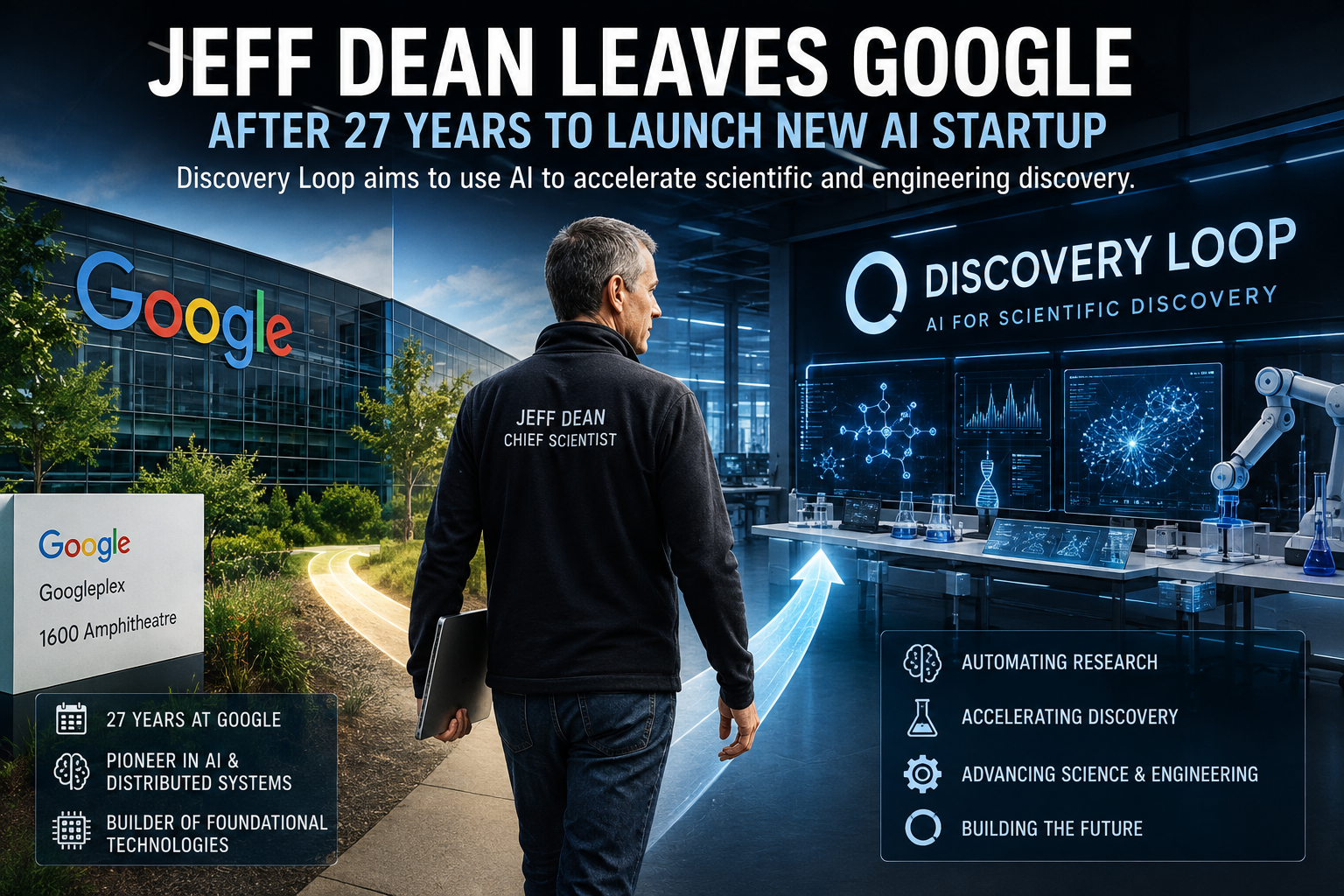
Jeff Dean Launches Discovery Loop
Dean will become chief executive of Discovery Loop, a newly created public-benefit corporation designed to use AI to accelerate scientific and engineering research.
The company plans to develop systems capable of automating complex, multistep research tasks. Its initial work is expected to focus on machine-learning research and engineering, with longer-term applications potentially including semiconductor design, drug discovery, materials science, and clean-energy development.
The name Discovery Loop reflects the company’s central idea: AI systems could repeatedly form hypotheses, design experiments, evaluate results, and use those findings to guide the next round of research.
Rather than using AI merely to answer questions or generate content, Discovery Loop wants to apply it to the full process of experimentation and discovery.
Dean Is Not Leaving Alone
Several prominent Google researchers are reportedly joining Dean, including Oriol Vinyals, Quoc Le, and Sanjay Ghemawat.
These are not interchangeable employees.
Vinyals and Le have played important roles in the development of modern neural networks and Google’s Gemini models. Ghemawat worked alongside Dean on foundational distributed-computing technologies that helped Google scale search, advertising, cloud services, and machine learning.
The group’s departure therefore represents a substantial concentration of technical knowledge leaving Google at the same time.
That makes the Google AI leadership shake-up particularly notable. The AI industry is already engaged in an aggressive competition for a relatively small number of researchers capable of designing frontier models and the infrastructure required to train them.
Alphabet Is Investing in the New Company
There is an important complication to the story: Alphabet is not treating Discovery Loop as a conventional rival.
Alphabet is expected to invest in the startup and provide it with Google Cloud computing resources. Venture firms Radical Ventures and Khosla Ventures are also reportedly backing the company.
This arrangement could allow Alphabet to maintain a strategic and financial relationship with Dean and his team even though they will no longer work inside Google.
Discovery Loop may become a major Google Cloud customer, an Alphabet investment asset, and a potential source of technologies that could eventually be licensed, acquired, or integrated into Google products.
For investors, that makes the situation more nuanced than simply saying that Google has lost its chief scientist.
Alphabet may be allowing a highly specialized research effort to operate with greater independence while still retaining exposure to its future success.
Why Leave Google to Build an AI Startup?
Large technology companies offer extraordinary computing power, data, capital, and research talent. They also contain layers of product priorities, management structures, and commercial obligations.
Discovery Loop’s founders reportedly believe that automating scientific discovery requires a different type of infrastructure and organizational focus than Google’s consumer-oriented AI projects provide.
A standalone startup can concentrate on one mission without needing to prioritize search, advertising, mobile devices, cloud customers, and consumer AI products simultaneously.
It can also offer founders and employees a more direct financial stake in the technology they create.
This dynamic has become common across the AI industry. Established companies supply the talent, research experience, and technical foundations. New startups then attempt to move faster by organizing those resources around a narrower goal.
A Broader Reorganization at Google DeepMind
Dean’s exit coincides with a broader leadership transition inside Alphabet’s AI organization.
Demis Hassabis is reportedly moving from chief executive of Google DeepMind to chairman while becoming Alphabet’s chief scientist. He is also expected to continue leading Isomorphic Labs, Alphabet’s AI-driven drug-discovery business.
This suggests Alphabet is not stepping away from scientific AI.
Instead, it appears to be restructuring its leadership around several connected but distinct organizations:
- Google DeepMind for frontier AI research and Gemini development
- Isomorphic Labs for AI-driven drug discovery
- Discovery Loop for automated scientific and engineering research
- Google Cloud as the infrastructure provider connecting the projects
The Google AI leadership shake-up may therefore be better understood as a decentralization of Alphabet’s AI ambitions rather than a complete breakdown in its research organization.
Why AI Talent Has Become So Valuable
The technology industry often focuses on access to graphics processors, data centers, electricity, and training data. Those resources are essential, but the latest movement of elite researchers shows that human talent may be even more difficult to replace.
A relatively small group of scientists and engineers has contributed disproportionately to the technologies underlying modern AI.
Dean and Ghemawat helped create systems including MapReduce and Bigtable, which formed part of the infrastructure that allowed Google to process information at enormous scale.
Dean also contributed to TensorFlow, Google Brain, custom AI chips, and the broader machine-learning architecture used throughout Alphabet. TensorFlow itself was designed as a large-scale machine-learning system capable of distributing computation across processors, servers, GPUs, and specialized chips.
When researchers with that depth of experience leave, replacing the job title does not necessarily replace the institutional knowledge.
Could This Hurt Alphabet Stock?
Alphabet shares were trading only modestly lower following the report, suggesting investors were not treating the departure as an immediate threat to the company’s earnings outlook.
That reaction is understandable.
Alphabet has an enormous AI research organization, extensive proprietary data, custom Tensor Processing Units, one of the world’s largest cloud-computing platforms, and the financial capacity to continue recruiting top talent.
The company is also investing in Discovery Loop rather than allowing Dean’s team to become completely disconnected from the Alphabet ecosystem.
However, the long-term market significance may be greater than the initial stock reaction suggests.
Investors should watch whether Dean’s departure is an isolated entrepreneurial move or part of a broader pattern of researchers leaving Google for startups and competitors.
Recent departures from Google’s AI organization have already highlighted the increasing competition among Alphabet, OpenAI, Anthropic, Meta, and well-funded private laboratories for elite researchers.
The Next Phase of AI May Be Scientific Discovery
The first wave of generative AI focused heavily on language, images, software development, and consumer productivity.
The next wave may move deeper into science and engineering.
AI systems are increasingly being designed to generate research ideas, write experimental code, run simulations, evaluate results, and repeat the process. Academic researchers have already demonstrated early frameworks capable of automating portions of the scientific workflow.
If those systems become reliable, they could shorten development timelines in industries where experimentation is slow and expensive.
Potential applications include:
- Designing new medicines and biological treatments
- Developing more efficient semiconductors
- Discovering new materials
- Improving battery and energy technology
- Automating portions of AI-model development itself
Discovery Loop is being built around the belief that AI’s largest economic impact may ultimately come from accelerating the creation of new technologies rather than simply improving existing digital products.
What Traders Should Watch
The immediate trading impact on Alphabet may remain limited unless the company provides additional details regarding management changes, financial commitments, or the number of employees joining Discovery Loop.
For active traders, several developments could produce volatility:
- Additional high-profile departures from Google DeepMind
- Funding or valuation details for Discovery Loop
- Major Google Cloud agreements involving the startup
- Announcements regarding Demis Hassabis’ expanded Alphabet role
- Evidence that Gemini development is slowing or accelerating
- Partnerships involving drug discovery, chips, energy, or scientific research
Alphabet’s investment in the company may soften the negative interpretation, but markets will continue evaluating whether Google can retain enough leadership depth to compete across several AI fronts at once.
The TraderInsight Perspective
The Google AI leadership shake-up highlights one of the defining characteristics of the current technology cycle: the most important AI assets do not always sit neatly inside one public company.
Talent, capital, cloud infrastructure, and intellectual property are moving through a network of large technology companies and private startups.
Jeff Dean may be leaving Google, but Discovery Loop will reportedly remain connected to Alphabet through investment and cloud computing. That could eventually make the startup strategically valuable to the company he is leaving.
For Alphabet shareholders, the departure creates legitimate execution and talent-retention concerns. It also gives the company a stake in a highly ambitious effort to automate scientific discovery.
The near-term stock reaction may be muted, but the longer-term outcome could be meaningful.
If Discovery Loop succeeds, Dean’s departure may eventually look less like a loss for Alphabet and more like the creation of another AI business within its orbit.
Google chief scientist Jeff Dean leaving company after 27 years
Google AI Architect Jeff Dean Leaves to Co-Found AI Science Startup – WSJ
Google’s Top AI Brains Are Leaving to Launch Discovery Loop | WIRED