
The Small Cap Swing Trader Alert Archive
Below you'll find The Small Cap Swing Trader setups stacked up and ordered chronologically.Earnings to Watch Thursday, July 16, 2026
Earnings to Watch Thursday, July 16, 2026: Netflix, TSMC, UnitedHealth, GE Aerospace and More
The earnings calendar for Thursday, July 16, 2026, features several market-moving companies spanning healthcare, semiconductors, aerospace, banking, streaming, industrials, logistics, and technology. Investors will be watching not only whether companies beat Wall Street estimates, but also what management teams say about consumer demand, artificial intelligence spending, corporate investment, healthcare costs, credit conditions, and the broader economy.
Here are the most important earnings to watch Thursday, July 16, 2026, along with the developments that could influence trading in each company and its broader sector.
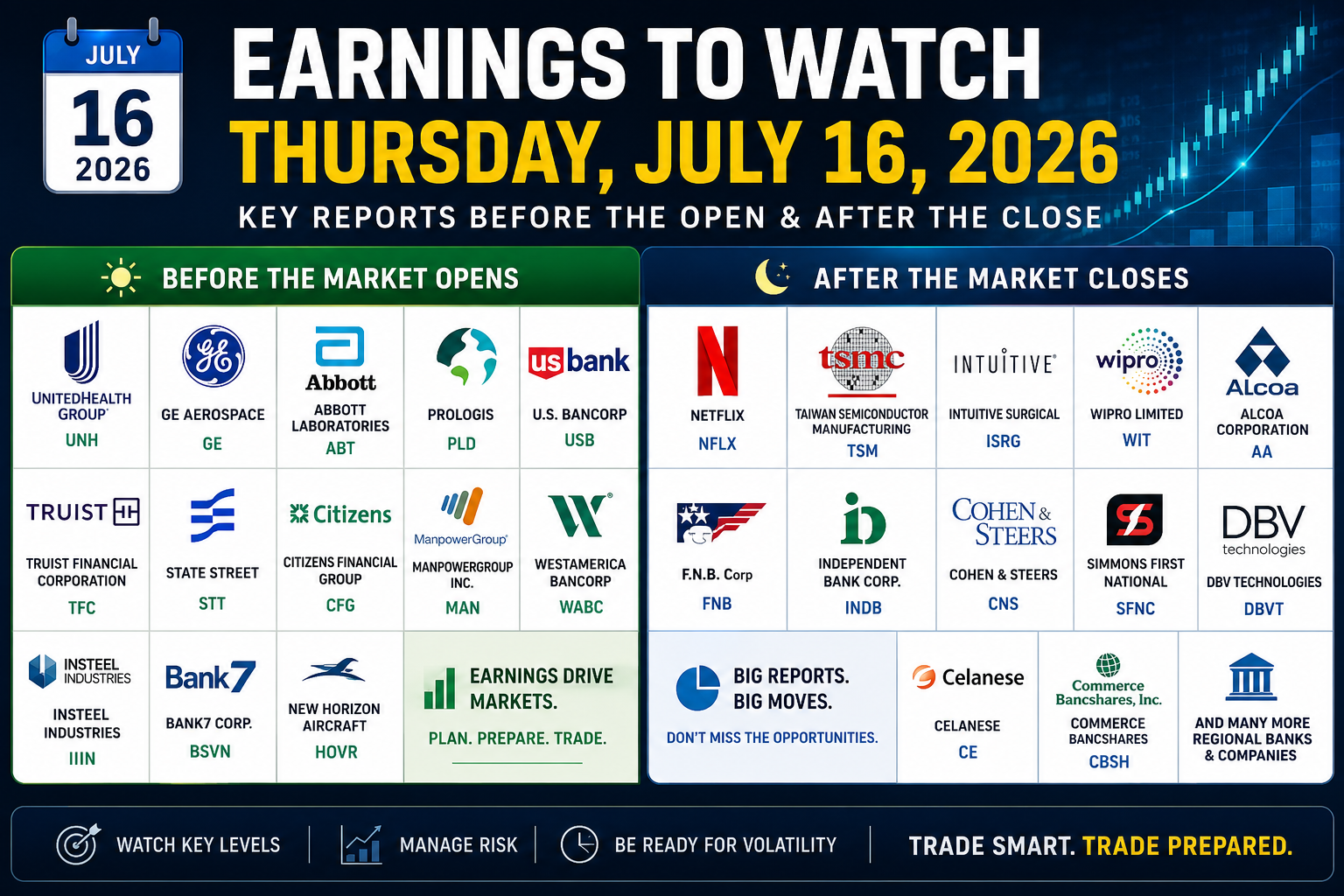
Earnings July 16, 2026
Before the Market Opens
UnitedHealth Group (NYSE: UNH)
UnitedHealth Group headlines the morning earnings reports and could influence the entire managed-care sector. Investors will focus on medical cost trends, Medicare Advantage profitability, insurance enrollment, reimbursement rates, and management’s updated outlook.
After an exceptionally volatile period for healthcare insurers, guidance may matter more than the quarterly earnings number itself. Traders should watch related names across the managed-care industry for a possible sector-wide reaction.
GE Aerospace (NYSE: GE)
GE Aerospace remains a major beneficiary of strong commercial aviation demand. Investors will monitor aircraft engine deliveries, aftermarket service revenue, defense contracts, free cash flow, production capacity, and supply chain conditions.
The company’s outlook may also affect aircraft manufacturers and suppliers because GE Aerospace provides engines and services throughout the global aviation industry.
Abbott Laboratories (NYSE: ABT)
Abbott Laboratories offers exposure to medical devices, diagnostics, nutrition, and established pharmaceutical products. Wall Street will be watching organic sales growth, profit margins, diabetes-care products, cardiovascular devices, international demand, and full-year guidance.
Performance within Abbott’s medical-device portfolio could provide another important read on healthcare procedure volumes and hospital spending.
Prologis (NYSE: PLD)
As one of the world’s largest industrial real estate investment trusts, Prologis serves as an important indicator for warehouse demand, logistics activity, global trade, and e-commerce fulfillment.
Investors will focus on occupancy rates, rental growth, leasing activity, development starts, property valuations, and management’s outlook for commercial real estate.
U.S. Bancorp (NYSE: USB)
U.S. Bancorp will provide another important look at conditions across the banking industry. Key areas include net interest income, net interest margins, loan growth, deposit costs, credit quality, consumer spending, and commercial lending.
Traders will also watch for commentary about interest rates and whether customers are becoming more cautious about borrowing.
Truist Financial (NYSE: TFC)
Truist Financial’s report will offer additional insight into regional banking conditions. Investors will evaluate deposit stability, lending activity, net interest margins, expense controls, capital levels, and potential credit losses.
Any meaningful change in management’s outlook could influence regional bank stocks throughout Thursday’s session.
State Street (NYSE: STT)
State Street provides custody, asset-servicing, investment-management, and institutional financial services. Its results can offer insight into global asset values, institutional trading activity, fund flows, and investor risk appetite.
Assets under custody and administration, fee revenue, net interest income, and expense growth will be closely watched.
Citizens Financial Group (NYSE: CFG)
Citizens Financial Group will also be evaluated on deposit trends, loan demand, net interest income, credit performance, and funding costs.
With several large and regional banks reporting on the same day, investors may compare results across the group to determine whether operating conditions are improving or deteriorating.
ManpowerGroup (NYSE: MAN)
ManpowerGroup’s results could provide an important signal about labor-market conditions. Staffing demand often changes before official employment data, making the company’s commentary useful for investors assessing the direction of hiring and economic growth.
Traders should watch demand for temporary workers, permanent placement activity, geographic trends, and management’s outlook for employer hiring plans.
Additional Companies Reporting Before the Open
- Westamerica Bancorporation (NASDAQ: WABC)
- Insteel Industries (NYSE: IIIN)
- Bank7 Corp. (NASDAQ: BSVN)
- New Horizon Aircraft (NASDAQ: HOVR)
Although these companies are smaller than the morning’s headline names, their results could still produce significant stock-specific volatility. Insteel may offer insight into construction and infrastructure demand, while the smaller banks provide additional evidence about local lending and credit conditions.
After the Market Closes
Netflix (NASDAQ: NFLX)
Netflix is likely to be one of the most closely watched reports in the earnings lineup. Investors will focus on revenue growth, operating margins, advertising sales, engagement, pricing, content spending, and management’s outlook for the remainder of 2026.
Wall Street will also be looking for evidence that Netflix can continue expanding its advertising business while maintaining subscriber engagement and profitability. Because of Netflix’s size and influence, the report could affect the broader communication-services and streaming sectors.
Taiwan Semiconductor Manufacturing Company (NYSE: TSM)
Taiwan Semiconductor Manufacturing Company is one of the most important companies in the global artificial intelligence supply chain. TSMC manufactures advanced processors for major technology companies, including many of the leading designers of AI accelerators, smartphones, networking equipment, and high-performance computing systems.
Investors will monitor:
- Demand for AI and high-performance computing chips
- Advanced-node production growth
- Advanced packaging capacity
- Capital expenditure plans
- Gross margins
- Customer demand and production guidance
TSMC’s outlook could influence semiconductor stocks throughout the market, including chip designers, equipment manufacturers, memory producers, and other companies tied to the AI infrastructure buildout.
Intuitive Surgical (NASDAQ: ISRG)
Intuitive Surgical remains the leader in robotic-assisted surgery. Investors will watch procedure growth, placements of da Vinci surgical systems, recurring instrument and accessory revenue, international expansion, and adoption of newer systems.
Because a significant portion of the company’s revenue is tied to procedure volume, the report can also offer useful insight into hospital activity and elective surgery trends.
Wipro Limited (NYSE: WIT)
Wipro’s results provide a window into enterprise technology spending, outsourcing demand, cloud migration, artificial intelligence projects, and digital transformation.
Bookings, contract wins, operating margins, and management’s revenue guidance will help investors assess whether corporate customers are accelerating or delaying technology investments.
Alcoa Corporation (NYSE: AA)
Alcoa’s earnings could provide insight into global industrial demand, aluminum prices, manufacturing activity, energy costs, and trade conditions.
Investors will watch realized aluminum prices, production levels, raw-material expenses, tariffs, and management’s outlook for demand from the automotive, aerospace, construction, and packaging industries.
Celanese Corporation (NYSE: CE)
Celanese manufactures specialty materials and chemical products used across automotive, industrial, consumer, and electronics markets. Its report may provide another useful indicator of manufacturing activity and global demand.
Traders will focus on pricing, sales volumes, margins, debt reduction, and signs of improvement or continued weakness in industrial end markets.
Regional and Community Banks Reporting
A large group of regional and community banks is also scheduled to report. The results could provide a broad picture of lending demand, deposit competition, net interest margins, commercial real estate exposure, and credit quality across different parts of the country.
- F.N.B. Corporation (NYSE: FNB)
- Independent Bank Corp. (NASDAQ: INDB)
- Commerce Bancshares (NASDAQ: CBSH)
- First Financial Bankshares (NASDAQ: FFIN)
- BancFirst Corporation (NASDAQ: BANF)
- Hilltop Holdings (NYSE: HTH)
- 1st Source Corporation (NASDAQ: SRCE)
- Peoples Financial Services (NASDAQ: PFIS)
- Bar Harbor Bankshares (NYSE American: BHB)
- Capital Bancorp (NASDAQ: CBNK)
- Farmers & Merchants Bancorp (NASDAQ: FMAO)
- Citizens & Northern Corporation (NASDAQ: CZNC)
- BayCom Corp. (NASDAQ: BCML)
- Chemung Financial Corporation (NASDAQ: CHMG)
- Oak Valley Bancorp (NASDAQ: OVLY)
- BV Financial (NASDAQ: BVFL)
- BCB Bancorp (NASDAQ: BCBP)
Additional Companies Reporting After the Close
- Cohen & Steers (NYSE: CNS)
- Simmons First National (NASDAQ: SFNC)
- DBV Technologies (NASDAQ: DBVT)
- POSCO Holdings (NYSE: PKX)
- Grupo Simec (NYSE American: SIM)
- Cementos Pacasmayo (NYSE: CPAC)
- Vizsla Silver (NYSE American: VZLA)
- Cass Information Systems (NASDAQ: CASS)
- Omega Flex (NASDAQ: OFLX)
- Champions Oncology (NASDAQ: CSBR)
- Highway Holdings (NASDAQ: HIHO)
This group includes companies tied to asset management, biotechnology, steel, construction materials, precious metals, industrial manufacturing, financial processing, and cancer-research services. Traders should be prepared for elevated volatility in these smaller names because limited liquidity can amplify post-earnings price moves.
The Most Important Earnings Reports for Traders
Several reports stand out because of their potential to move entire sectors rather than only the reporting companies.
- Netflix: Streaming demand, digital advertising, consumer engagement, and communication-services sentiment.
- TSMC: AI infrastructure spending, semiconductor production, advanced packaging, and global chip demand.
- UnitedHealth: Medical costs, Medicare Advantage, insurance pricing, and managed-care profitability.
- GE Aerospace: Commercial aviation, aircraft production, defense spending, and industrial supply chains.
- Abbott Laboratories: Medical devices, diagnostics, and healthcare procedure volumes.
- Prologis: Warehouse demand, logistics activity, e-commerce, and commercial real estate.
- Major and regional banks: Interest rates, deposits, loan growth, credit quality, and economic conditions.
Trading Implications
The earnings to watch Thursday, July 16, 2026, provide traders with an unusually broad snapshot of the domestic and global economy.
Strong results or guidance from TSMC could support semiconductor and artificial intelligence stocks. Weak guidance, capacity concerns, or margin pressure could create volatility across the chip sector.
Netflix has the potential to influence streaming companies and the broader communication-services sector. Traders should watch the initial after-hours reaction carefully because price can change sharply during the conference call as management discusses advertising, engagement, content spending, and future guidance.
UnitedHealth could produce a major reaction across managed-care stocks if medical costs or reimbursement trends differ meaningfully from expectations. GE Aerospace may influence industrial and aviation names, while Abbott and Intuitive Surgical could affect medical-device stocks.
The large number of bank earnings will give investors a clearer picture of credit conditions and the effects of interest rates. Particular attention should be paid to net interest margins, deposits, loan-loss provisions, commercial real estate exposure, and management commentary about borrowers.
As always, traders should look beyond whether a company beats or misses consensus estimates. Forward guidance, management commentary, revisions to full-year expectations, and the market’s positioning before the announcement frequently matter more than the headline numbers.
Bottom Line
The earnings calendar for Thursday, July 16, 2026, covers nearly every major segment of the economy, from AI chip manufacturing and streaming entertainment to healthcare, aerospace, industrial real estate, labor markets, materials, and banking.
With heavyweight companies including Netflix, TSMC, UnitedHealth, GE Aerospace, Abbott Laboratories, Prologis, and Intuitive Surgical reporting, traders should prepare for increased volatility across several major sectors.
The most important opportunity may come from identifying where earnings results change expectations—not simply where a company beats or misses. Watch the guidance, listen to the conference calls, map the important price levels, and allow the market’s reaction to confirm the trade.
For more earnings information visit Earnings Calendar
Earnings to Watch Today – July 15, 2026
Earnings to Watch Today: United Airlines, Conagra, JB Hunt and More Report Results
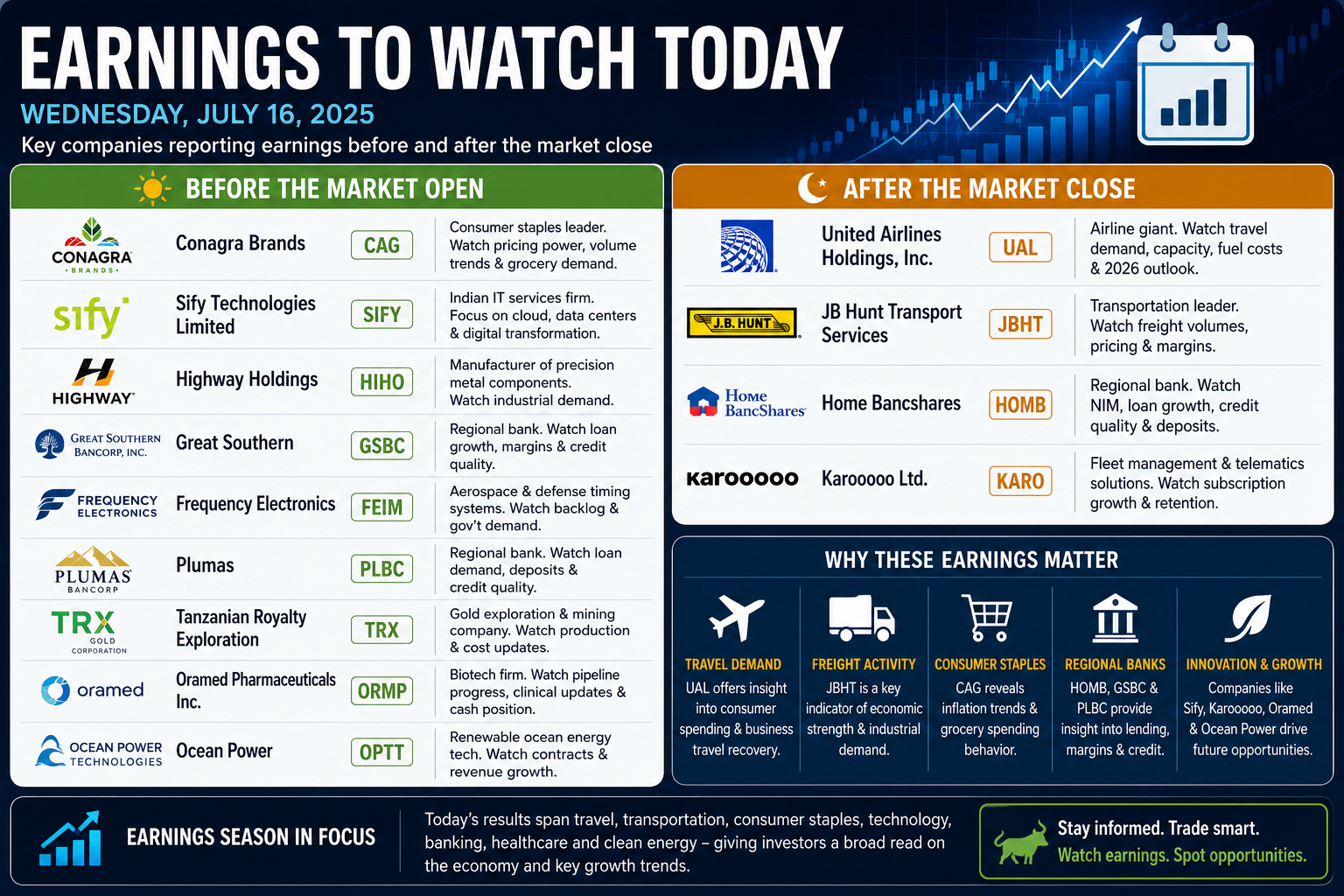
Earnings to Watch Today: United Airlines, Conagra, JB Hunt and More
Today’s earnings calendar features several companies that could move not only their own shares but also influence broader sectors including airlines, transportation, consumer staples, technology, banking, healthcare, and alternative energy. While many investors focus on mega-cap earnings, these reports often provide valuable insight into consumer spending, freight demand, business investment, and economic conditions.
Below are the earnings to watch today and why each report matters.
After the Market Close
United Airlines (NASDAQ: UAL)
United Airlines headlines today’s earnings lineup. Investors will be watching closely for:
- Summer travel demand
- International booking trends
- Corporate travel recovery
- Fuel cost guidance
- 2026 earnings outlook
Airline earnings often provide one of the clearest reads on consumer discretionary spending and business travel demand.
JB Hunt Transport Services (NASDAQ: JBHT)
As one of North America’s largest transportation companies, JB Hunt serves as an important economic bellwether.
Key metrics include:
- Intermodal shipping volumes
- Freight pricing
- Truckload demand
- Operating margins
- Management commentary on the U.S. economy
Transportation stocks frequently provide an early indication of changes in manufacturing activity and consumer demand.
Home BancShares (NYSE: HOMB)
Regional banks remain under close scrutiny as investors evaluate:
- Net interest margins
- Loan growth
- Credit quality
- Commercial real estate exposure
- Deposit trends
Management’s outlook may offer additional clues about regional economic conditions and lending activity.
Karooooo Ltd. (NASDAQ: KARO)
Karooooo provides fleet management, telematics, and software solutions. Investors will focus on subscription growth, customer retention, recurring revenue, and international expansion.
Before the Market Open
Conagra Brands (NYSE: CAG)
Conagra’s report offers valuable insight into grocery spending and consumer behavior.
Wall Street will monitor:
- Pricing power
- Food inflation
- Volume trends
- Retail demand
- 2026 guidance
Packaged food companies often reveal whether consumers continue trading down to lower-cost grocery options.
Sify Technologies (NASDAQ: SIFY)
The Indian technology services provider offers exposure to cloud infrastructure, data centers, and digital transformation across India’s rapidly growing economy.
Highway Holdings (NASDAQ: HIHO)
Highway Holdings manufactures precision metal components for industrial customers. Investors will watch for updates on manufacturing demand and global supply chain activity.
Great Southern Bancorp (NASDAQ: GSBC)
Like many regional financial institutions, Great Southern’s results will provide insight into lending activity, deposit growth, and credit quality.
Frequency Electronics (NASDAQ: FEIM)
Frequency Electronics supplies precision timing systems used in aerospace, defense, and satellite communications. Government contract updates and backlog growth will be closely monitored.
Plumas Bancorp (NASDAQ: PLBC)
This regional California bank provides another snapshot of community banking conditions, loan demand, and credit performance.
TRX Gold Corporation (NYSE American: TRX)
Formerly Tanzanian Royalty Exploration, TRX Gold operates mining assets in Tanzania. Investors will watch production levels, operating costs, and gold price sensitivity.
Oramed Pharmaceuticals (NASDAQ: ORMP)
Biotechnology investors will be looking for updates on the company’s clinical development pipeline, regulatory progress, and cash position.
Ocean Power Technologies (NYSE American: OPTT)
Ocean Power develops renewable ocean energy and autonomous maritime technologies. Investors will focus on commercial contract wins, government partnerships, and revenue growth.
What Traders Should Watch
Several reports stand out as having broader market implications.
- United Airlines (UAL) – Consumer spending, travel demand, and fuel costs.
- JB Hunt (JBHT) – Freight activity and overall economic strength.
- Conagra (CAG) – Inflation trends and consumer purchasing behavior.
- Regional Banks (HOMB, GSBC, PLBC) – Lending conditions and interest rate impacts.
Together, these earnings offer investors a cross-section of the U.S. economy—from grocery aisles and airline terminals to freight networks and local banks.
Trading Implications
Today’s earnings reports could create sector-specific volatility throughout the trading session and into tomorrow. Strong guidance from United Airlines or JB Hunt may boost transportation stocks, while Conagra’s comments on pricing and consumer demand could influence the broader consumer staples sector.
Meanwhile, regional bank earnings will continue to shape expectations around interest rates, loan growth, and credit quality heading into the second half of 2026.
As always during earnings season, traders should pay close attention not only to whether companies beat estimates, but also to forward guidance and management commentary, which often have a greater impact on stock prices than the quarterly numbers themselves.
Pentair Stock Plunges
Pentair Stock Plunges After Slashing 2026 Outlook as Pool Inventory Destocking Weighs on Results
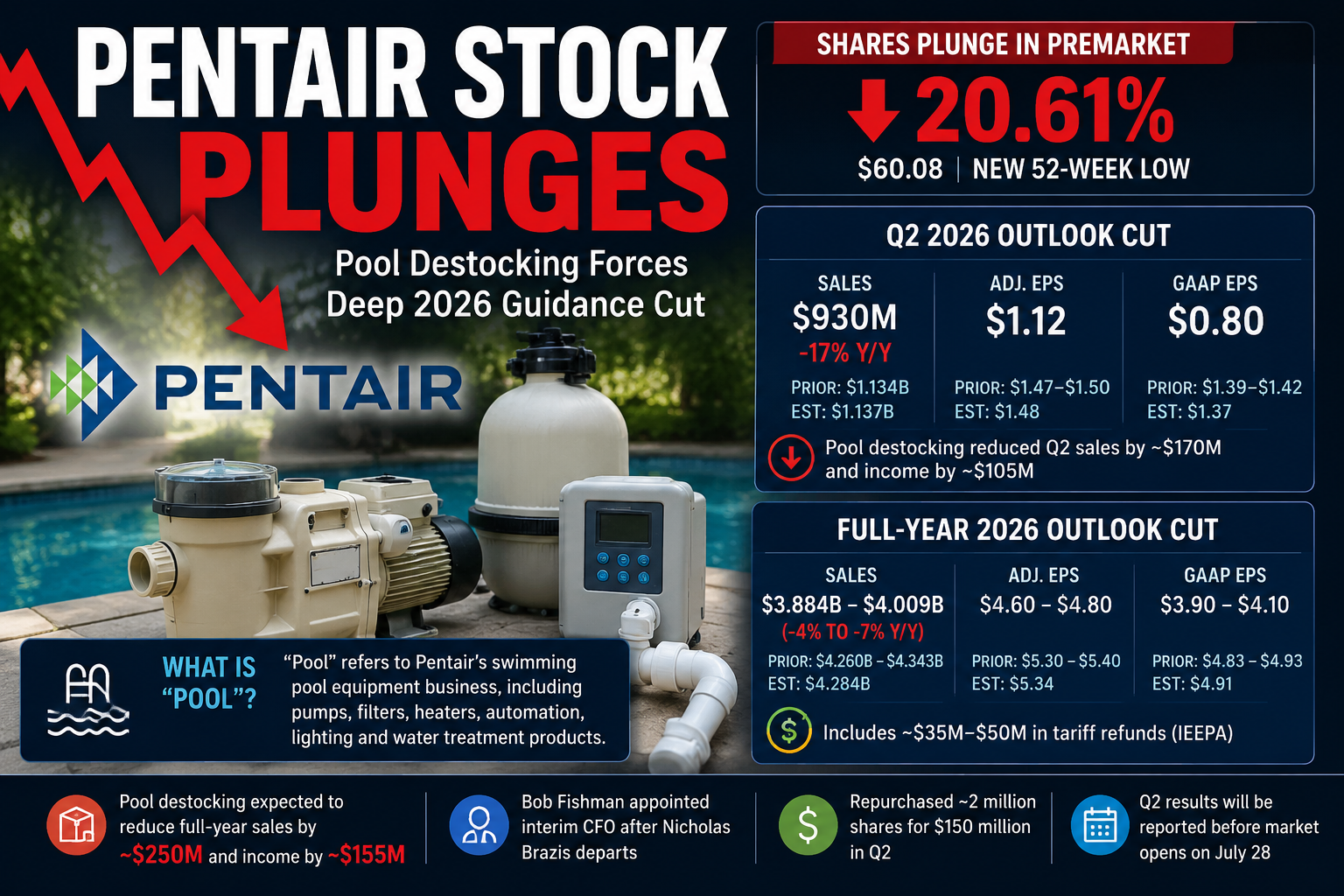
Pentair stock plunges more than 20% in premarket trading after the water treatment and pool equipment manufacturer dramatically cut its second-quarter and full-year 2026 guidance. The company blamed an unexpectedly severe reduction in inventory among swimming pool distributors and retailers, triggering one of its largest guidance resets in years.
The sharp decline sent shares to a new 52-week low as investors reacted to weaker sales expectations, lower earnings forecasts, and management’s warning that the recovery may not materialize until 2027.
Why Pentair Stock Plunges
Pentair now expects second-quarter sales of approximately $930 million, down 17% from a year ago and well below both Wall Street expectations and the company’s previous guidance.
Adjusted earnings per share are expected to come in around $1.12, missing analyst estimates by a wide margin.
The primary culprit is what management describes as a significant “Pool” channel destocking, which reduced second-quarter sales by approximately $170 million while lowering operating income by roughly $105 million.
What Does “Pool” Mean?
In Pentair’s earnings update, “Pool” refers to the company’s swimming pool equipment business, not a financial pool or investment fund.
Pentair manufactures products used in residential and commercial swimming pools, including:
- Pool pumps
- Filtration systems
- Pool heaters
- Automation and control systems
- Water treatment equipment
- Lighting and cleaning systems
The company’s products are sold primarily through distributors, wholesalers, pool builders, dealers, and retail partners.
Over the past several years, many of those distributors built unusually large inventories following pandemic-era supply shortages. As demand normalized and financing costs rose, distributors began aggressively reducing inventory levels rather than placing new orders with manufacturers such as Pentair.
This process—known as destocking—can significantly reduce manufacturer sales even if demand from homeowners remains relatively stable.
Pentair stock plunges
Pentair Cuts Full-Year Outlook
The weak second quarter prompted management to substantially lower its full-year forecast.
Pentair now expects:
- Revenue between $3.88 billion and $4.01 billion
- Adjusted EPS between $4.60 and $4.80
- GAAP EPS between $3.90 and $4.10
Those figures are significantly below both the company’s previous guidance and Wall Street consensus estimates.
Management estimates that destocking of pool inventory alone will reduce full-year sales by approximately $250 million and operating income by roughly $155 million.
The company also cited elevated interest rates and persistent inflation as additional headwinds affecting demand across the swimming pool market.
Tariff Refunds Offer Partial Offset
One bright spot in the updated guidance is an expected benefit from tariff refunds.
Pentair expects to receive between $35 million and $50 million related to tariffs previously collected under the International Emergency Economic Powers Act (IEEPA).
While those refunds help cushion some of the earnings impact, they are not enough to offset the sharp decline in pool-related sales.
CFO Transition Adds More Uncertainty
Alongside the guidance cut, Pentair announced a leadership change.
Former Chief Financial Officer Bob Fishman will return as interim CFO after Nicholas Brazis departed the company on July 10 to join a private business.
CEO John Stauch emphasized that management believes the inventory correction is temporary.
“We believe these headwinds are temporary and we are taking decisive actions to adapt the business to current demand levels while positioning it to return to normalized performance in 2027.”
Despite the weaker outlook, Pentair repurchased approximately 2 million shares during the second quarter for roughly $150 million, signaling confidence in the company’s longer-term prospects.
Trading Implications
Pentair stock plunges because investors are repricing expectations for earnings growth after management acknowledged that inventory normalization will take longer than previously expected.
For traders, the stock may remain volatile until investors gain confidence that distributor inventories have stabilized and order activity begins recovering.
While Pentair’s Flow and Water Solutions businesses continue performing largely in line with expectations, the swimming pool segment remains the company’s largest source of uncertainty.
Investors should closely monitor inventory commentary from pool equipment distributors, home improvement retailers, and residential construction trends over the coming quarters.
Bottom Line
Pentair stock plunges after the company sharply lowered its 2026 guidance due to a much larger-than-expected inventory correction in its swimming pool equipment business. Although management believes the weakness is temporary and expects conditions to normalize by 2027, investors are likely to remain cautious until distributor inventories stabilize and new orders begin to recover.
With shares now trading at fresh 52-week lows, upcoming earnings on July 28 will be closely watched for additional insight into the timing of that recovery and whether the worst of the inventory reset is finally behind the company.
TSLA Three-Layer Trade
TSLA Rejects $400: A Three-Layer Trade Using SpotGamma, Bookmap and Price Structure
Tesla pushed directly into the psychologically important $400 level on July 14, 2026, but the better opportunity was not chasing the breakout. The cleaner setup developed when TSLA failed to hold above $400, order flow stopped advancing and the five-minute chart confirmed that sellers had regained control.
This TSLA $400 rejection trade is a useful example of how traders can combine three different forms of information: an options-derived market map from SpotGamma, real-time liquidity and execution data from Bookmap, and a defined price-action trigger on the five-minute chart.
The three-layer framework: identify the important level, watch how orders behave as price reaches it, and wait for the chart to confirm the trade. The level creates context. Order flow provides evidence. Price structure supplies the trigger.
Layer One: SpotGamma Identified $400 as the Key Gamma Strike
Before TSLA tested the level, SpotGamma identified $400 as the Key Gamma Strike. That immediately made the area important. A gamma level is not an automatic buy or sell signal, but it can become a powerful reference point because options positioning may affect hedging activity, liquidity and the way price behaves around the strike.
The HIRO display showed call-related activity expanding as TSLA moved toward $400. The push was strong enough to carry the stock through the level briefly, but the key question was whether that flow could sustain higher prices. As price moved above $400 and the advance began to stall, the character of the trade changed from a possible breakout to a possible failed breakout.
 SpotGamma placed the Key Gamma Strike at $400. Call-driven activity helped propel TSLA into the level,
but price could not maintain the breakout.
Layer Two: Bookmap Revealed the Liquidity Waiting Overhead
The next layer came from Bookmap. The heatmap showed meaningful liquidity near $399 and $400. That visible supply mattered because TSLA was no longer moving through an open area. Buyers were pushing into a zone where larger resting offers were waiting.
A bright liquidity band does not guarantee a reversal. Orders can be pulled, absorbed or traded through. The important information was how price responded. TSLA repeatedly pushed into the overhead liquidity, but the auction did not continue cleanly higher. The stock rolled away from the offers and aggressive selling began to appear as the price dropped back toward the upper $398 area.
That behavior provided evidence that the breakout was not gaining acceptance. Buyers had reached the level, but they were not yet demonstrating the ability to clear it and hold above it.
 Bookmap showed substantial liquidity near $399 and $400. The failed push through that supply helped confirm
that the breakout was losing strength.
Layer Three: The Five-Minute Chart Supplied the Trigger
The five-minute chart completed the setup. TSLA reached approximately $400.26, but the move above $400 did not hold. Price then fell back beneath the nearby $399.08 reference level.
This is where a market opinion becomes a structured trade. The thesis was no longer simply that $400 looked expensive or that a round number might create resistance. The thesis was that TSLA had attempted a breakout, failed to gain acceptance above the Key Gamma Strike and then lost the price structure that had supported the advance.
A trader could use the break beneath $399.08, or a weak bounce that failed to reclaim it, as the short trigger. The chart then provided objective downside references at $397.23 and $396.08. If selling momentum continued, the lower levels near $394.97 and $393.70 offered additional reference points.
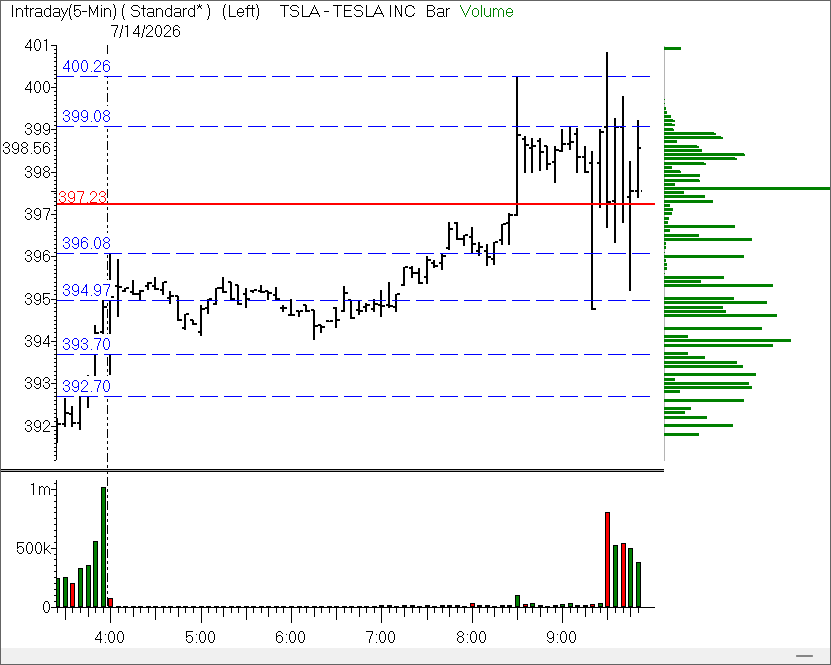 TSLA traded as high as $400.26, failed to hold the breakout and dropped back below $399.08.
The next marked support references were $397.23 and $396.08.
How the TSLA $400 Rejection Trade Could Be Structured
The trade can be organized around a clear sequence rather than a prediction:
- Context: TSLA approaches the $400 Key Gamma Strike after a strong intraday advance.
- Evidence: Bookmap shows meaningful offers near $399 and $400, and price fails to auction cleanly through them.
- Trigger: The breakout above $400 fails and TSLA loses the $399.08 chart level.
- Risk: A protective stop can be placed above the failed-breakout area, sized according to the trader’s predetermined risk limit.
- Targets: $397.23 becomes the first downside reference, followed by $396.08 if selling continues.
The precise entry and stop will vary with execution style. A faster trader may act as price breaks beneath the trigger. A more conservative trader may wait for a bounce that cannot reclaim $399.08. In either case, the trade should be defined before entry, including the maximum acceptable loss and the conditions that would invalidate the setup.
Why Blindly Shorting $400 Would Have Been the Wrong Process
It is tempting to assume that a stock should reverse simply because it reaches a large round number. That approach substitutes opinion for process. TSLA could have absorbed the liquidity at $400, held above the strike and accelerated higher. Traders who sold too early would have been exposed to exactly that possibility.
The higher-quality decision was to wait. First, allow price to reach the level. Next, observe whether buyers can clear the resting supply. Finally, require the five-minute chart to show that the attempted breakout has actually failed.
Do not short a stock merely because it has reached resistance. Wait for the market to show that the resistance is holding.
The Larger Trading Lesson: Confluence Is a Sequence
Traders often talk about confluence as if it were a collection of indicators appearing at the same time. In practice, the sequence is more important than the number of tools on the screen.
SpotGamma identified where the trade could matter. Bookmap showed what market participants were doing at that location. The five-minute chart identified when the trade became actionable. Each tool answered a different question:
- Where should we pay attention? The $400 Key Gamma Strike.
- What is happening there? Buyers are encountering substantial overhead liquidity and failing to sustain the auction higher.
- When is the setup confirmed? When price rejects the breakout and loses the supporting five-minute level.
This framework helps prevent anticipation, chasing and emotionally driven entries. It also creates a repeatable process that can be reviewed after the trade.
See These Opportunities Develop Live
Inside the TraderInsight War Room, we combine preplanned levels, real-time order flow and defined chart triggers to identify structured trading opportunities during the market session.
Educational disclaimer: This material is provided for educational purposes only and is not investment advice or a recommendation to buy or sell any security. Trading involves substantial risk, and past examples do not guarantee future results. Levels and observations discussed here reflect a specific intraday market environment and may change rapidly.