
Understanding Self-Efficacy and Why Believing You Can Execute Matters More Than Believing You’ll Win
Mental Insight explores the psychology, neuroscience, and behavioral science behind consistent performance under pressure. These articles explain why we think, learn, decide, and perform the way we do—and how understanding those processes can help us become more consistent in trading, work, relationships, and life.
“I know I can win.”
It sounds confident. It sounds positive. And in many performance environments, we are encouraged to believe that this is exactly the mindset we should cultivate.
But what happens when winning is not entirely under your control?
A trader cannot control what the market does after an entry. An athlete cannot control an opponent. A surgeon cannot control every biological variable. A salesperson cannot force a prospect to say yes.
This is where an important distinction in performance psychology emerges.
The most useful form of confidence may not be:
“I believe I will succeed.”
It may be:
“I believe I can execute what this situation requires of me.”
Psychologist Albert Bandura called this belief self-efficacy. It is not optimism, positive thinking, or a generalized belief that everything will work out. Self-efficacy is our belief in our capability to organize and carry out the actions required to manage a particular situation. Bandura’s landmark 1977 paper established self-efficacy as a central mechanism in behavioral change, and his later work placed it at the heart of human agency.
That distinction makes self-efficacy in trading especially interesting. A trader does not need to believe the next trade will win. The trader needs to believe they can prepare, make a sound decision, manage risk, execute the plan, tolerate uncertainty, and respond appropriately to whatever happens next.
Those are very different kinds of confidence.
The Science of Self-Efficacy
Albert Bandura introduced self-efficacy theory in 1977 as part of a broader effort to understand why people initiate behaviors, how much effort they invest, and whether they persist when circumstances become difficult. Rather than viewing people as simply responding to rewards and punishments, Bandura’s social cognitive perspective emphasized the active role people play in regulating their own behavior.
Self-efficacy is fundamentally task-specific.
Someone can have tremendous confidence in one area and very little in another. An accomplished attorney may feel highly efficacious walking into a courtroom but uncertain sitting down at a trading screen. An experienced trader may confidently manage a volatile position yet feel completely out of place giving a speech to 500 people.
That is why self-efficacy is different from simply saying, “I’m a confident person.”
The more useful question is:
Confident that I can do what?
Bandura proposed that efficacy beliefs influence whether people initiate challenging behaviors, how much effort they invest, how persistent they are when difficulties appear, and how they respond emotionally to demanding situations.
Later research has supported a meaningful relationship between self-efficacy and performance. A 1998 meta-analysis by Alexander Stajkovic and Fred Luthans examined 114 studies involving 21,616 participants and found a significant positive relationship between self-efficacy and work-related performance, with a weighted average correlation of .38. The strength of that relationship varied with factors including task complexity and research setting—an important reminder that self-efficacy is influential, not magical.
Self-Efficacy Is Not the Same as Confidence That You’ll Win
This distinction deserves some attention because it changes how we think about the “mental game.”
Imagine two traders approaching the market.
The first says:
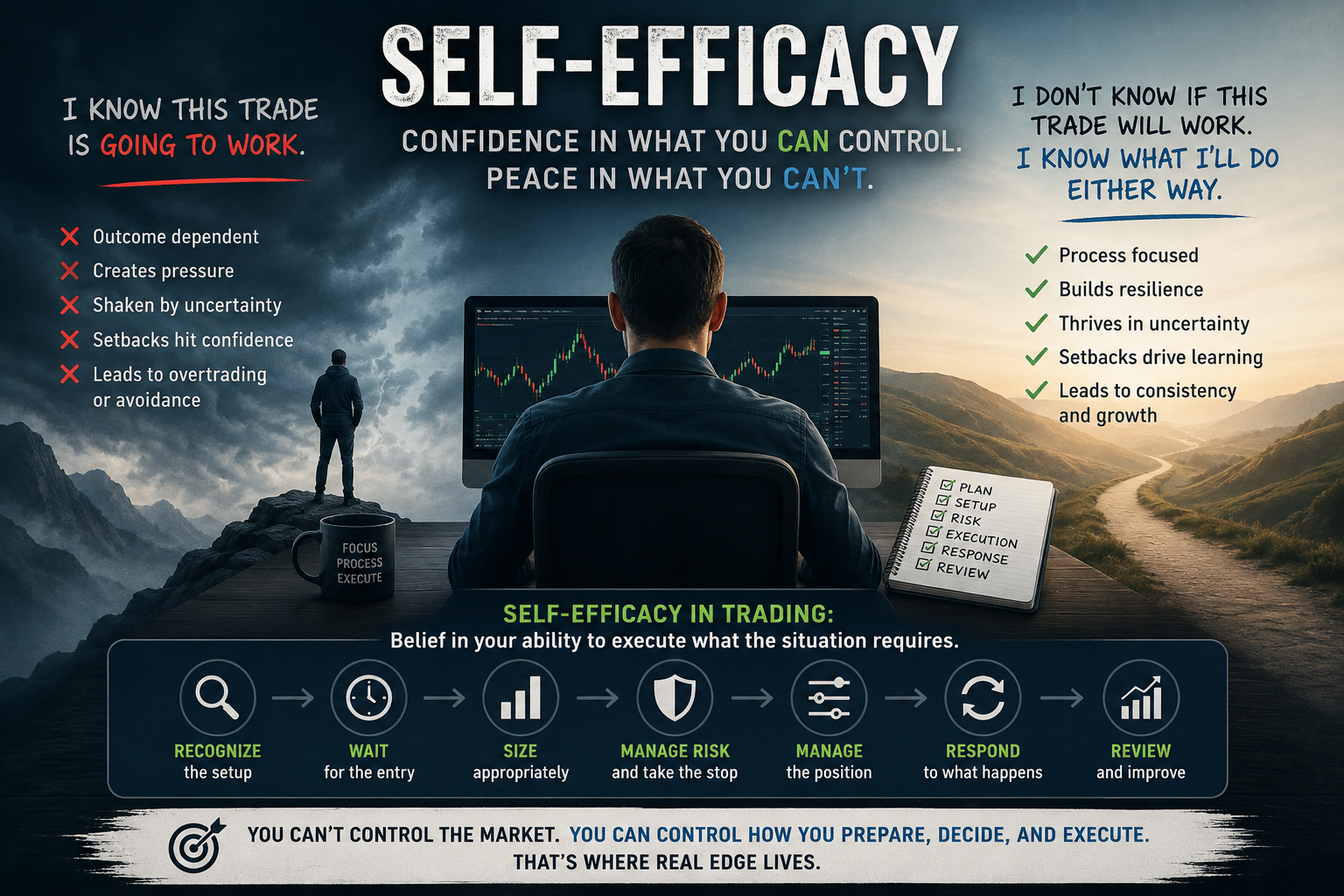
“I know this trade is going to work.”
The second says:
“I don’t know whether this trade will work. I know what I’ll do either way.”
Which trader is actually more psychologically prepared?
The first trader’s confidence depends upon predicting an outcome that is inherently uncertain. When the trade moves against them, confidence itself may begin to collapse.
The second trader has placed confidence somewhere much more stable: in their own capacity to respond.
They believe they can recognize the setup. They can wait for the entry. They can size the position appropriately. They can take the stop if necessary. They can manage a winner without becoming impulsive. And they can come back tomorrow regardless of what happens today.
That is self-efficacy in trading.
And it creates a very different relationship with uncertainty.
Why It Matters for Performance
When people believe they lack the capability to manage a situation, avoidance becomes tempting. Difficult tasks feel threatening. Setbacks become evidence that perhaps they “can’t do this,” and effort can decline precisely when persistence would be most useful.
When efficacy is stronger and appropriately calibrated, difficulty can carry a different meaning.
A setback becomes something to solve rather than proof of incapacity.
This does not mean high self-efficacy guarantees success. Nor does it mean more confidence is always better. Confidence that greatly exceeds actual skill can be dangerous. A novice trader who believes they can manage risk but repeatedly demonstrates that they cannot does not need more positive thinking.
They need greater competence—and more accurate self-assessment.
The goal is therefore not maximum self-efficacy.
It is earned and calibrated self-efficacy.
We want our belief in our ability to execute to increasingly reflect our demonstrated ability to execute.
Self-Efficacy in Trading
Trading provides an unusually revealing environment for studying self-efficacy because uncertainty and immediate feedback are unavoidable.
A trader with fragile efficacy may know a strategy perfectly well when studying it after hours but struggle to execute it when money is at risk. A losing streak may suddenly create hesitation. A missed trade may lead to chasing. A large winner may produce overconfidence and unnecessary risk.
This is why self-efficacy in trading cannot be built merely by studying more setups or telling yourself to “be confident.”
It has to be developed through successful execution.
Suppose your plan says that when a particular setup occurs, you will enter at a predetermined level, risk a defined amount, and exit if the setup is invalidated.
You execute it correctly.
The trade loses.
What did you just learn?
If confidence is tied to outcomes, you may have learned:
“Maybe I can’t do this.”
But if confidence is tied to execution, you have evidence of something completely different:
“I can follow my process even when the outcome is uncomfortable.”
That is a mastery experience.
And mastery experiences are central to how self-efficacy develops.
Where Self-Efficacy Comes From
Bandura described four major sources through which efficacy beliefs develop. These give us a remarkably useful framework for performance training.
| Source of Self-Efficacy | What It Means | Performance Application |
|---|---|---|
| Mastery Experiences | Successfully performing the behavior yourself | Practice and document correct execution—not merely wins |
| Vicarious Experience | Seeing comparable others perform successfully | Observe skilled performers and study how they handle difficulty |
| Verbal Persuasion | Credible encouragement, coaching, and feedback | Use specific, evidence-based feedback rather than empty praise |
| Physiological & Emotional States | How we interpret arousal, stress, fatigue, and emotion | Learn that activation under pressure does not automatically mean incapacity |
Of these, mastery experience is particularly important.
You build confidence in your ability to do something largely by accumulating evidence that you can actually do it.
That sounds obvious, but it has enormous implications for how we train.
The MPM Perspective: Build Evidence, Not Affirmations
Within the Manz Performance Model, self-efficacy gives us another reason to separate process from outcome.
If confidence rises and falls primarily with results, it becomes inherently unstable.
Win three trades and you feel brilliant.
Lose three and suddenly you question whether you belong in the market.
Neither conclusion may be warranted.
Instead, we can build confidence around capabilities that are much more under our control.
Can I prepare?
Can I recognize my setup?
Can I wait?
Can I execute?
Can I manage risk?
Can I take a loss without abandoning the next valid opportunity?
Can I review what happened accurately?
Every time the answer becomes yes, we create another piece of evidence supporting self-efficacy in trading.
This also fits beautifully with the larger MPM idea of agency.
Agency does not mean controlling the world around us. It means recognizing and strengthening our capacity to act effectively within it.
Self-efficacy is one of the psychological mechanisms that makes agency possible.
A Different Way to Build Confidence
Many people wait to feel confident before they act.
Self-efficacy suggests almost the opposite approach.
Action can create the evidence that produces confidence.
Start with a challenge you can execute successfully. Repeat it. Increase difficulty gradually. Review what worked. Learn from errors. Watch skilled performers. Seek accurate feedback. Practice responding to pressure rather than avoiding it.
Over time, you accumulate evidence.
I have handled this before.
I know how to do this.
I can tolerate this feeling.
I can recover from an error.
I can execute even when I’m uncertain.
That is much sturdier than telling yourself everything will turn out well.
The Confidence Ladder
One useful way to think about self-efficacy is as a ladder rather than a switch.
You do not need to jump directly from uncertainty to mastery.
| Step | The Evidence You’re Building |
|---|---|
| 1. Understand It | “I know what I’m supposed to do.” |
| 2. Practice It | “I can do it without much pressure.” |
| 3. Execute It | “I can do it in the real environment.” |
| 4. Repeat It | “I’ve demonstrated that I can do this consistently.” |
| 5. Recover | “I can still execute after something goes wrong.” |
That fifth level may be the most important.
True performance confidence is not believing nothing will go wrong.
It is knowing that when something does go wrong, you can respond effectively.
Putting It Into Practice
Think about an area in which you currently lack confidence.
Instead of asking, “How can I become more confident?” make the question more specific:
What capability am I uncertain I can execute?
Perhaps you do not trust yourself to take a stop. Maybe you hesitate to enter when the setup appears. Perhaps you struggle to speak clearly under pressure, have a difficult conversation, or stay composed after an error.
Now identify the smallest version of that behavior you can practice deliberately.
The objective is not to convince yourself that you are capable.
It is to create evidence that you are capable.
That distinction turns confidence from an emotion you hope to feel into a capability you can deliberately develop.
The Hidden Force
Self-efficacy influences what challenges we approach, how much effort we invest, and how persistent we remain when performance becomes difficult.
But the hidden force works both ways.
Low efficacy can cause us to withdraw before our actual ability has been tested. Inflated efficacy can encourage us to attempt things for which our skills are not yet sufficient.
The goal is not blind confidence.
The goal is calibrated confidence built from evidence.
One Thing to Think About
Think about something you currently wish you felt more confident doing.
Now change the question.
Instead of:
“How can I feel more confident?”
ask:
“What evidence would convince me that I can execute this?”
That question leads somewhere very different.
Performance Challenge: Build an Evidence Log
For the next seven days, stop recording only outcomes.
Record one piece of evidence each day that demonstrates a capability you want to strengthen.
For a trader, it might be: “I waited for my setup instead of chasing.” “I honored my stop.” “I passed on a trade that did not meet my criteria.” “I returned to the plan after a loss.”
For another performer, it might be successfully handling a difficult conversation, finishing a practice session despite frustration, asking for feedback, or staying composed after making an error.
At the end of the week, review the list.
Do not ask:
How many times did I win?
Ask:
What have I now demonstrated that I can do?
That is the beginning of earned self-efficacy.
Julie’s Book Corner
Self-Efficacy: The Exercise of Control
Albert Bandura
For readers who want to go beyond popular treatments of confidence and understand the psychological theory itself, Bandura’s work is foundational. His research connects self-efficacy to human agency, motivation, persistence, learning, and behavior across a remarkable range of situations.
For a more accessible companion book, we could also use something like The Confidence Code or another mainstream title, but for the Mental Insight library I actually like having Bandura here. It signals that this series is rooted in the original psychological science rather than simply repackaging “mindset” advice.
Julie’s Toolbox
The Self-Efficacy Evidence Log
For this article, I wouldn’t recommend a generic journal.
I’d give readers a specific MPM exercise they can reproduce on a single page.
Create four columns:
| Situation | What I Needed to Execute | What I Actually Did | Evidence I Can Carry Forward |
|---|---|---|---|
| Trade moved toward my stop | Follow risk plan | Exited where planned | I can accept a planned loss |
| Missed an entry | Avoid chasing | Waited for another setup | I can tolerate missing out |
| Difficult feedback | Stay curious | Asked questions before responding | I can remain open under pressure |
The final column is the important one.
You are deliberately creating a record of mastery experiences.
Over time, instead of confidence depending on how you happen to feel that morning, you have a body of evidence showing what you have repeatedly demonstrated you can do.
The Science Behind the Insight
Albert Bandura’s foundational 1977 paper, Self-Efficacy: Toward a Unifying Theory of Behavioral Change, proposed that people’s beliefs about their ability to execute necessary behaviors play a central role in behavioral change. His later work expanded self-efficacy into a broader theory of human agency—the idea that people are active contributors to their actions and development rather than simply passive recipients of environmental forces.
The relationship is not limited to laboratory studies. Stajkovic and Luthans’ 1998 meta-analysis synthesized 114 studies, 157 effect estimates, and 21,616 participants and reported a weighted average correlation of .38 between self-efficacy and work-related performance. They also found meaningful variation depending on characteristics such as task complexity and whether performance occurred in laboratory or field settings.
References
Bandura, A. (1977). Self-efficacy: Toward a unifying theory of behavioral change. Psychological Review, 84(2), 191–215.
Bandura, A. (1982). Self-efficacy mechanism in human agency. American Psychologist, 37(2), 122–147.
Stajkovic, A. D., & Luthans, F. (1998). Self-efficacy and work-related performance: A meta-analysis. Psychological Bulletin, 124(2), 240–261.
Final Thought
There is a profound difference between believing you will win and believing you can perform.
The first depends partly on circumstances you cannot control.
The second can be built.
Through preparation. Practice. Repetition. Feedback. Recovery. And accumulated evidence that you can do what the situation requires—even when the situation becomes uncomfortable.
That may be one of the most useful forms of confidence an elite performer can develop.
Because the strongest performer does not walk into an uncertain situation thinking:
“I know how this will turn out.”
They walk in knowing:
“Whatever happens, I know what I need to do next.”