
Meta AI Glasses Raise Privacy Concerns as “Super Sensing” Prototype Advances
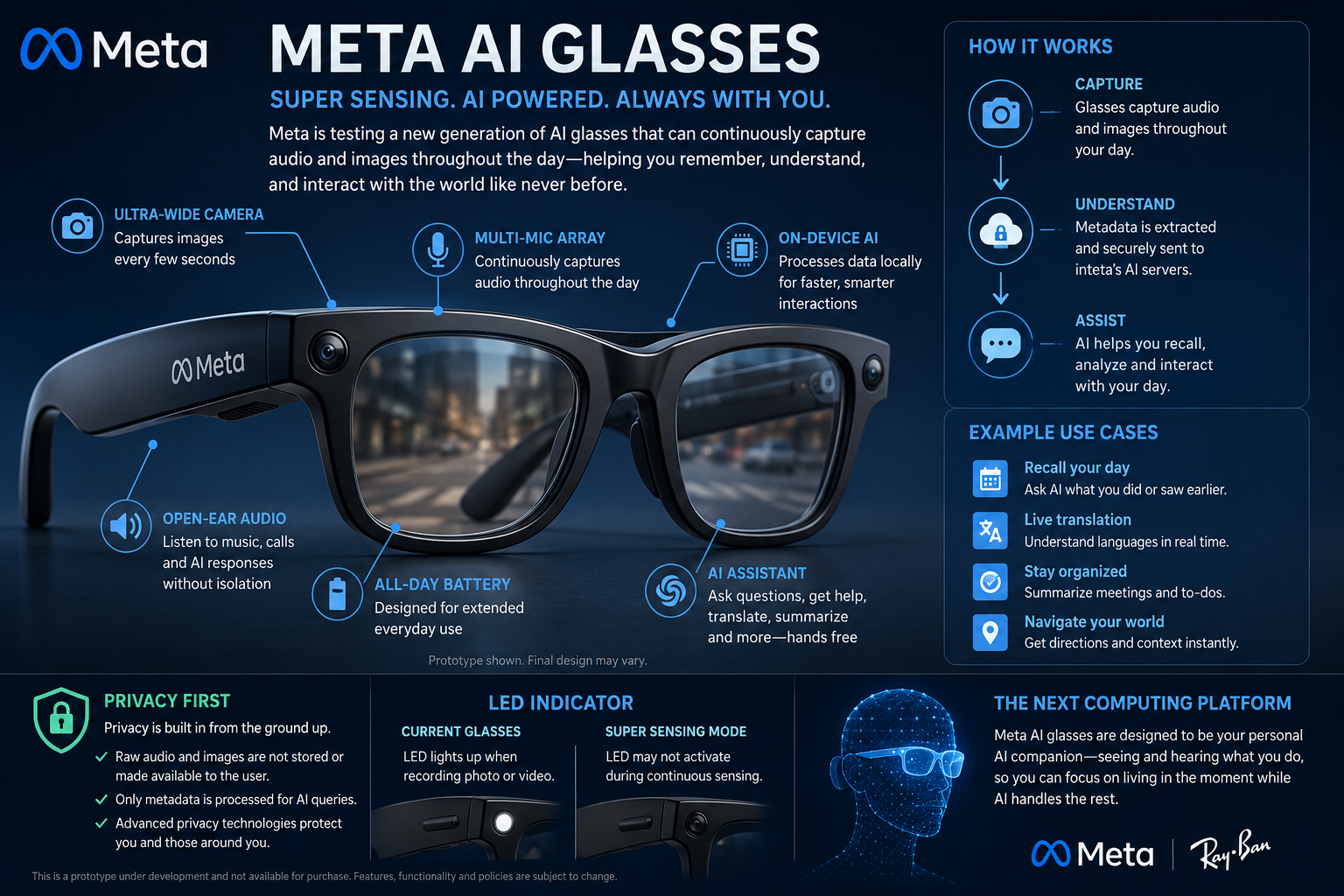
Meta is testing a new prototype of Meta AI glasses that could continuously capture audio and take photos every few seconds, creating a powerful but controversial vision for the future of wearable artificial intelligence.
The proposed “super sensing” glasses would allow users to query their day, recall what they saw or heard, and interact with AI in a more personal, always-available format. But the same features that could make the product useful also create serious privacy, legal, and regulatory questions.
Meta AI Glasses Move Toward Always-On Recording
The next generation of Meta AI glasses could go well beyond today’s Ray-Ban smart glasses. Current models allow users to take photos, record videos, listen to audio, and ask AI questions about the world around them.
The new prototype reportedly goes further by continuously collecting audio and periodically capturing images throughout the day. Users could then ask the AI to help remember conversations, identify what they saw, summarize their activities, or retrieve information from earlier moments.
For Meta, the opportunity is clear: if AI glasses become a daily-use device, they could eventually challenge the smartphone as the primary way users interact with AI.
Privacy Concerns Could Become the Central Issue
The biggest challenge for Meta AI glasses may not be the technology. It may be public acceptance.
Meta’s existing glasses include an LED indicator that lights up when a user takes a photo or records video. However, internal discussions have reportedly included plans not to activate that LED during some super-sensing features.
That could make it difficult for bystanders to know when they are being recorded or analyzed by an AI-powered device.
This issue matters because wearable AI does not only collect information from the person wearing the device. It may also capture voices, faces, locations, conversations, and behaviors of people who never agreed to participate.
Meta’s Data Strategy Faces Scrutiny
Meta has discussed systems in which raw audio and images would not be stored or made directly available to the user. Instead, metadata could be extracted and uploaded so Meta’s AI systems could process and answer questions based on the wearer’s experience.
That may reduce some privacy risks, but it does not eliminate them.
Important questions remain:
- What data is collected?
- How long is it retained?
- Can it be used to train AI models?
- Can bystanders opt out?
- Who is responsible if recording laws are violated?
These questions could become increasingly important if Meta AI glasses move from prototype to consumer product.
Legal and Regulatory Risks Are Building
Always-on wearable devices could face major legal challenges.
In several U.S. states, recording audio without the consent of all parties may violate wiretapping laws. Privacy experts have also raised concerns about biometric data, facial recognition, data collection, and the rights of people who are captured by smart glasses without knowing it.
Regulators may eventually need to decide whether AI wearables should be treated like cameras, smartphones, surveillance tools, biometric devices, or something entirely new.
That uncertainty creates both product risk and headline risk for Meta.
Why Meta Is Pushing Into AI Wearables
Meta has shifted away from its costly metaverse-first strategy and toward AI-powered hardware that may have broader consumer appeal.
The company’s Ray-Ban smart glasses, built in partnership with EssilorLuxottica, have been one of Meta’s more successful hardware efforts. Newer versions include cameras, speakers, AI features, and even display capabilities.
CEO Mark Zuckerberg has repeatedly suggested that glasses could become the next major computing platform, giving users an AI assistant that is available throughout the day.
If that vision works, Meta AI glasses could become a major new product category.
Trading Implications
Meta Platforms (NASDAQ: META)
For traders, this story cuts both ways.
The bullish case is that Meta continues to build one of the most ambitious consumer AI hardware platforms in the market. If smart glasses gain traction, Meta could create a new ecosystem around AI assistants, wearables, advertising, and personal data-driven services.
The bearish risk is that privacy controversy could slow adoption, invite regulatory scrutiny, or create reputational damage.
Key trading considerations include:
- Watch for regulatory headlines tied to AI wearables and privacy laws.
- Monitor consumer adoption trends for Ray-Ban Meta glasses.
- Track whether hardware spending improves sentiment or raises cost concerns.
- Watch for competition from Apple, Google, OpenAI partners, and other wearable AI platforms.
- Pay attention to any disclosures around AI training data and privacy safeguards.
Sector Impact
The broader AI wearable theme may also affect companies tied to sensors, optics, edge AI chips, audio processing, augmented reality, and privacy compliance technology.
Potential beneficiaries could include semiconductor suppliers, lens partners, display technology companies, and firms building low-power AI processing components.
At the same time, any major backlash against always-on devices could pressure the entire wearable AI category.
Bottom Line
Meta AI glasses represent one of the clearest examples of where artificial intelligence may be heading: away from screens and into always-available personal devices.
That could create a major new growth opportunity for Meta. But it also introduces a difficult question for consumers, regulators, and investors: how much continuous sensing will people accept in daily life?
For traders, the opportunity is real, but so is the risk. The market will likely reward evidence of strong adoption, but privacy headlines, legal challenges, or regulatory action could quickly become volatility catalysts for META stock.