
Physical Insight
The Trader’s Performance Edge with Dr. Julie Manz
Because the most important edge you will ever develop is not in the market. It is in yourself.
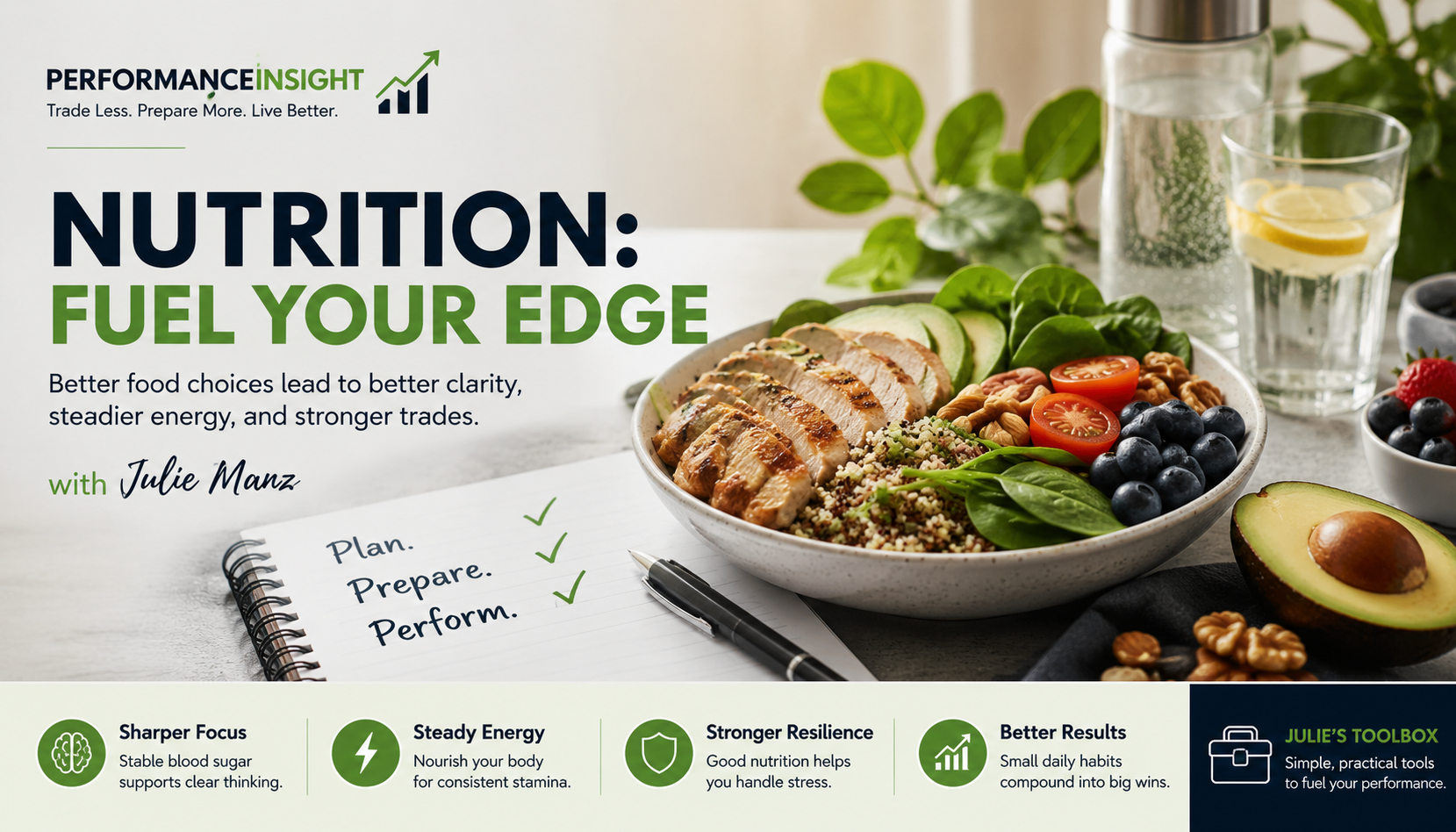
I am going to start this one with a disclaimer.
I am not going to tell you that there is one perfect diet for traders. I am not going to tell you that you need to eliminate carbohydrates, live on protein, become vegan, count every calorie, fast until noon, or follow whatever nutrition trend happens to be popular this month.
That is not the point.
The point is much simpler.
Trading is a cognitive performance activity, and the brain doing that work needs to be fueled.
We spend enormous amounts of time thinking about entries, stops, targets, volatility, position size and risk. But every one of those decisions is being made by a biological system.
That system can be rested or exhausted, hydrated or dehydrated, steady or distracted, comfortable or hungry, calmly alert or overstimulated. And those conditions can affect the way we perform.
That is why nutrition belongs in the Manz Performance Model.
The Performance Connection: You Are Trading With a Brain, Not Just a Strategy
One of the easiest mistakes to make in trading is to think of performance as something that happens entirely on the screen. It does not.
The charts provide the information. Your trading plan provides the framework. But your brain still has to interpret what is happening and decide what to do.
Should I enter? Should I wait? Is that breakout legitimate? Am I seeing confirmation or just seeing what I want to see? Should I take the stop? Should I hold for the target? Should I trade this at all?
During an active session, your brain is constantly processing information, recalling prior experience, evaluating risk and regulating emotion. That requires energy. And although the brain represents only a relatively small portion of total body weight, it is metabolically demanding.
In other words, the brain is expensive equipment to run.
So when we talk about nutrition for trading performance, we are really talking about creating better conditions for the system responsible for every decision we make.
The Hidden Performance Drain: Unstable Energy
The market already provides enough volatility. We do not necessarily need our bodies contributing more.
Most of us have experienced what it feels like to become hungry, tired or sluggish during the middle of a demanding workday. Patience gets a little thinner, concentration becomes harder, and we become more easily distracted. Small frustrations feel larger than they should.
In trading, those seemingly minor changes can matter.
You may chase something you would normally wait for. You may exit a trade simply because you are uncomfortable. You may take another setup because you are bored. Or you may stay at the screen long after the quality of your decision-making has started to decline.
None of this means that eating the “right” breakfast is going to make someone profitable. It means that physical instability can become another source of cognitive strain in an environment that already demands a great deal from us.
And if some of that strain can be reduced through better preparation, why would we ignore it?
The Trading Day Starts Before the Opening Bell
A lot of traders think about breakfast in one of two ways. Either they eat whatever is fastest before the market opens, or they skip it entirely because they are too busy preparing.
A better question may be:
What helps me feel mentally sharp, physically comfortable, and reasonably steady through the most demanding part of my trading day?
The answer will not be identical for everyone. Some people genuinely perform well eating early. Others feel better with something lighter. Some tolerate larger breakfasts easily, while others feel sluggish afterward.
The useful part is not copying someone else’s routine. It is learning your own.
Meals that include protein, fiber, healthy fats and minimally processed carbohydrates often provide a different experience than something built almost entirely around sugar or refined carbohydrates. That does not mean breakfast needs to become complicated.
Eggs and whole-grain toast. Greek yogurt with berries and nuts. Oatmeal with added protein. A smoothie with fruit, yogurt and greens.
The exact food matters less than the response.
Do you feel alert? Are you satisfied? Are you thinking about food again 45 minutes later? Do you crash halfway through the morning?
Those are performance questions.
Your Body Gives You Data Too
Traders love data. We track price, volume, volatility, win rates, average excursion, risk-to-reward, time of day, and market regime.
And yet we often ignore an entire source of performance data sitting right in front of us: how we feel.
Not in a vague emotional sense, but in observable physical patterns.
What did you eat? How was your energy two hours later? Were you hungry during the opening session? Did you feel sharp after lunch or half asleep? Did three cups of coffee make you more focused—or just more anxious? Did you snack because you were hungry or because the market was slow?
Those patterns are worth noticing.
You do not need a sophisticated nutrition app to start. A few notes over several trading days may be enough to reveal that certain routines reliably work better for you than others. That is exactly the kind of feedback loop we encourage everywhere else in trading.
Hydration Is a Performance Variable Too
Hydration is one of the simplest performance habits to overlook.
The opening bell rings. Something starts moving. You get involved in a trade. Another setup appears. You are staring at Bookmap, charts, news, alerts and everything else in front of you.
Then suddenly it is noon and the only thing you have consumed since 7:30 is coffee.
The easiest solution is often not motivation—it is environment.
Keep water beside the trading station. Make the behavior automatic. A large bottle within reach requires almost no thought, and that matters because the fewer decisions we attach to basic health behaviors, the more likely we are to repeat them.
Caffeine is another variable worth observing. Coffee can absolutely be part of a normal routine, but it is worth paying attention to what it does to you. Does it create calm alertness, or does it make you restless, impatient and reactive? More stimulation is not always better performance.
The Screen-Side Snack Trap
Trading creates a very particular kind of eating.
Sometimes we are not hungry—we are waiting. Waiting for a level, waiting for confirmation, waiting for the next setup, waiting for the market to do something interesting. And food becomes something to do while we wait.
The brain does not love uncertainty. It wants stimulation, reward or relief. Food can provide all three very quickly.
That does not make snacking bad, but it does make mindless snacking worth noticing. One simple solution is deciding what you will snack on before the session begins: fruit, Greek yogurt, cottage cheese, vegetables and hummus, nuts, or a protein bar.
The key is that the decision is intentional rather than reactive. The goal is not restriction. It is awareness.
Food Can Become an Emotional Trade Too
Stress changes behavior. Sometimes it suppresses appetite, sometimes it increases it.
A difficult trading session can make highly palatable food suddenly feel very appealing. That is normal—food is tied to comfort and reward. The question is whether we are actually hungry or trying to change how we feel.
That distinction should sound familiar to traders. After a losing trade, we sometimes feel pressure to take another trade immediately—not because the opportunity is good, but because we want relief. Eating can serve a similar emotional function. Neither response makes us weak. It simply means the brain is trying to reduce discomfort.
A useful skill is learning to insert a pause. Stand up. Drink water. Walk away from the screens. Give yourself five minutes.
Then ask: What do I actually need right now?
That separation between impulse and action is a recurring theme throughout the Manz Performance Model.
Lunch Can Change the Afternoon
Almost everyone has experienced the large-lunch problem. You eat too much, return to the screen, and suddenly staying awake feels like a performance skill. Then comes the predictable solution: more coffee.
This does not require complicated rules. It requires attention.
Which lunches leave you steady and focused? Which leave you sluggish? Which foods support stable energy? Which make the afternoon harder?
The body is constantly giving feedback. A strong performer learns to use it.
What This Looks Like for Us
Adrian and I try to keep nutrition practical.
Trading mornings are busy, and preparation begins early. So the more we can prepare in advance, the easier everything becomes.
Having breakfast figured out, keeping snacks available, filling the water bottle, and knowing roughly what lunch will be—these are small things, but each removes a decision during the part of the day when attention should be on the market.
After the first hour and a half of trading, we usually take a walk with the dog. That break creates a chance to check in:
Am I hungry? Am I thirsty? Am I tired? Am I stressed? Or am I just carrying the morning session with me? The more accurately we can answer those questions, the less likely we are to react automatically.
Good nutrition, like good trading, is not one dramatic decision. It is many small decisions made a little more deliberately.
The Performance Loop
Nutrition does not operate alone. It interacts with everything else.
Sleep affects hunger and energy. Exercise affects stress, recovery and metabolic health. Nutrition supplies the resources both systems rely on. Together, they shape how we feel when we sit down to perform.
So the relationship is not: Eat well → trade profitably.
It is closer to: Better fueling → more stable physical state → better focus and emotional regulation → better execution.
Nutrition for trading performance does not directly create a trading edge. But it can support the person who has to execute one.
Julie’s Performance Challenge
For the next five trading days, decide what you will eat and drink during the first half of the day before the market opens.
Nothing extreme.
Prepare breakfast or know what you will have. Fill your water bottle. Choose a snack ahead of time.
Then observe:
How steady is your energy? How distracted are you by hunger? How much caffeine are you using? How calm do you feel during the busiest part of the session? How do you feel after lunch?
You may also rate yourself from 1 to 10 on:
Energy
Focus
Patience
Do not try to prove anything. Just collect information. Treat yourself like a trading strategy: observe, look for patterns, then adjust.
Julie’s Toolbox
Every elite performer has tools that make good habits easier. These are not requirements. They simply reduce friction.
Insulated Stainless Steel Water Bottle
Hydration is easier when water is already beside you. A durable insulated bottle can be filled before the session and kept within reach to supply the nutrition for trading performance. Simple usually wins.
View Julie’s water-bottle suggestion on Amazon
Meal-Preparation Containers
Preparing food in advance removes decision-making during the trading day. Glass containers make it easy to store meals, snacks, fruit, vegetables, and protein.
View Julie’s meal-prep suggestion on Amazon
Protein Bars
Useful as a backup when the market is active to supply nutrition for trading performance. Look for meaningful protein and fiber rather than candy-bar nutrition in disguise.
View Julie’s protein-bar suggestion on Amazon
High-Speed Blender
Makes quick breakfasts easier. Smoothies can be adapted with fruit, greens, yogurt, milk, or protein sources.
View Julie’s blender suggestion on Amazon
Disclosure: Some links may be affiliate links. TraderInsight may earn a small commission at no additional cost to you.
Julie’s Book Corner
How Not to Die** by Michael Greger, M.D.**
This book encourages readers to think about nutrition through research rather than trends. Dr. Greger translates a large body of studies into practical insights. You do not need to follow everything to benefit from thinking more carefully about nutrition, health, and nutrition for trading performance.
The Science Behind the Insight
Nutrition does not make someone a better trader directly. It shapes the physical environment in which cognitive performance occurs.
Eating patterns influence energy, hunger, and comfort. Hydration supports normal cognitive function. Macronutrients and micronutrients support the biological systems that keep the brain and body functioning.
Nutrition also interacts with sleep, exercise, stress, and long-term health.
The key takeaway is simple:
The quality of our decisions is influenced by the condition in which we make them. Nutrition is one of the variables we can control.
One Thing to Think About
Professional athletes do not separate nutrition from performance. Preparation happens everywhere, not just during competition.
Traders should consider the same idea. Every decision you make depends on the condition of the brain making it.
We protect trading capital carefully. Perhaps we should also protect the system managing it.
One Final Thought
Traders often search for an edge by adding complexity: more indicators, more data, more screens.
But performance is not always improved by addition. Sometimes it improves by removing friction.
Hunger is friction. Dehydration is friction. Energy crashes are friction. Mindless eating is friction. Excess caffeine used to compensate for fatigue is friction.
None of these determines whether a trade works, but each affects the condition of the trader. Nutrition is not about finding a perfect diet. It is about creating a stable platform for decision-making.
Sleep prepares the brain. Exercise builds and regulates the performer. Nutrition fuels the system. Together, they form the physical foundation of consistent performance.
The market measures the result—but the performer arrives already prepared or already compromised. That begins long before the opening bell.
Until next time, trade well, think clearly, and take care of the performer behind the performance.
— Dr. Julie Manz
Physical Insight
Part of the Manz Performance Model Library