
Nvidia and Wall Street Team Up on $500 Billion AI Infrastructure Push: Trading Ideas and Stocks to Watch
Nvidia AI infrastructure financing: The artificial intelligence boom is entering a new phase, and this one may be as much about Wall Street as Silicon Valley.
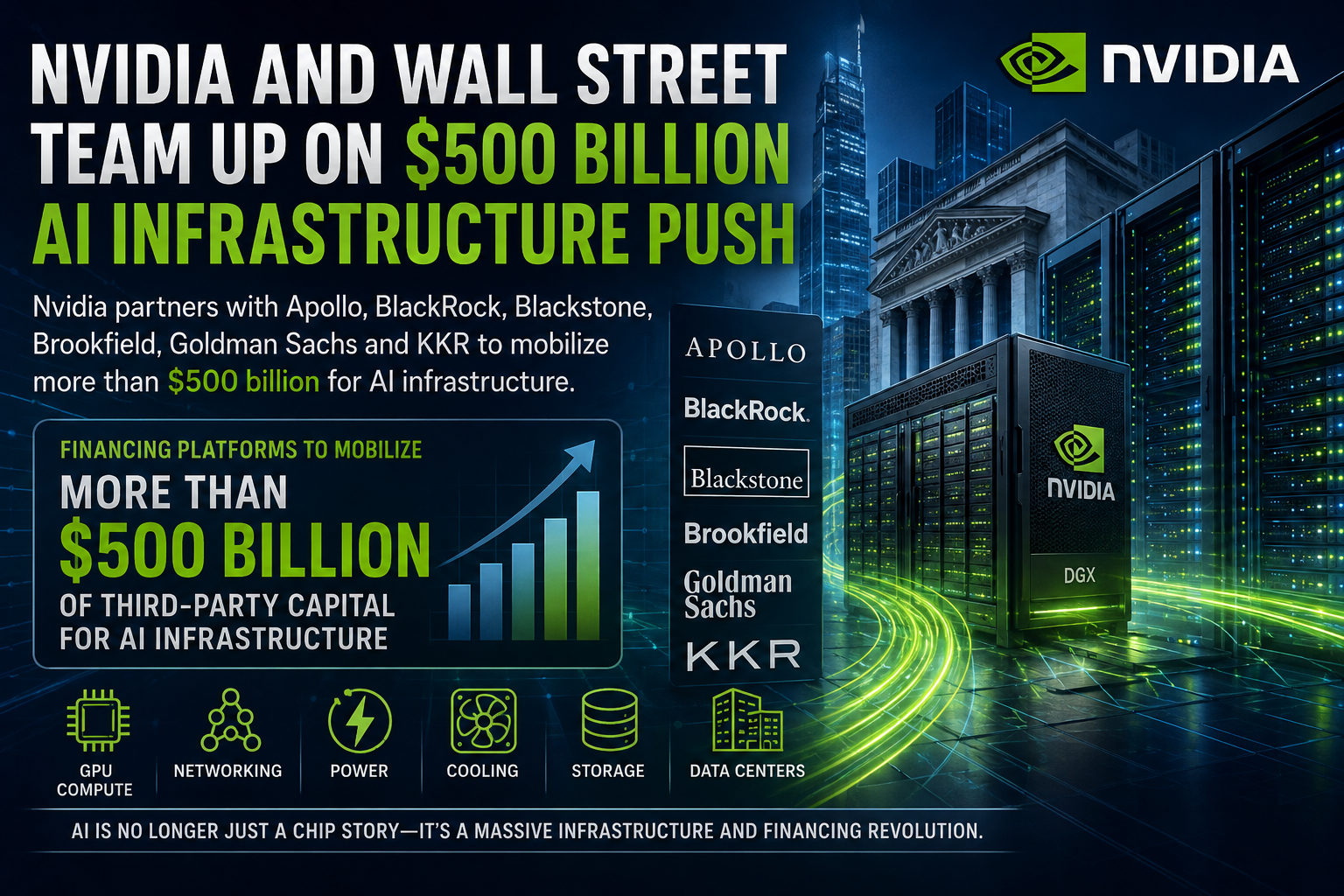
Nvidia is partnering with Apollo Global Management, BlackRock, Blackstone, Brookfield Asset Management, Goldman Sachs and KKR to establish financing platforms designed to mobilize more than $500 billion of third-party capital for AI computing infrastructure.
The size of the initiative is extraordinary. But the bigger story may be what it tells us about the evolution of artificial intelligence.
AI is no longer simply a semiconductor story. It is becoming one of the largest infrastructure construction and financing projects in modern history.
For traders, Nvidia AI infrastructure financing potentially expands the opportunity well beyond NVDA into networking, power generation, electrical equipment, data centers, memory, construction and even the publicly traded private-capital companies helping finance the buildout.
Key Takeaways
- Nvidia and six major financial institutions are creating platforms intended to mobilize more than $500 billion for AI infrastructure.
- The initiative highlights how rapidly AI has evolved from a chip cycle into a massive physical infrastructure buildout.
- Nvidia could benefit by making it easier for customers to finance purchases of Nvidia GPUs, networking equipment and complete AI systems.
- Power availability, networking, cooling and financing are becoming nearly as important as access to GPUs.
- Potential trading beneficiaries extend beyond Nvidia to semiconductors, memory, networking, power, electrical infrastructure, data centers and alternative asset managers.
- The growing use of debt and private capital also introduces risks if AI infrastructure eventually fails to produce adequate economic returns.
Nvidia Is Moving Beyond Selling Chips
Nvidia built its position at the center of the AI boom by supplying the graphics processors used to train and operate many of the world’s most advanced artificial intelligence models.
But selling GPUs is increasingly only part of the story.
The next generation of AI requires enormous computing campuses containing GPUs, memory, high-speed networking, cooling systems and electrical infrastructure. Those facilities require billions—and in some cases potentially tens of billions—of dollars before they begin generating meaningful revenue.
That creates a new problem for the industry:
Who is going to finance all of it?
The new Nvidia AI infrastructure financing initiative provides part of the answer.
By working with Apollo, BlackRock, Blackstone, Brookfield, Goldman Sachs and KKR, Nvidia is helping connect AI developers and infrastructure operators with some of the deepest pools of institutional capital in the world.
AI Is Becoming an Infrastructure Asset Class
This may be one of the most important developments in the AI boom.
Data centers are increasingly beginning to resemble traditional infrastructure projects rather than ordinary technology purchases.
They require:
- Land
- Gigawatts of electricity
- Transmission infrastructure
- Cooling systems
- Thousands of advanced GPUs
- High-bandwidth networking
- Memory and storage
- Backup power
- Long-term financing
Wall Street already knows how to finance enormous infrastructure projects such as pipelines, utilities, airports, telecommunications networks and energy facilities.
The Nvidia partnership suggests that AI computing capacity may increasingly be financed in much the same way.
Pension funds, insurance companies, private credit funds and institutional investors could ultimately provide the capital that allows AI developers to build computing capacity without carrying the entire cost on their own balance sheets.
The Numbers Are Getting Enormous
The $500 billion headline sounds staggering until it is placed against the projected size of the broader AI infrastructure cycle.
Morgan Stanley estimates approximately $2.9 trillion of global data-center capital spending between 2025 and 2028.
The firm estimates roughly $1.4 trillion could be funded by hyperscaler cash flows, with additional capital coming from corporate debt, securitized credit, private credit and joint-venture financing.
Morgan Stanley has also raised its expectations for capital spending by major hyperscale technology companies to approximately $800 billion in 2026 and roughly $1.16 trillion in 2027.
Those numbers illustrate an important transition.
AI has become a capital spending story.
And increasingly, it is becoming a credit-market story.
Nvidia Could Benefit Twice
The structure potentially creates a powerful economic loop for Nvidia.
First, Nvidia supplies the processors, networking equipment and software used inside AI computing systems.
Then, through Nvidia AI infrastructure financing, the company can help create financing pathways allowing customers to build even larger Nvidia-powered systems.
Think about the cycle:
Capital becomes available → AI data centers get built → GPUs and networking equipment are purchased → Nvidia revenue increases → additional infrastructure becomes financeable.
That could dramatically expand the amount of computing infrastructure customers are able to purchase.
It also positions Nvidia as something more significant than a semiconductor manufacturer.
The company increasingly appears to be building an ecosystem around the entire AI factory—from chips and networking to software and now potentially financing.
The Biggest Constraint May Become Power
Money may not ultimately be the hardest part of the AI buildout.
Electricity increasingly looks like one of the industry’s most important bottlenecks.
Morgan Stanley has warned that power constraints could become particularly significant around 2027 and 2028 as data-center construction collides with years of underinvestment in portions of the electrical grid.
That is pushing hyperscalers and developers toward what Morgan Stanley describes as a “time-to-power” strategy: finding whichever energy solution allows a data center to begin operating fastest.
That could include:
- Natural gas generation
- Nuclear power
- Microgrids
- Battery storage
- On-site generation
- Renewable energy
- Grid expansion
This is one reason the AI trade keeps expanding into industries that initially appeared unrelated to artificial intelligence.
The Risk: Circular AI Financing
There is another side to the story.
The financing ecosystem can accelerate demand, but it can also increase financial concentration.
Imagine this simplified cycle:
Nvidia or its financial partners help finance an AI infrastructure project.
The project uses that financing to purchase Nvidia GPUs.
Nvidia reports higher revenue because more GPUs were purchased.
Those revenues reinforce expectations of continued AI growth.
Additional financing becomes available for another project.
There is nothing inherently wrong with that structure. Vendor financing and project financing have existed for decades.
But the arrangement makes the ultimate economic return generated by AI increasingly important.
If businesses are able to monetize the computing capacity, the system can continue expanding.
If returns disappoint, however, investors could discover that chip companies, AI developers, lenders and infrastructure owners are all exposed to variations of the same underlying risk.
The Question Is Changing From “How Much AI?” to “What Is the Return?”
For several years, investors primarily asked one question:
How much are companies spending on AI?
The next question may be more important:
How much money are they making from that spending?
As AI capital expenditures move into the trillions of dollars, Wall Street is likely to pay closer attention to return on invested capital.
That means traders should monitor not only Nvidia’s revenue but also the financial performance of companies operating the infrastructure.
Utilization rates, AI revenue growth, financing costs and power expenses could become increasingly important market catalysts.
Trading Ideas: How to Play the AI Infrastructure Buildout
The most interesting aspect of Nvidia AI infrastructure financing for active traders may be the number of secondary opportunities it creates.
Rather than viewing every AI headline strictly as an NVDA trade, traders can begin building a broader AI infrastructure watchlist.
1. Nvidia — NVDA
Nvidia remains the primary trading vehicle.
Major infrastructure announcements can directly affect expectations for future GPU demand. NVDA should remain the first chart traders watch when major AI capital-spending news hits the tape.
For intraday traders, watch for reactions around the opening range, prior-day highs and lows, VWAP and major volume-by-price levels after significant AI infrastructure announcements.
A particularly important signal will be whether NVDA can hold gains generated by infrastructure headlines. Failure to hold good news may signal that investors are beginning to focus more heavily on financing risk and future returns.
2. Broadcom — AVGO
AI data centers require much more than GPUs.
Broadcom has become one of the major beneficiaries of high-speed AI networking and custom accelerators.
When data-center spending expectations increase, AVGO can offer a second way to trade the same infrastructure theme without simply following NVDA.
3. AMD — AMD
AMD remains Nvidia’s most visible publicly traded competitor in accelerated computing.
A rapidly expanding pool of AI infrastructure spending increases the overall addressable market, potentially allowing multiple semiconductor companies to benefit even if Nvidia retains its dominant position.
AMD can therefore become particularly interesting when an AI-capex announcement triggers broad semiconductor buying.
4. Micron — MU
GPUs cannot operate without memory.
High-bandwidth memory has become an increasingly important component of advanced AI accelerators, making Micron another important name to watch as AI infrastructure spending expands.
For traders, MU can sometimes provide greater percentage movement than the largest semiconductor names when memory supply, pricing or AI demand becomes the dominant narrative.
5. Arista Networks — ANET
Massive AI clusters require extremely fast communication between servers and processors.
That makes high-speed networking one of the most important second-order AI trades.
Arista Networks is worth monitoring whenever hyperscalers announce larger data-center budgets or additional AI campuses.
6. Vertiv — VRT
Every additional rack of high-performance GPUs generates enormous amounts of heat.
That increases demand for sophisticated power-management and cooling infrastructure.
Vertiv has emerged as one of the market’s most direct publicly traded plays on this portion of the AI data-center buildout.
VRT can therefore be an important sympathy trade when data-center capital spending accelerates.
7. Eaton — ETN
AI infrastructure requires transformers, switchgear, electrical distribution and power-management systems.
Eaton provides another way to trade the physical infrastructure behind AI rather than the chips themselves.
Watch ETN particularly closely when the market narrative shifts from GPU demand toward grid capacity and electrical equipment shortages.
8. GE Vernova — GEV
As AI’s electricity requirements grow, power-generation companies can become increasingly sensitive to data-center news.
GE Vernova provides exposure to generation equipment and electrical infrastructure that could benefit from increasing demand for reliable power.
9. Constellation Energy — CEG
Nuclear energy has attracted increasing attention because AI data centers need large quantities of reliable, around-the-clock electricity.
Constellation Energy has therefore become closely associated with the AI power theme.
Watch CEG when hyperscalers announce nuclear power agreements or when data-center power availability becomes the market’s primary focus.
10. Data Center REITs — EQIX and DLR
Equinix and Digital Realty provide exposure to the physical data-center ecosystem.
Their behavior can offer useful confirmation about whether investors believe expanding AI computing demand will translate into sustained demand for data-center capacity.
A New Trade: Follow the Money
The financing announcement creates another category of potential trades that deserves attention.
The financial firms participating in the Nvidia initiative are themselves publicly traded.
That includes:
- Apollo Global Management — APO
- BlackRock — BLK
- Blackstone — BX
- Brookfield Asset Management — BAM
- Goldman Sachs — GS
- KKR — KKR
These companies may not move tick-for-tick with Nvidia, but the opportunity could become significant over time.
If AI computing infrastructure becomes a new institutional asset class, alternative asset managers could earn management fees, financing fees and investment returns from enormous amounts of capital flowing into these projects.
That makes APO, BX, KKR and BAM particularly interesting longer-term names to keep on an AI infrastructure watchlist.
A Trader’s AI Infrastructure Watchlist
One practical approach is to separate the theme into groups rather than treating every company as the same trade.
AI Compute:
NVDA, AMD
Networking and Custom Silicon:
AVGO, ANET
Memory:
MU
Power and Cooling Equipment:
VRT, ETN
Power Generation:
GEV, CEG
Data Centers:
EQIX, DLR
AI Infrastructure Finance:
APO, BX, BLK, BAM, GS, KKR
This gives traders several places to look when an AI infrastructure catalyst hits the market.
Don’t Automatically Buy Every AI Infrastructure Headline
There is another trading lesson in this announcement.
Nvidia shares initially declined following reports of the financing arrangement.
That reminds traders that a bullish headline does not guarantee a bullish price reaction.
The market may already have priced in enormous AI spending expectations.
That makes the reaction to the news potentially more useful than the news itself.
If NVDA receives apparently bullish infrastructure news and cannot rally, that is information.
If NVDA breaks resistance and AVGO, MU, ANET, VRT and other infrastructure names confirm the move, the market may be signaling that investors believe the announcement represents genuinely incremental demand.
Trade the reaction—not the headline.
What Traders Should Watch Next
The Nvidia AI infrastructure financing story gives traders several important fundamental catalysts to monitor.
- Hyperscaler capital-spending guidance
- New AI data-center announcements
- Large Nvidia GPU orders
- AI infrastructure financing agreements
- Private-credit and bond issuance
- Power purchase agreements
- Nuclear and natural-gas projects tied to data centers
- Utility interconnection agreements
- Networking equipment orders
- High-bandwidth memory demand
- AI data-center utilization rates
- Evidence of actual revenue generated from AI investment
When one of these catalysts appears, traders can look across the infrastructure watchlist to identify where relative strength is developing.
The Bigger Picture: AI Is Becoming an Industrial Buildout
The most important takeaway from the $500 billion initiative may have little to do with the exact amount of money raised.
It demonstrates how fundamentally the artificial intelligence story has changed.
The earliest phase of the AI boom revolved around models and software.
Then it became a semiconductor story.
Now it is becoming a massive industrial infrastructure story involving:
- Semiconductors
- Memory
- Networking
- Electricity generation
- Electrical equipment
- Cooling
- Real estate
- Construction
- Private credit
- Capital markets
That dramatically increases the number of potential trading opportunities created by the AI cycle.
And Eventually, Could Some of This Move Into Space?
The financing announcement also connects to another emerging technology we have been following at TraderInsight: orbital data centers.
SpaceX and other companies are exploring whether future AI computing systems could eventually be deployed in orbit, where solar energy could provide enormous amounts of power without placing additional demand on terrestrial electrical grids.
That idea remains highly speculative.
But it illustrates the scale of the problem the industry is attempting to solve.
AI companies are not searching for increasingly exotic sources of power and computing capacity because today’s infrastructure is sufficient.
They are doing it because expected demand for compute is becoming enormous.
Bottom Line
Nvidia AI infrastructure financing may signal the beginning of another major phase of the artificial intelligence trade.
Nvidia is no longer simply supplying the chips powering AI. The company is increasingly helping assemble the financial, technological and physical ecosystem required to build the next generation of computing infrastructure.
A partnership involving Nvidia, Apollo, BlackRock, Blackstone, Brookfield, Goldman Sachs and KKR—and targeting more than $500 billion of third-party capital—shows just how large that ecosystem may become.
For investors, the opportunity reaches well beyond NVDA.
For traders, that may be even more important.
A single AI infrastructure announcement can potentially create opportunity across semiconductors, memory, networking, power generation, electrical equipment, data centers and financial stocks.
But as the amount of money involved climbs into the trillions, the market is also likely to become increasingly sensitive to one fundamental question:
Will the economic returns generated by AI justify the extraordinary amount of capital being invested?
The tension between enormous expected demand and enormous financing requirements could create some of the most important trading opportunities in the AI sector for years to come.
TraderInsight provides market commentary and trading education for informational and educational purposes only. Nothing in this article should be considered investment advice or a recommendation to buy or sell any security. Trading involves risk, and traders should perform their own analysis and use appropriate risk management.