
Nvidia’s $13 Billion Hugging Face Deal Pushes the AI Race Beyond Chips n
At first glance, the transaction looks like another large technology acquisition by a company flush with cash from the AI boom. Strategically, however, the deal is considerably more important. Nvidia is not simply buying an AI software company. It is gaining control of one of the primary platforms through which developers discover, distribute, customize and deploy artificial intelligence models.
That extends Nvidia’s reach well beyond the graphics processors that originally made the company synonymous with AI infrastructure.
Nvidia Is Building an AI Platform, Not Just Selling Chips
Nvidia already occupies an unusually powerful position in the artificial intelligence supply chain. Its GPUs provide much of the computing capacity used to train and run advanced AI systems. CUDA created a software ecosystem around those processors, while acquisitions and internal development have expanded Nvidia into high-speed networking, complete AI servers and increasingly sophisticated data-center infrastructure.
The Hugging Face acquisition adds another layer.
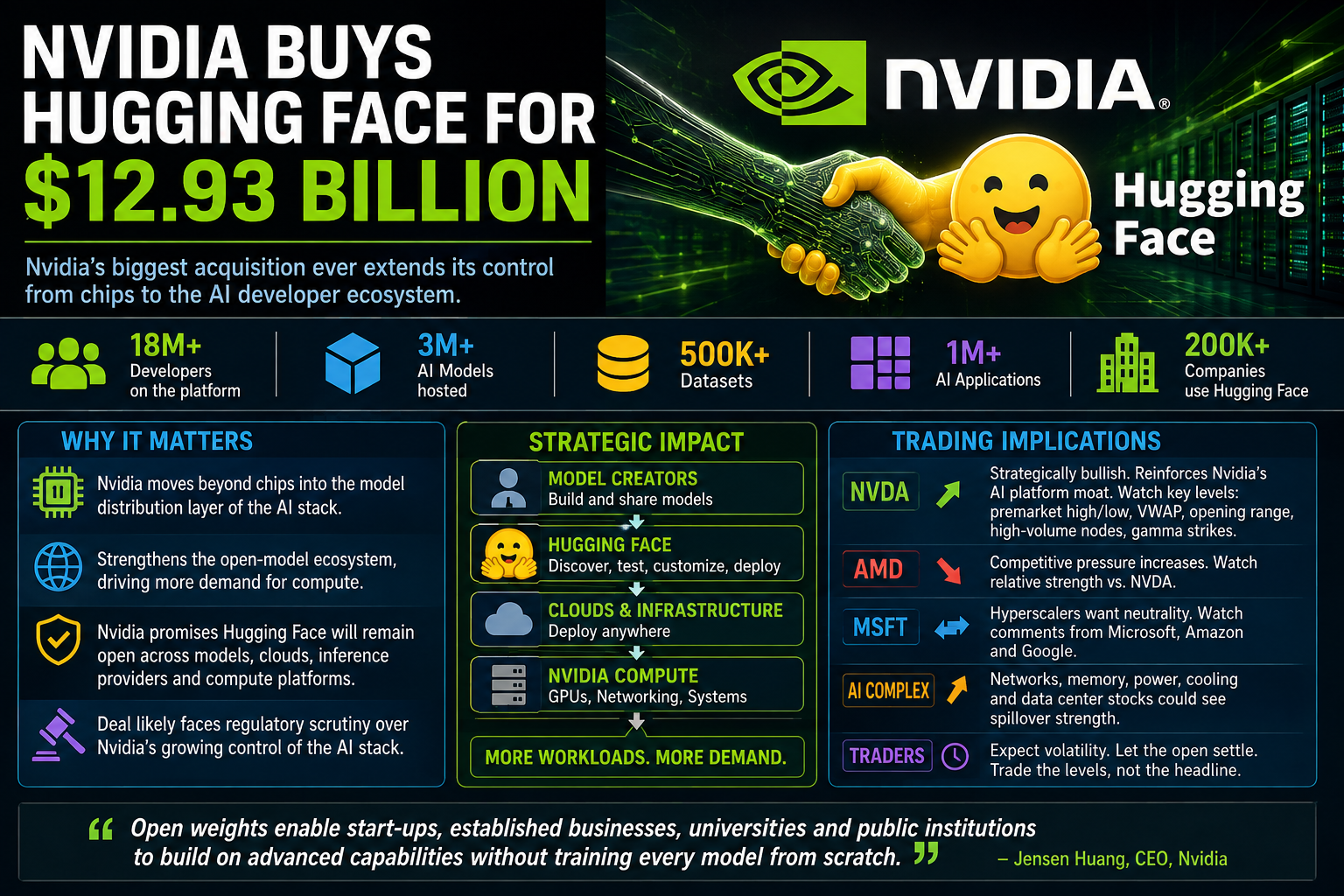
Hugging Face has become a central marketplace and collaborative platform for open artificial intelligence. More than 18 million developers use the platform, which hosts more than 3 million AI models, roughly 500,000 datasets and about 1 million applications. More than 200,000 companies use Hugging Face to discover, evaluate, customize or deploy artificial intelligence technology.
That makes Hugging Face much more than a software repository. It has become part of the distribution infrastructure for the AI industry.
Owning that distribution layer potentially allows Nvidia to influence not only where artificial intelligence is computed, but also how developers gain access to the models that ultimately generate that demand for computing power.
Why Open AI Models Matter to Nvidia
A major theme behind the acquisition is Nvidia’s support for open-weight AI models.
Unlike proprietary models offered primarily through controlled interfaces by companies such as OpenAI and Anthropic, open-weight models can generally be downloaded, modified and deployed by developers on infrastructure they select themselves.
That distinction has enormous strategic value for Nvidia.
Nvidia does not necessarily need one dominant AI model provider to win the artificial intelligence race. In many respects, the company benefits more from an ecosystem containing thousands of competing models, applications and specialized AI systems.
Every additional model that needs to be trained, customized or deployed potentially creates additional demand for computing infrastructure.
In other words, Nvidia can benefit from fragmentation at the model level while maintaining dominance at the computing level.
That may be one of the most important strategic ideas behind the transaction.
The Nvidia Moat Gets Wider
The acquisition also further broadens Nvidia’s competitive moat.
The company has already built multiple reinforcing advantages:
- Industry-leading AI accelerators
- CUDA software and developer tools
- High-speed networking technology
- Complete AI server and data-center systems
- AI software libraries and deployment tools
- A rapidly expanding ecosystem of enterprise AI products
Hugging Face potentially adds model discovery and distribution to that list.
If Nvidia can make models hosted on Hugging Face easier or more efficient to deploy on Nvidia infrastructure, the platform could become another funnel directing developers toward Nvidia hardware.
Nvidia has emphasized that Hugging Face will remain an open platform and that developers will continue to be able to choose different models, cloud providers, inference services and computing platforms. Nvidia has specifically stated that Nvidia hardware will not be required to use Hugging Face.
That commitment will be extremely important because the acquisition is almost certain to attract regulatory scrutiny.
Regulators May Focus on Nvidia’s Growing Control of the AI Stack
Nvidia’s expanding role across the artificial intelligence industry creates an obvious regulatory question.
Can a company that already dominates the hardware used to run artificial intelligence also own one of the most influential platforms used to distribute AI models?
Competition regulators may examine whether Nvidia could eventually favor models optimized for CUDA, steer developers toward Nvidia infrastructure or disadvantage competing accelerators produced by AMD and other semiconductor companies.
Those questions do not necessarily prevent the acquisition from closing, but regulatory review could become one of the principal risks surrounding the deal.
Investors should remember Nvidia’s previously proposed acquisition of Arm, which ultimately collapsed after intense regulatory resistance. Hugging Face presents a different competitive situation, but Nvidia’s growing importance throughout the AI ecosystem virtually guarantees close examination.
What the Deal Means for NVDA
For Nvidia shareholders, the acquisition reinforces the argument that NVDA should increasingly be viewed as an artificial intelligence platform company rather than simply a semiconductor manufacturer.
The immediate impact on Nvidia’s earnings may be relatively small compared with the enormous revenue generated by its data-center business. Strategically, however, the acquisition could significantly increase Nvidia’s long-term influence over the artificial intelligence ecosystem.
That distinction matters for valuation.
Semiconductor companies traditionally trade according to expectations for unit demand, product cycles, margins and capital spending. Platform businesses can command higher valuation multiples because developers and customers become increasingly embedded inside their ecosystems.
Nvidia has already moved substantially in that direction through CUDA.
Hugging Face could deepen that platform effect.
AMD Faces Another Competitive Challenge
AMD may be one of the companies most directly affected by the acquisition.
The competition between Nvidia and AMD is no longer simply a contest between GPU architectures.
AMD must compete against Nvidia’s hardware, software, networking, developer tools and complete infrastructure ecosystem. If Hugging Face becomes another deeply integrated component of that ecosystem, Nvidia’s competitive advantage potentially becomes even harder to overcome.
The important question will be whether Hugging Face remains genuinely hardware-neutral.
If developers can deploy models just as easily on AMD accelerators as they can on Nvidia infrastructure, the direct competitive effect may be limited. But if Nvidia integration gradually produces performance or usability advantages, AMD could face another layer of ecosystem friction.
Microsoft, Amazon and Google Will Be Watching Closely
The large cloud providers also have significant interests at stake.
Microsoft, Amazon and Google collectively operate enormous AI computing platforms and have invested heavily in their own AI chips, development environments and model ecosystems.
Hugging Face currently works across multiple cloud and computing platforms. Maintaining that neutrality will therefore be essential.
If Amazon Web Services, Microsoft Azure or Google Cloud begin to perceive Hugging Face as primarily an Nvidia distribution channel, they could respond by expanding their own open-model marketplaces or supporting competing platforms.
That could ultimately accelerate competition in the model-distribution layer of artificial intelligence.
What It Means for OpenAI and Anthropic
The transaction also strengthens the strategic importance of the open-model ecosystem.
OpenAI and Anthropic have built businesses around powerful proprietary models delivered largely through controlled platforms and application programming interfaces.
Open models represent an alternative architecture for the AI economy.
Companies can deploy smaller specialized models internally, customize models for particular industries and potentially reduce the recurring cost of accessing large proprietary systems.
Nvidia’s willingness to spend roughly $13 billion on Hugging Face signals that the company expects open AI to remain a major component of the industry rather than a niche alternative to proprietary frontier models.
Broader Market Implications
The acquisition should be viewed as another confirmation that the AI capital-investment cycle continues to expand beyond semiconductor purchases.
The next phase of the artificial intelligence buildout increasingly involves the entire ecosystem surrounding AI:
- Data centers
- Networking
- Power generation
- Cooling infrastructure
- Model development
- Cloud computing
- Enterprise software
- Cybersecurity
- AI deployment platforms
That can keep investor attention focused on the broader AI complex even when individual semiconductor stocks experience periods of consolidation.
It also reinforces the idea that AI spending is becoming structural rather than simply a short-lived hardware upgrade cycle.
Trading Implications
For active traders, the Nvidia-Hugging Face deal creates several potential opportunities beyond simply watching NVDA.
NVDA
Nvidia will naturally be the primary trading vehicle.
The initial reaction should be evaluated relative to whether investors interpret the acquisition as strategically valuable or simply another example of Nvidia deploying its enormous financial resources.
Because the acquisition price is relatively modest compared with Nvidia’s market capitalization, traders should be careful about assuming that the transaction alone will produce a sustained directional move.
Instead, watch whether the news becomes a catalyst that attracts additional institutional momentum into a stock already sensitive to AI headlines.
Key intraday areas to monitor include:
- Premarket high and low
- Previous session high and low
- VWAP
- Opening-range boundaries
- High-volume price areas
- Major options-related gamma strikes
If NVDA gaps higher but cannot hold above the premarket high or VWAP, the acquisition may become a sell-the-news catalyst rather than the beginning of another momentum leg.
Conversely, a strong opening followed by consolidation above VWAP can indicate that institutional buyers are willing to absorb early profit-taking.
AMD
AMD may develop an inverse or relative-strength relationship with Nvidia around this story.
Weakness in AMD while NVDA strengthens would suggest that traders are interpreting the acquisition as another widening of Nvidia’s competitive moat.
If AMD remains firm despite Nvidia’s announcement, however, that resilience could indicate that investors view Hugging Face’s continued hardware neutrality as credible.
That makes the NVDA/AMD relative-strength relationship particularly useful.
MSFT, AMZN and GOOGL
The hyperscalers may not respond dramatically to the transaction immediately, but they should remain on the watchlist because each company operates enormous AI infrastructure businesses.
Watch for analyst commentary about whether Nvidia’s growing ecosystem threatens cloud-provider independence or creates additional demand for AI computing services.
Google may be especially interesting because it continues to develop its own TPU architecture as an alternative to Nvidia GPUs.
AI Infrastructure Stocks
A renewed AI narrative can also spill into adjacent semiconductor and infrastructure names.
Traders should monitor relative strength in companies connected to networking, memory, data-center equipment, cooling, power infrastructure and semiconductor manufacturing.
The important signal is not simply whether these stocks rise, but whether several areas of the AI complex begin moving together.
Broad participation would suggest that investors see the acquisition as another confirmation of continued AI infrastructure spending.
Expect Volatility Around the Open
For day traders, the most important period may be the opening 30 to 60 minutes following the market’s first full opportunity to digest the transaction.
Large Nvidia headlines frequently create substantial premarket positioning, which can produce exaggerated opening moves as overnight traders, institutional investors and options-related hedging activity interact.
That makes chasing the first directional move particularly risky.
A more informative signal may develop after the initial opening imbalance has cleared and traders can see whether price holds above or below VWAP and important premarket reference levels.
If NVDA initially rallies sharply but repeatedly fails at a major resistance level, that can create a useful exhaustion or mean-reversion setup.
If price instead establishes value above the opening range with persistent bid support, the probability of continuation increases.
Watch the Options Market
NVDA’s enormous options market can amplify intraday moves around major headlines.
Large concentrations of call or put positioning can create areas where dealer hedging either suppresses or accelerates price movement.
Traders should pay particular attention to major gamma strikes near the opening price.
A headline-driven move through an important options level can generate rapid follow-through if dealers need to adjust hedges. Conversely, a large gamma concentration can act as a magnet and repeatedly pull price back toward the strike.
Combining those levels with VWAP, volume-by-price and order-flow information can help distinguish a genuine breakout from a temporary reaction to the headline.
The Bigger Story
The most important implication of the acquisition may ultimately have little to do with Hugging Face’s current revenue.
Nvidia is steadily assembling an increasingly complete artificial intelligence ecosystem.
Mellanox strengthened networking. CUDA created the software foundation. Nvidia’s GPUs dominate accelerated computing. Its data-center systems increasingly integrate the entire hardware architecture.
Now Hugging Face potentially gives Nvidia a major position in the distribution layer where AI developers choose models and turn them into applications.
There is an interesting paradox in Nvidia’s strategy.
The company argues that open models can distribute artificial intelligence more broadly and reduce concentration in the model industry.
That may be true.
But the more AI models proliferate, the more computing capacity the industry needs.
And today, Nvidia remains the company providing much of that capacity.
The result is a strategy in which artificial intelligence may become increasingly decentralized while Nvidia becomes increasingly central to the infrastructure powering it.
TraderInsight Bottom Line
The Nvidia-Hugging Face acquisition is not primarily about adding another company’s revenue to Nvidia’s income statement.
It is about controlling another strategic layer of the artificial intelligence ecosystem.
For long-term investors, the deal strengthens the argument that Nvidia is evolving from a GPU manufacturer into the operating infrastructure behind much of the AI economy.
For traders, the immediate opportunity will come from how the market prices that strategic advantage.
Watch NVDA’s reaction around VWAP, premarket support and resistance, the opening range and important options levels. Then watch AMD and the broader AI complex for confirmation.
If Nvidia strengthens while AMD weakens and semiconductor participation expands, the market is likely interpreting the acquisition as another meaningful extension of Nvidia’s competitive moat.
If NVDA cannot sustain the initial reaction, however, the headline may prove more important strategically than tactically — producing volatility without creating a durable directional move.
TraderInsight.com — Trade the plan, not the headline.
“`