
SpaceX Targets $1 Trillion in Annual Revenue by 2030—but Investors Want to See the Math
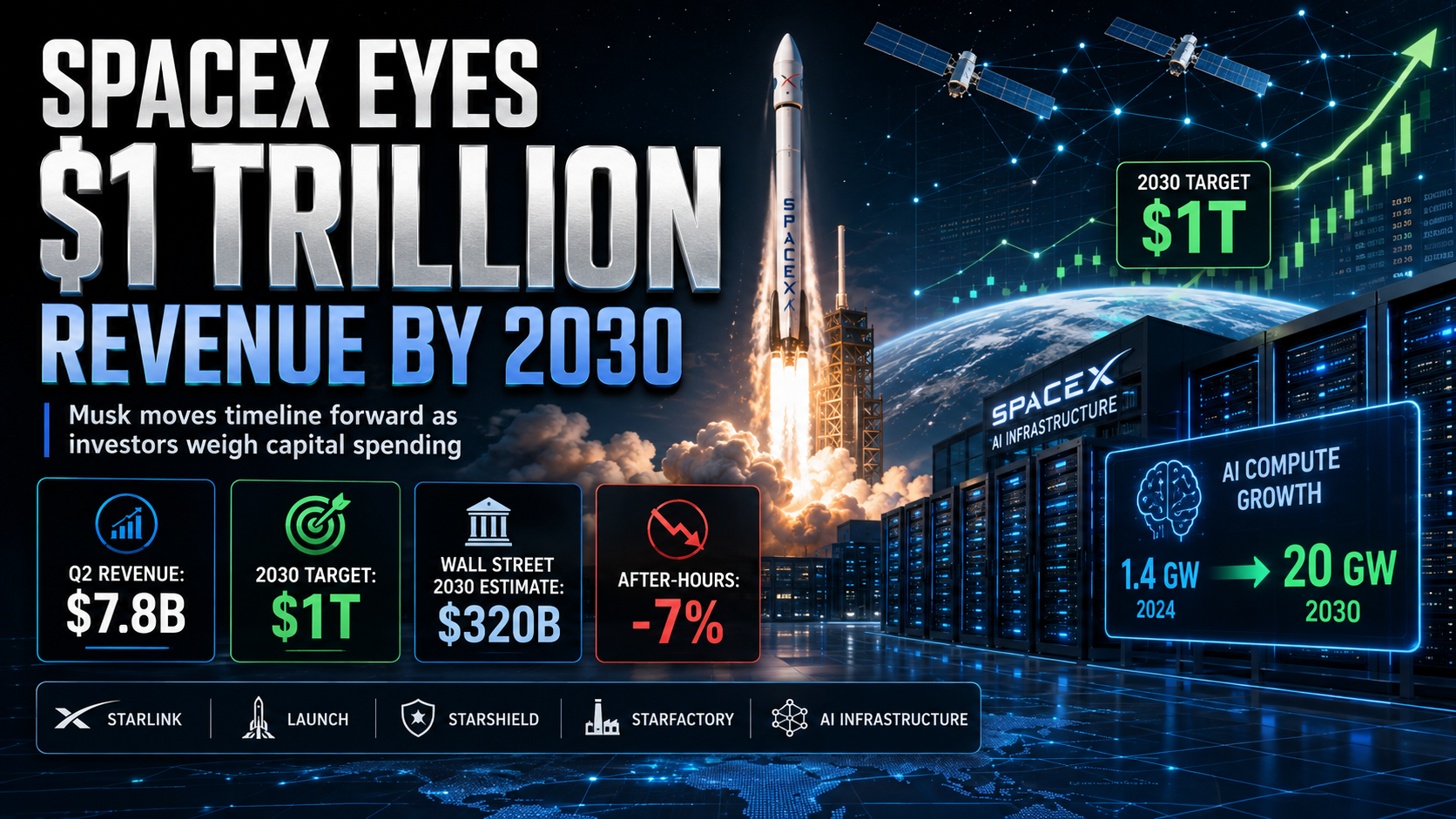
SpaceX CEO Elon Musk has moved one of the most ambitious corporate growth targets on Wall Street forward by a year, telling investors that SpaceX expects to generate $1 trillion in annual revenue by 2030.
Musk added that there is a “non-zero probability” the company could reach that level as early as 2029.
The projection is extraordinary when measured against SpaceX’s current financial results. The rocket, satellite, and artificial-intelligence company generated $7.8 billion in second-quarter revenue, representing a 92% increase from the same period one year earlier. That was also well above the approximately $6.8 billion analysts had expected.
Despite the strong revenue growth, SpaceX shares initially fell approximately 6% to 7% in after-hours trading after gaining more than 9% during the regular session.
The market reaction suggests investors are not questioning whether SpaceX can grow. They are questioning how much capital the company must spend to pursue the SpaceX $1 trillion revenue target—and how long shareholders may have to wait before that growth produces dependable profits and cash flow.
From $7.8 Billion a Quarter to $1 Trillion a Year
A company generating $1 trillion in annual revenue would average approximately $250 billion per quarter.
SpaceX’s current quarterly revenue of $7.8 billion would translate into an annualized run rate of roughly $31.2 billion. Reaching $1 trillion from that starting point would require the company to increase annual revenue by approximately 32 times in less than five years.
That would place SpaceX among the largest businesses ever created.
For comparison, Microsoft, Apple, and Alphabet are collectively expected to generate roughly $1.3 trillion in 2026 revenue. Musk is effectively projecting that SpaceX alone could approach the current combined sales of three of the world’s largest technology companies.
Wall Street’s existing forecasts are far more conservative. Morgan Stanley has projected approximately $330 billion in SpaceX revenue by 2030, while Goldman Sachs has estimated more than $470 billion. Both forecasts already assume enormous expansion, but they remain well below Musk’s trillion-dollar objective.
AI Must Become the Primary Growth Engine
SpaceX’s traditional businesses are unlikely to produce $1 trillion in annual revenue on their own.
Starlink continues to expand its consumer, enterprise, aviation, maritime, and government connectivity operations. SpaceX also generates revenue from commercial launches, national-security contracts, NASA missions, and its developing Starship transportation system.
Those businesses may become extremely large. However, the numbers behind the SpaceX $1 trillion revenue target suggest that artificial intelligence must eventually become the company’s dominant revenue source.
SpaceX’s AI strategy combines several enormous projects:
- Terrestrial AI data centers and compute-leasing services
- Space-based data centers powered by large satellite constellations
- AI models and services developed through xAI
- Proprietary semiconductor manufacturing through the TeraFab initiative
- Starlink connectivity supporting distributed AI infrastructure
- Starship launches capable of placing massive computing capacity into orbit
The company’s AI division generated approximately $2.6 billion in second-quarter revenue, while Starlink remained its largest established business.
That makes AI one of the fastest-growing components of SpaceX, but the business would still need to expand dramatically to support Musk’s 2030 forecast.
The 20-Gigawatt Requirement
Musk estimates that AI compute can generate approximately $30 to $50 of annual revenue per watt of installed capacity.
At the upper end of that estimate, one gigawatt of AI compute could theoretically support approximately $50 billion in annual revenue. To produce $1 trillion, SpaceX would therefore need roughly 20 gigawatts of productive AI capacity—assuming pricing remains near $50 per watt and the infrastructure operates at high utilization.
SpaceX reportedly ended the second quarter with approximately 1.4 gigawatts of compute capacity.
Expanding from 1.4 gigawatts to 20 gigawatts would require the company to increase capacity more than fourteenfold. It would also require enormous quantities of:
- Advanced AI processors
- High-bandwidth memory
- Electricity generation and transmission
- Cooling infrastructure
- Networking equipment
- Data-center construction
- Satellite manufacturing and launch capacity
For context, research examining the development of frontier AI supercomputers found that power requirements for leading systems have been doubling approximately every year. The study projected that a leading AI system in 2030 could require approximately nine gigawatts and hardware investment approaching $200 billion.
SpaceX is not merely proposing to build one massive supercomputer. It is attempting to create an integrated global—and potentially orbital—AI computing platform.
Why SpaceX Wants Data Centers in Orbit
Musk believes terrestrial AI infrastructure will eventually encounter constraints involving electricity, water, land, environmental approval, and grid access.
Space-based data centers could theoretically address some of those limitations. Solar panels in orbit can receive energy for longer periods than terrestrial installations, while the vacuum of space may provide unique thermal-management opportunities.
SpaceX also controls the technologies required to attempt such a system. The company builds rockets, satellites, communications networks, launch infrastructure, and AI services. Starship is intended to lower the cost of placing heavy payloads into orbit, while Starlink already provides a large-scale satellite communications network.
The strategy depends on SpaceX successfully combining all of these capabilities.
The technical hurdles remain substantial. Orbital computing systems must withstand radiation, manage heat, operate with limited opportunities for physical maintenance, transmit enormous quantities of data, and remain economically competitive with rapidly improving terrestrial data centers.
The company must also manufacture and launch the infrastructure at a scale that has never been attempted.
Capital Spending Becomes the Central Question
SpaceX’s second-quarter report showed why investors may be cautious despite the revenue beat.
The company reported a quarterly net loss of approximately $541 million, even as revenue nearly doubled. Capital spending surged as SpaceX invested in AI infrastructure, Starship development, and the Starlink network.
SpaceX’s long-term opportunity may be enormous, but creating enough capacity to pursue $1 trillion in sales will require tens—or potentially hundreds—of billions of dollars in additional investment.
That spending introduces several risks:
- AI compute pricing could decline as more capacity enters the market.
- New processors could make existing infrastructure obsolete more quickly.
- Electricity and construction costs could rise.
- Demand may not grow quickly enough to keep all capacity fully utilized.
- Space-based data centers may take longer to commercialize than expected.
- Additional debt or equity financing could pressure existing shareholders.
The trillion-dollar forecast therefore cannot be evaluated solely as a revenue opportunity. Investors must also estimate the amount of capital required to generate that revenue and the profit margins SpaceX could ultimately retain.
Why the Stock Fell After Strong Results
SpaceX produced the kind of headline revenue growth that would normally support a sharp rally. Quarterly sales increased 92%, revenue exceeded expectations, and Musk presented an exceptionally bullish long-term outlook.
Yet the stock initially declined after the report.
That reaction may indicate that investors had already positioned for an impressive quarter. SpaceX shares gained more than 9% during regular trading before the earnings announcement, creating a classic possibility of buying the anticipation and selling the completed event.
The decline may also reflect concern about the distance between management’s ambition and the company’s current economics.
SpaceX is growing rapidly, but it remains unprofitable on a net basis. The company must simultaneously fund AI infrastructure, Starship, Starlink expansion, launch operations, semiconductor development, and potential orbital data centers.
The after-hours selling does not necessarily mean investors rejected the long-term vision. It means the market wants more evidence that the company can turn extraordinary spending into durable returns.
Trading Implications for SpaceX
The first session following the earnings report could produce substantial volatility in SpaceX shares.
The stock gained sharply before the announcement and then reversed lower after hours. That creates several competing groups of market participants:
- Traders who bought ahead of earnings and may now sell to protect profits
- Short sellers who may cover if the stock stabilizes
- Long-term investors attracted by the $1 trillion forecast
- Existing shareholders concerned about spending and dilution
- Momentum traders reacting to the post-earnings opening range
Rather than deciding in advance that the revenue forecast is either brilliant or impossible, traders should allow price action to establish the structure.
Bullish Scenario
A bullish setup would begin with SpaceX absorbing the initial post-earnings selling. Traders should watch for the stock to reclaim important after-hours levels, hold above the opening range, and demonstrate relative strength against the Nasdaq and other AI-related stocks.
If buyers quickly recover the after-hours decline, the reversal could indicate that the market is looking beyond near-term spending and focusing on the company’s long-term growth potential.
Bearish Scenario
A bearish setup would develop if SpaceX opens below key support, attempts to rally, and then fails beneath the after-hours breakdown area.
The strongest short-side structure would not necessarily be an immediate opening decline. It could be a failed bounce that confirms trapped buyers are using strength to exit.
If the stock cannot stabilize despite the large revenue beat, it would suggest that capital spending, profitability, and valuation concerns are outweighing the headline growth.
Volatility Scenario
SpaceX could also remain trapped between enthusiastic long-term buying and aggressive short-term profit-taking.
In that case, the stock may produce wide swings without establishing a durable trend. Traders should reduce position size, use clearly defined stops, and avoid chasing movement in the middle of an extended range.
What Investors Should Watch Next
The SpaceX $1 trillion revenue target will ultimately be judged through measurable operating progress rather than projections alone.
Important milestones will include:
- Quarterly growth in AI compute revenue
- Installed compute capacity measured in gigawatts
- Utilization rates and revenue generated per watt
- Starlink subscriber and enterprise-customer growth
- Starship launch frequency and reusability
- Capital spending and free-cash-flow trends
- Progress on orbital AI infrastructure
- Evidence that AI revenue can produce attractive margins
Investors should also compare management’s forecasts with independent analyst estimates. A large gap between the two does not automatically make Musk wrong, but it raises the level of execution required to justify the company’s valuation.
The TraderInsight Perspective
Elon Musk’s forecast gives investors a compelling long-term narrative: SpaceX could evolve from a rocket and satellite company into one of the largest AI infrastructure providers in the world.
But compelling narratives do not eliminate trading risk.
The stock’s initial after-hours decline demonstrates the difference between a company reporting impressive growth and a stock delivering the reaction traders expected. SpaceX exceeded revenue estimates, but the market had to weigh that performance against losses, enormous capital requirements, and expectations that had risen during the regular session.
For short-term traders, the next opportunity will come from the stock’s reaction—not from debating whether SpaceX will actually generate $1 trillion in 2030.
Let the opening range form, identify the levels where buyers and sellers are defending positions, and trade the confirmed structure rather than the trillion-dollar headline.
Further Reading
SpaceX: A First Look At Financials (Pending:SPCX) | Seeking Alpha
SpaceX (SPCX) Q2 2026 Earnings Report: Live updates
SpaceX’s Spending on A.I. Soars, In First Results After I.P.O. – The New York Times
Musk’s SpaceX Reveals Its Finances for the First Time as It Readies for IPO – The New York Times
SpaceX beats expectations in first earnings as a public company | CNN Business