
SpaceX Orbital Data Centers Could Reshape the AI Infrastructure Race
Elon Musk’s trillion-dollar vision would move AI compute into orbit—but the investment case still depends on solving launch cadence, heat rejection, radiation protection and hardware replacement at a scale never attempted.
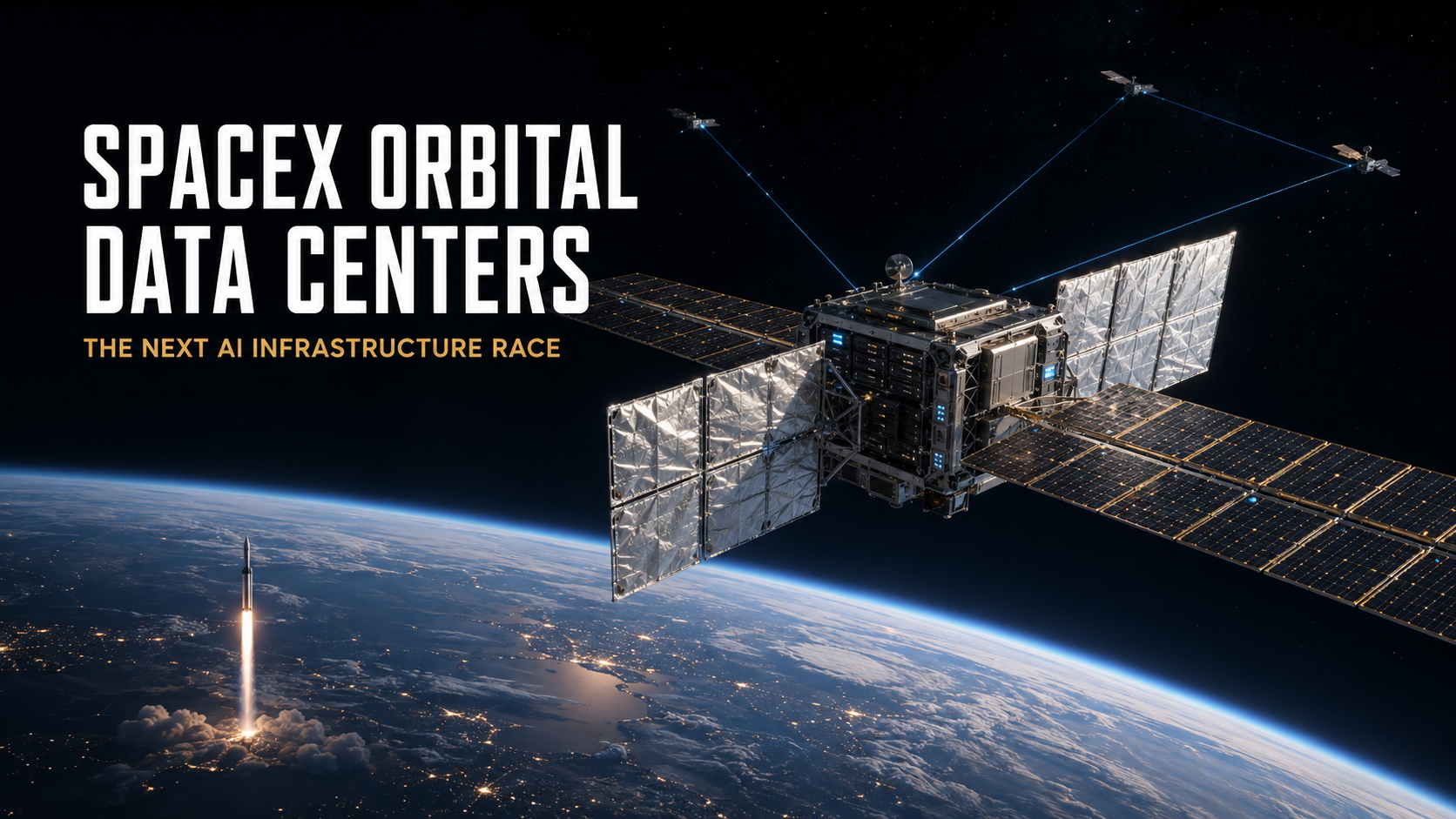
SpaceX is asking investors to imagine a new layer of the artificial-intelligence economy: millions of solar-powered satellites carrying advanced computing hardware and operating as data centers in orbit. If the company succeeds, SpaceX orbital data centers could give it control over an unusually broad technology stack—from rockets and satellite manufacturing to communications, electrical power and AI compute.
That is the strategic appeal. AI development is increasingly constrained not only by access to chips, but also by electricity, cooling capacity, land, permitting and network infrastructure. SpaceX argues that orbit could eventually ease some of those terrestrial constraints by providing abundant solar energy and a globally connected computing platform.
However, the orbital-compute thesis is not yet an operating business that investors can value through conventional revenue and cash-flow forecasts. It is a high-conviction engineering roadmap. SpaceX itself warned in its public offering documents that orbital AI compute involves substantial technical complexity and technologies that may not become commercially viable.
From Rocket Company to AI Infrastructure Platform
The long-term value proposition rests on vertical integration. Starship would transport large payloads at a lower cost per kilogram than earlier launch systems. SpaceX would manufacture the satellites, connect them through its communications network and supply them with near-continuous solar power. Advanced processors—initially expected to include Nvidia hardware—would provide the computing capacity.
SpaceX has requested regulatory authority for a constellation that could eventually include as many as one million orbital data-center satellites. Reuters reported in June that the company was targeting initial demonstration systems for late 2027, ahead of the “as early as 2028” deployment language in its offering documents. More recently, Musk said the first Nvidia-equipped Starmind satellites were being targeted for the fourth quarter of 2027, with a more meaningful scale-up planned for 2028.
The distinction between a demonstration and a commercial network is critical. A successful first flight would validate parts of the architecture. It would not prove that SpaceX can manufacture, launch, maintain and replace hundreds of thousands of satellites economically.
The Three Problems SpaceX Must Solve
1. Starship Must Become Rapidly and Reliably Reusable
A large orbital-compute network would require a launch cadence far beyond anything the aerospace industry has previously sustained. One engineering estimate suggests that maintaining a one-million-satellite constellation—with 60 satellites per Starship and a five-year replacement cycle—could require more than nine launches every day.
Starship was designed to carry much larger payloads than Falcon 9 and is central to SpaceX’s cost assumptions. Yet the vehicle still must demonstrate the fast turnaround, dependable recovery and full reusability needed for thousands of launches per year. Until that happens, the orbital-data-center model remains highly sensitive to launch cost and schedule risk.
2. Powerful Computers Must Be Cooled in a Vacuum
Space is cold, but it is also a vacuum. Without air, heat cannot be removed through ordinary convection. A data-center satellite must transfer heat from its processors through a liquid-cooling system and then radiate that energy into space.
SpaceX’s published concept uses large deployable radiators. The proposed satellite could generate roughly 250 kilowatts at peak, creating a thermal-management problem far beyond that of a conventional communications satellite. The underlying methods are understood and resemble systems used aboard the International Space Station, but SpaceX would need a lighter, more powerful and highly reliable version capable of operating without routine human maintenance.
3. Chips Must Survive Radiation—and Stay Current
High-energy particles can corrupt data, cause computers to crash and permanently damage electronics. SpaceX can mitigate these risks through shielding, redundancy and error-correction systems, but every protective measure adds mass and cost.
The company also faces a different kind of obsolescence. AI hardware advances quickly. Even if a satellite remains operational, its processors could become economically outdated well before the spacecraft fails. SpaceX has historically replaced Starlink satellites after roughly five years, but maintaining that cycle across a vastly larger and heavier compute constellation would require continuous production and launch capacity.
The Economics May Be Harder Than the Physics
An orbital data center does have potential advantages. Solar arrays can receive more consistent energy in suitable orbits, terrestrial construction and permitting constraints are reduced, and SpaceX already controls a launch and communications ecosystem that competitors would struggle to reproduce.
But terrestrial data centers are not standing still. Operators continue to improve liquid cooling, energy efficiency, grid access and chip utilization. Ground-based facilities can also be repaired, upgraded and repurposed without launching replacement hardware into orbit.
For SpaceX, the decisive metric will not be whether an AI computer can function in space. That is increasingly plausible. The real test is whether the all-in cost of useful compute—including launch, satellite production, cooling equipment, radiation protection, failures, networking and replacement—can compete with rapidly improving infrastructure on Earth.
Environmental and Regulatory Risks
A constellation of this size would create environmental and orbital-management questions on an unprecedented scale. Large solar arrays increase collision exposure, while failed satellites would add to the challenge of tracking and managing debris. Frequent atmospheric re-entry may also deposit metals and other material into the upper atmosphere, with consequences that scientists are still working to understand.
These issues could translate into slower approvals, operating restrictions, additional mitigation costs or limits on deployment. For investors, regulatory progress should therefore be treated as a core business milestone rather than a secondary consideration.
What SpaceX Orbital Data Centers Mean for the Broader Market
The immediate market impact extends beyond SpaceX. The project reinforces the idea that the AI buildout is becoming an infrastructure race rather than merely a contest among software models.
- SpaceX: The orbital-compute narrative can support a premium valuation, but it also increases sensitivity to Starship tests, regulatory filings, satellite demonstrations and capital-spending guidance.
- Nvidia: A successful space-qualified architecture could create another long-duration market for accelerated computing, although early satellite volumes would be small relative to terrestrial AI demand.
- Aerospace and satellite suppliers: Thermal systems, radiation-hardened electronics, solar arrays, optical communications and precision manufacturing could receive increased attention.
- Terrestrial data-center companies: The orbital plan validates the seriousness of power and cooling constraints, but it does not displace ground-based infrastructure in the near term. Utilities, independent power producers, cooling specialists and data-center operators remain essential to the current AI cycle.
- Semiconductor supply chains: SpaceX has acknowledged that access to enough AI chips is a prerequisite. That links the project to foundry capacity, advanced packaging, high-bandwidth memory and networking equipment.
Trading Implications
For traders, the orbital-data-center story is likely to produce event-driven volatility rather than a smooth repricing. The most important catalysts will be observable milestones: successful Starship recovery and reuse, a flight-ready satellite design, thermal-vacuum testing, regulatory approvals, confirmed Nvidia hardware, launch-manifest additions and on-orbit computing results.
SpaceX
SpaceX shares may react sharply when headlines alter the perceived probability of commercialization. A successful Starship test or verified Starmind milestone can generate momentum and gap risk. Test failures, schedule delays, cost overruns or regulatory resistance can reverse that enthusiasm just as quickly.
Day traders should avoid treating every orbital-compute headline as equal. A statement of intent is less consequential than evidence that changes launch cadence, cost per kilogram, power capacity or the date of commercial deployment. On high-volume news days, premarket support and resistance, the opening range, VWAP and volume-by-price structure should help distinguish sustained institutional accumulation from a headline-driven opening spike.
Nvidia and Related AI Infrastructure Stocks
Nvidia may receive a sentiment benefit from confirmation that its architecture will power the first systems, but SpaceX-specific news is unlikely to transform Nvidia’s near-term earnings by itself. The better trading question is whether the announcement broadens the market’s estimate of long-run AI compute demand.
If it does, strength may spread into networking, memory, cooling and power names. If the reaction remains isolated, the move is more likely to fade after the initial news cycle.
Near-Term Volatility Outlook
Expect volatility to cluster around Starship tests, regulatory decisions, earnings commentary and Starmind launch updates. Between those events, the orbital thesis may function mainly as a valuation narrative. As the targeted fourth-quarter 2027 launch window approaches, schedule credibility should matter more, and each technical milestone is likely to carry greater market weight.
A Practical Milestone Checklist for Investors and Traders
- Has Starship demonstrated repeatable recovery and rapid reuse?
- Has SpaceX disclosed validated thermal-vacuum and radiation-test results?
- Is the first Nvidia-based satellite on a confirmed launch manifest?
- Has the company demonstrated useful AI workloads in orbit?
- Are regulators approving expansion beyond a limited demonstration?
- Is SpaceX disclosing credible cost-per-compute or customer-economics data?
- Can satellite manufacturing and chip supply support the proposed cadence?
This checklist separates engineering progress from promotional scale. The market may assign value to the vision well before the economics are proven, but durable valuation support will require the milestones to converge.
The TraderInsight Takeaway
SpaceX orbital data centers represent one of the boldest attempts yet to solve AI’s emerging energy and infrastructure bottlenecks. The strategy is compelling because SpaceX controls several of the pieces that would be nearly impossible for a conventional data-center company to assemble: reusable launch systems, mass satellite production, orbital communications and a direct relationship with leading chip suppliers.
That advantage does not eliminate the execution risk. The company must transform Starship from an experimental launch system into an industrial transportation network, reject enormous amounts of heat in a vacuum, protect leading-edge processors from radiation and replace hardware fast enough to remain competitive with Earth-based facilities.
The opportunity is real enough to watch—but speculative enough to trade with discipline. Investors should value orbital compute as a series of probability-weighted milestones, while short-term traders should let price, volume and confirmation determine whether each new headline has produced a durable repricing or merely another burst of enthusiasm.
Sources and Further Reading
SpaceX public offering filing
SpaceX Starmind overview
Reuters: SpaceX targets orbital AI demonstrations
Financial Times: SpaceX’s orbital data-center bet
This article is for educational purposes only and does not constitute investment advice. Trading involves substantial risk, and readers should conduct their own research before making financial decisions.