
Market Insight · Technology & Transportation
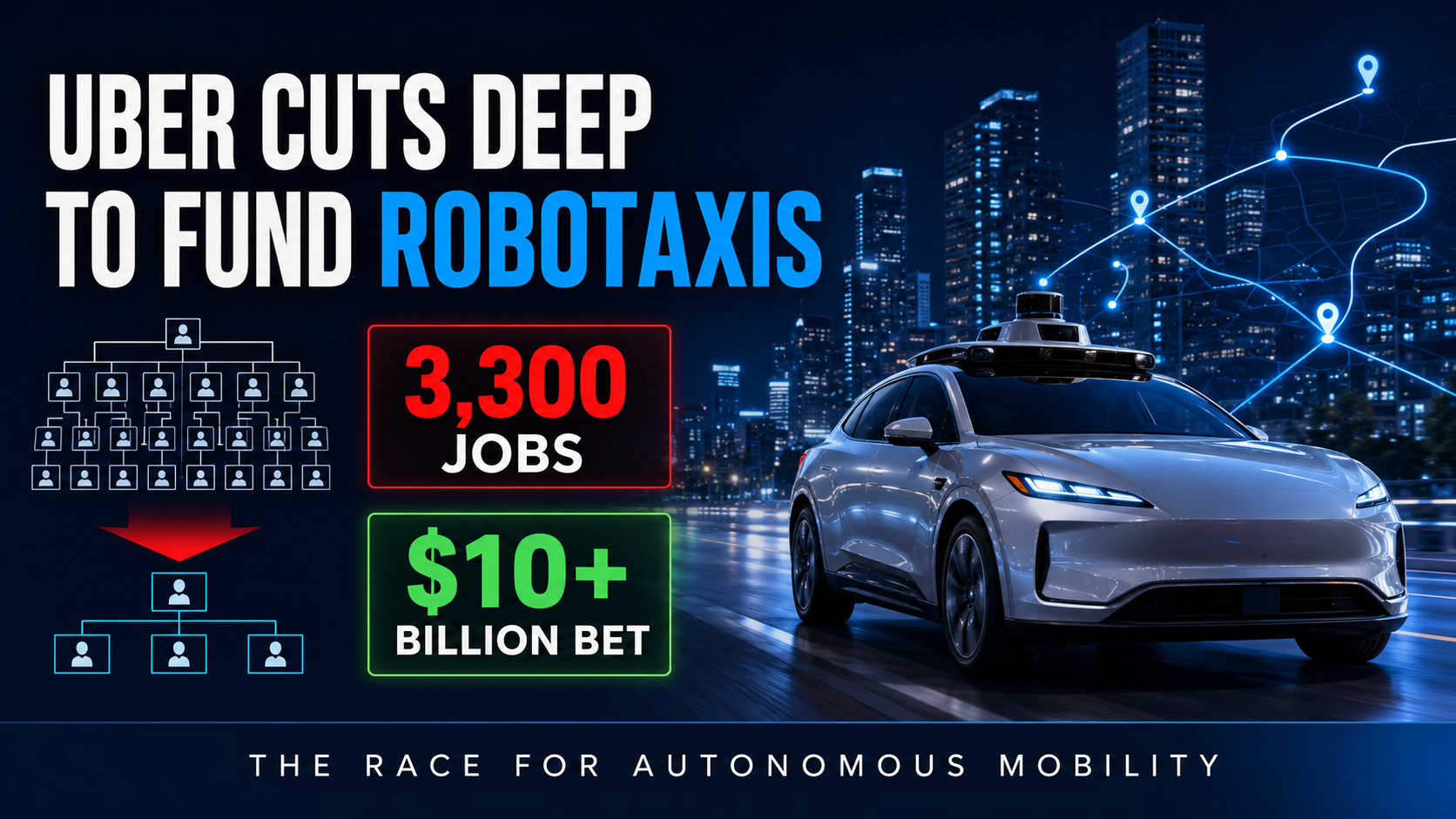
Uber Cuts 3,300 Jobs to Fund the Robotaxi Race
Uber’s largest workforce reduction since the pandemic could save an estimated $825 million annually. Investors must now decide whether the restructuring represents disciplined execution—or the rising cost of defending its platform from autonomous rivals.
Uber is eliminating approximately 3,300 positions, equal to about 10% of its global workforce, as chief executive Dara Khosrowshahi strips away management layers and redirects capital toward the company’s increasingly expensive robotaxi strategy.
The restructuring is the company’s broadest since the coronavirus pandemic. Management says years of rapid growth produced more layers, fragmented ownership and too much internal coordination. Citi analysts estimate the cuts could reduce annual expenses by roughly $825 million, providing additional funding for autonomous-vehicle initiatives and other growth priorities.
This Is a Capital-Reallocation Story
Layoffs often produce an immediate positive stock response because investors can calculate the savings faster than they can assess the long-term consequences. In Uber’s case, however, the savings are not simply intended to flow through to earnings. The company has pledged to invest more than $10 billion in expanding its autonomous ride network.
That makes the announcement a capital-reallocation story rather than a conventional cost-cutting exercise. Uber is shrinking administrative complexity to finance a strategic transition that could determine whether it remains the dominant marketplace for paid transportation—or becomes vulnerable to autonomous-vehicle operators that control both the technology and the cars.
Uber’s Robotaxi Advantage—and Its Vulnerability
Uber’s strongest asset is distribution. Its platform reaches more than 200 million customers, giving autonomous-vehicle partners immediate access to demand, routing, payments and marketplace liquidity. Uber plans to offer robotaxi services in at least 15 cities this year and has positioned itself as the network through which multiple autonomous fleets can reach riders.
This asset-light, partnership-based model allows Uber to participate without having to develop every vehicle and autonomous-driving system internally. It can serve as the customer-facing layer connecting riders with human drivers, commercial fleets and robotaxis.
The vulnerability is equally clear. Alphabet’s Waymo is expanding its own commercial footprint, while Tesla continues to pursue a vertically integrated robotaxi model. If autonomous providers build strong direct consumer relationships, Uber could face margin pressure or disintermediation. If customers prefer one familiar app that offers the fastest available ride across many fleets, Uber’s network could become more valuable.
| Company | Strategic position | Central investor question |
|---|---|---|
| Uber | Large customer network and multi-partner mobility marketplace | Can platform scale outweigh dependence on outside AV technology? |
| Alphabet / Waymo | Purpose-built autonomous-driving technology and expanding operated fleet | Can it scale vehicles and service areas while controlling costs? |
| Tesla | Vertically integrated vehicles, software and installed owner base | Can it deliver safe, regulator-approved autonomy at commercial scale? |
AI Efficiency Is Part of the Picture—But Not the Whole Story
Citi analyst Ronald Josey observed that the restructuring was likely enabled, at least partly, by efficiencies produced through Uber’s AI investments. That does not necessarily mean AI directly replaced every eliminated position. The company’s stated objective is to reduce organizational layers, consolidate small teams and clarify ownership while investing in growth and innovation.
The distinction matters. If AI tools allow fewer managers and employees to operate a growing platform, the restructuring could produce durable operating leverage. If the cuts merely offset escalating autonomous-vehicle spending, investors may see little improvement in free cash flow.
Uber is also tightening its office policy, with fully remote arrangements expected to apply to only about 1% of employees. Management appears to be using the restructuring to change both the cost base and the company’s operating culture.
Uber Eats Faces a Separate Competitive Problem
Autonomous mobility is not Uber’s only challenge. Uber Eats has gained share in the UK, France and Germany, but continues to trail DoorDash in the United States. YipitData estimates DoorDash holds approximately 64% of the U.S. food-delivery market, compared with roughly 31% for Uber.
Delivery still contributes important order frequency and cross-platform engagement, but the market-share gap limits pricing power. Uber must fund an autonomous future while defending two intensely competitive marketplaces. Simplifying the organization may help decision-making, yet it does not remove the need for sustained spending on incentives, product development and partnerships.
What It Means for the Broader Market
For UBER: Lower operating expenses can support margins, but investors will watch how much of the savings is reinvested and whether autonomous rides improve bookings, utilization and unit economics.
For GOOGL: Uber’s spending confirms the commercial significance of Waymo’s lead. The relationship can be both collaborative and competitive because Waymo rides are already available through Uber in selected markets.
For TSLA: The announcement reinforces how much capital and distribution competitors are bringing to robotaxis. Tesla’s opportunity remains substantial, but execution and regulatory milestones matter more than industry enthusiasm.
For DASH: DoorDash’s U.S. delivery lead remains a pressure point for Uber and demonstrates that the company cannot focus exclusively on mobility.
For technology employment: The cuts reinforce a broader pattern in which companies seek AI-driven productivity while concentrating investment in compute-intensive strategic priorities.
Day-Trading and Volatility Implications
Workforce reductions can initially be interpreted as margin-positive, particularly when analysts provide a concrete savings estimate. The durability of any rally will depend on whether traders focus on the $825 million expense benefit or the more than $10 billion commitment that follows it.
- Premarket gap: Compare the size of the opening gap with relative volume and the broader Nasdaq tone. A cost-cutting headline can create an early pop that fades when reinvestment requirements receive more attention.
- Opening range: Watch whether price accepts above premarket resistance or loses the opening range and VWAP. That transition can reveal whether institutions view the news as genuine operating leverage.
- Peer confirmation: Moves in Alphabet, Tesla, DoorDash and autonomous-vehicle partners can indicate whether the market is trading Uber-specific savings or the broader robotaxi theme.
- Headline sensitivity: Partnerships, regulatory approvals and new-city launches could extend volatility beyond the layoff announcement.
- Do not assume one-way price action: Layoffs, AI efficiency and large strategic spending support conflicting narratives. Expect two-sided reactions around analyst commentary and management guidance.
What Investors Should Watch Next
- Whether management raises margin or free-cash-flow expectations after the restructuring.
- The pace and economics of robotaxi launches across the planned cities.
- Autonomous ride volumes, vehicle utilization and Uber’s revenue share with partners.
- Evidence that organizational simplification accelerates product decisions rather than disrupting execution.
- U.S. delivery-market share and any improvement against DoorDash.
- Whether the tightened office policy causes additional voluntary employee departures.
The Bottom Line
Uber is cutting deeply from its present organization to finance its vision of transportation’s future. The savings are meaningful, and the company’s enormous customer network gives it a credible advantage as autonomous fleets look for riders.
Yet the restructuring also reveals the scale of the threat. Waymo, Tesla and other autonomous operators are forcing Uber to invest before the economics of robotaxis are fully established. The next phase of the stock’s story will turn on whether Uber becomes the indispensable marketplace for autonomous rides—or spends billions defending an intermediary role that vehicle operators eventually learn to bypass.
Sources
The restructuring details were reported by Reuters and the Financial Times. Additional reporting on the workforce changes and company memo is available from TechCrunch.
This article is for educational and informational purposes only and does not constitute investment advice. Always evaluate risk and conduct your own research before making trading or investment decisions.