
War Profits and Market Rotation: How Defense Spending Is Driving Stock Market Opportunity
While most traders focus on headlines, professionals focus on where capital is flowing. And right now, one of the clearest flows in the market is coming from a source many traders overlook:
War-driven spending.
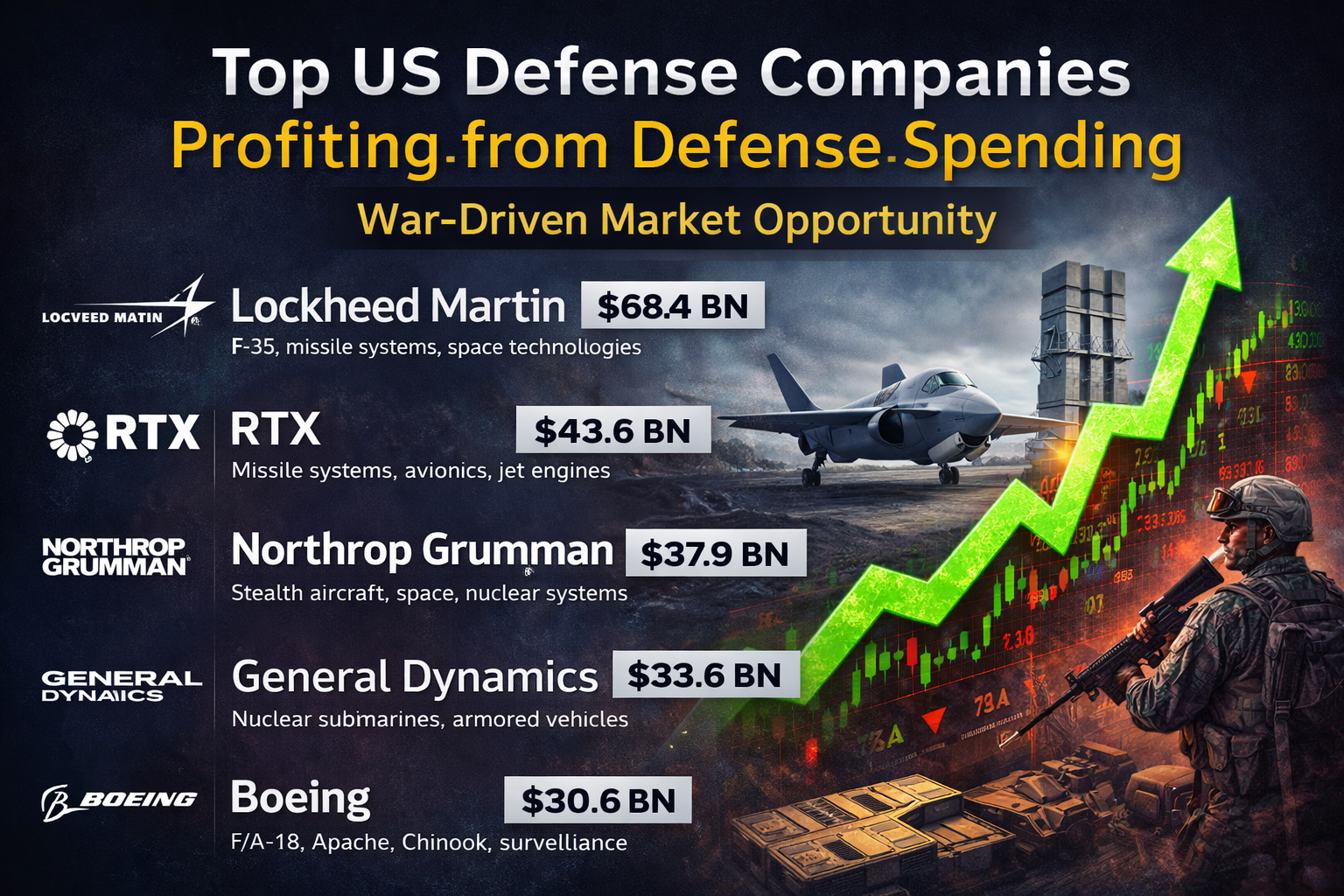
The current conflict involving Iran has accelerated global defense spending, and the result is already showing up in stock prices, sector rotation, and trading opportunities.
The Business of War Is Scaling Fast
Recent developments show that the United States is not just engaged in military operations—it is ramping up production at an extraordinary pace.
Major defense contractors have reportedly committed to significantly increasing the output of weapons systems, ranging from missile platforms to advanced aircraft and drone technologies. This is not a theoretical demand. It is active, funded, and expanding.
Global defense spending has already surged, with projections indicating U.S. military budgets will reach $1.5 trillion in the coming years. That kind of capital does not sit still. It moves into contracts, production pipelines, and ultimately into the stock prices of the companies supplying that demand.
This is the essence of war-driven market opportunity.
Where the Money Is Flowing
The biggest beneficiaries of this environment are some of the world’s largest defense contractors. These companies are directly tied to weapons systems, logistics, and advanced military technology.
Recent price action reflects that reality:
- Defense contractors are seeing steady stock price appreciation
- Backlogs are growing into the tens of billions of dollars
- Production expansion driven by geopolitical demand
This is not a short-term spike. It is a structural shift in spending priorities.
As we have discussed in the TraderInsight Article Archives, sustained capital flows tend to create repeatable trading opportunities—not just one-off events.
The Weapons Behind the Trend
The scale of the current conflict is reflected in the range of systems being deployed:
- Long-range cruise missiles and strike systems
- Advanced stealth aircraft and bomber platforms
- Missile defense systems such as Patriot and THAAD
- Drone technology, including low-cost expendable systems
- Surveillance and electronic warfare capabilities
Each of these categories represents a different segment of defense spending—and a different stream of revenue for contractors.
That diversification is one of the reasons war-driven market opportunities tend to persist rather than fade quickly.
The Power Players: Who Is Profiting from Defense Spending
To fully understand war-driven market opportunity, you have to know where the money is going. The largest defense contractors in the United States sit at the center of this capital flow, supported by long-term government contracts, rising global demand, and expanding production pipelines.
Here are the top five U.S. defense companies driving this trend:
- Lockheed Martin
The world’s largest defense contractor, formed in 1995 through a merger of Lockheed and Martin Marietta. In 2024, it generated $68.4 billion in revenue. The company produces advanced aircraft like the F-35, missile systems, and space technologies. Its Department of Defense contracts are worth tens of billions of dollars, and it continues to expand production of advanced air defense systems such as the PAC-3. - RTX
Formed in 2020 through the merger of Raytheon and United Technologies, RTX focuses on missile systems, jet engines, and avionics. In 2024, $43.6 billion of its revenue came from defense-related operations, making it a major beneficiary of rising military demand. - Northrop Grumman
A leader in stealth technology and advanced military systems, Northrop Grumman manufactures aircraft such as the B-21 Raider and provides key components for space and nuclear modernization programs. The company generated $37.9 billion in defense revenue in 2024. - General Dynamics
Known for its work in submarines, armored vehicles, and military systems, General Dynamics also produces Gulfstream business jets. In 2024, it generated $33.6 billion in defense-related revenue, driven by global demand for military infrastructure. - The Boeing Company
While widely known for commercial aviation, Boeing plays a major role in defense through aircraft such as the F/A-18 Super Hornet, Apache helicopters, and surveillance platforms like the P-8 Poseidon. In 2024, it generated $30.6 billion in defense revenue.
These companies are not just reacting to current events—they are positioned at the center of a long-term expansion in global defense spending.
As outlined in the broader analysis of the Iran conflict and defense sector growth, rising military demand is driving record backlogs, increased production commitments, and sustained upward pressure on defense-related equities.
This is a key component of war-driven market opportunity: identifying where large, persistent flows of capital are being directed—and aligning your trading strategy with those flows.
Stock Market Reaction: What We’re Seeing Now
Markets are already reacting to this shift in real time.
Defense-related equities have been pushing higher, supported by:
- Increased government contracts
- Expanded production commitments
- Long-term spending visibility
At the same time, other sectors—such as transportation and travel—have shown relative weakness, reflecting the broader economic impact of geopolitical tension.
This is classic rotation.
And rotation is where traders find opportunity.
Why Traders Miss This Move
Most traders approach geopolitical events incorrectly.
They focus on:
- Who is winning or losing the conflict
- What the political outcome might be
- How long will the situation last
But the market does not reward those questions.
The market rewards one question:
Where is capital moving right now?
That is why a war-driven market opportunity is often missed. It requires a shift away from narrative and toward flow.
We have emphasized this repeatedly in our work, including discussions on capital rotation and volatility in the article archives.
How This Translates Into Trades
From a trading standpoint, this environment creates several types of opportunities:
- Momentum trades in defense stocks benefiting from new contracts
- Gap opportunities following overnight geopolitical developments
- Sector rotation trades between defense, energy, and risk-sensitive industries
- Volatility-based setups as news flow accelerates price movement
These are not random moves. They are structured responses to capital entering specific market segments.
As we have shown in multiple TraderInsight studies, the first hour of trading is often where these imbalances become most actionable.
The Bigger Picture
Global defense spending is not just increasing—it is accelerating.
With NATO countries committing to higher budget allocations and ongoing conflicts driving demand for replenishment and expansion, the flow of capital into defense is likely to remain a dominant theme.
That means a war-driven market opportunity is not just a short-term trade. It may be an ongoing framework for understanding sector leadership in the months ahead.
Bottom Line
The current geopolitical environment is reshaping capital flows across the market. Defense contractors are benefiting from rising demand, expanding budgets, and long-term production commitments.
For traders, the takeaway is simple:
Do not trade the war. Trade the money flowing because of the war.
That distinction is where the edge lives.
Explore more insights: