
AI Bond Issuance and Treasury Yields: Why Rising Long-Term Rates Could Reshape the AI Trade
For most of the artificial intelligence boom, traders have focused on semiconductors, data centers, cloud computing, electricity demand and the enormous capital expenditure plans being announced by the world’s largest technology companies.
Now another piece of the AI investment cycle is beginning to matter: the bond market.
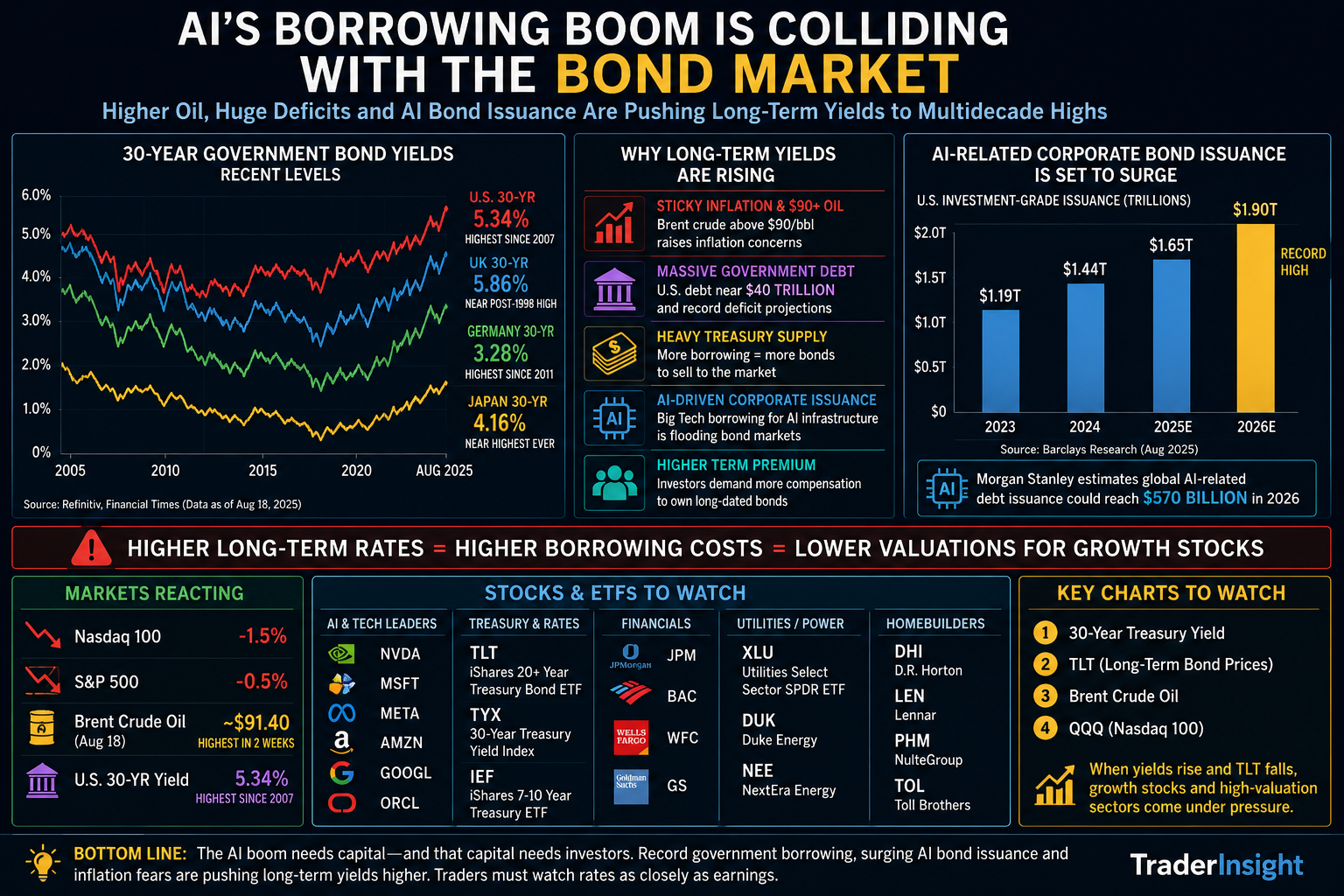
Long-term borrowing costs have climbed sharply around the world, with 30-year U.S. Treasury yields recently reaching levels not seen since before the financial crisis. Similar pressure has appeared in Germany, France, the United Kingdom and Japan.
The immediate explanation includes familiar concerns: persistent inflation, higher oil prices, enormous government deficits and growing Treasury issuance. But there is another source of supply entering the equation. Big technology companies are borrowing tremendous amounts of money to finance artificial intelligence infrastructure.
That means AI bond issuance and Treasury yields are becoming increasingly interconnected—and that relationship could have important consequences for technology stocks, financials, utilities, homebuilders and the broader equity market.
The Long End of the Bond Market Is Sending a Warning
The 30-year U.S. Treasury yield recently reached approximately 5.34%, its highest level since 2007. Long-duration government debt in Europe and Japan has also experienced substantial selling pressure.
This is important because the move is occurring at the long end of the yield curve.
Short-term interest rates are heavily influenced by expectations for central-bank policy. Long-term rates reflect something broader: expectations for future inflation, government borrowing, economic growth and the additional compensation investors demand for committing capital for decades.
When long-term yields rise even without a corresponding increase in central-bank policy rates, markets may be signaling that investors want to be paid considerably more to hold long-duration debt.
For equity traders, that distinction matters.
Higher long-term rates can raise corporate borrowing costs, increase mortgage rates and reduce the present value investors assign to future corporate earnings. The latter consideration is especially important for high-growth technology companies whose valuations depend heavily on profits expected many years into the future.
Oil Is Bringing Inflation Back Into the Conversation
One catalyst behind the bond selloff has been renewed strength in crude oil.
Energy prices have risen amid geopolitical instability surrounding the U.S.-Iran conflict, with Brent crude moving back above $90 per barrel.
Higher oil prices matter far beyond the energy sector.
Oil feeds into transportation, manufacturing, plastics, chemicals, agriculture and distribution costs throughout the economy. If energy prices remain elevated, investors may begin expecting inflation to remain higher for longer.
That creates an uncomfortable situation for central banks.
Economic growth can weaken while inflation remains persistent. In that environment, policymakers have less flexibility to aggressively reduce interest rates.
For traders, the interaction between oil prices and long-term Treasury yields may therefore become one of the most important macro relationships to monitor.
The Government Debt Problem Is Getting Harder to Ignore
The second force affecting long-term interest rates is fiscal policy.
The U.S. government debt burden is approaching $40 trillion, while large deficits require substantial new Treasury issuance. Investors must continually absorb that supply.
Normally, strong demand for Treasury securities can keep borrowing costs contained. But when investors are simultaneously worried about inflation, fiscal deficits and competing investment opportunities, they may demand higher yields before purchasing additional long-duration government debt.
This is sometimes described as a rising term premium.
Essentially, investors want more compensation for assuming the inflation and fiscal risks associated with holding a 20- or 30-year security.
The Treasury recently had to pay its highest interest rates since 2011 to sell 30-year bonds.
That tells us the market is not simply reacting to what the Federal Reserve may do at its next meeting. Investors are reconsidering the price of long-term capital itself.
Then Comes the AI Borrowing Boom
This is where the story becomes particularly interesting for technology traders.
The artificial intelligence buildout is extraordinarily capital intensive.
Companies are spending enormous sums on:
- AI data centers
- NVIDIA and other accelerator hardware
- Networking equipment
- Power generation and transmission
- Cloud infrastructure
- Cooling systems
- Real estate
- Fiber and connectivity
Not all of that spending will be financed from corporate cash flow.
Major technology companies are increasingly tapping global bond markets, including the market for long-duration corporate debt.
Barclays reportedly expects total investment-grade corporate issuance in 2026 to reach a record $1.9 trillion, compared with approximately $1.44 trillion last year.
That additional corporate supply is competing for some of the same investor capital needed to absorb government debt.
In other words, governments need money.
AI companies need money.
Infrastructure developers need money.
Utilities need money.
Data-center operators need money.
And investors are beginning to demand higher yields to provide it.
The AI Boom Could Be Creating Its Own Valuation Headwind
There is an interesting paradox developing.
The AI investment boom has been one of the principal reasons technology earnings expectations have risen so dramatically.
But financing that same investment boom could contribute to higher long-term interest rates.
Higher long-term rates, in turn, can reduce the valuations investors are willing to assign to technology companies.
This creates a feedback loop worth watching.
AI spending increases → corporate borrowing increases → bond supply increases → long-term yields rise → technology valuation multiples come under pressure.
That does not necessarily mean the AI trade is ending.
It means the market may become increasingly selective about which companies can generate enough earnings and cash flow to justify their valuations in a higher-rate environment.
Why the Nasdaq May Be Particularly Sensitive
The Nasdaq 100 recently fell approximately 1.5% during the latest increase in bond yields, compared with a smaller decline in the S&P 500.
That relative weakness makes economic sense.
Growth stocks are often described as long-duration equities.
Much of their perceived value comes from earnings investors expect far into the future. When the discount rate used to value those future earnings rises, their theoretical present value declines.
This is why traders should increasingly watch the relationship between:
- QQQ
- Nasdaq futures
- 10-year Treasury yields
- 30-year Treasury yields
- TLT
If long-term yields continue breaking higher while QQQ loses important technical support, we could see valuation compression even when individual technology companies continue reporting strong operating results.
Stocks to Watch: NVIDIA
NVIDIA (NVDA) remains at the center of AI infrastructure spending.
There are two competing forces traders should recognize.
On the positive side, enormous data-center investment supports demand for NVIDIA accelerators, networking products and AI infrastructure.
On the negative side, rapidly rising long-term interest rates can place pressure on the valuation multiples investors are willing to pay for high-growth technology companies.
For NVDA traders, this means strong company-specific news may increasingly have to overcome macro pressure from the bond market.
A particularly useful intraday tell will be whether NVDA can outperform QQQ when Treasury yields are rising. Relative strength during a hostile rate environment can indicate that institutional demand remains strong.
Microsoft, Meta, Amazon and Alphabet
Microsoft (MSFT), Meta Platforms (META), Amazon (AMZN) and Alphabet (GOOGL) are among the companies investing most aggressively in artificial intelligence infrastructure.
They also possess an advantage many smaller AI companies do not: enormous cash-generating businesses.
That distinction may become increasingly important.
If financing costs continue rising, investors may favor companies capable of funding AI expansion largely through operating cash flow rather than companies dependent upon constant access to capital markets.
Watch relative strength among the mega-cap technology names.
A market in which the strongest balance sheets outperform speculative AI companies would suggest that investors remain bullish on artificial intelligence while becoming more discriminating about financing risk.
Oracle and the Financing Question
Oracle (ORCL) deserves special attention because of its aggressive push into cloud and AI infrastructure.
Companies expanding data-center capacity rapidly may experience extraordinary revenue growth while simultaneously requiring enormous capital investment.
In a low-rate environment, markets tend to reward that expansion aggressively.
In a 5%-plus long-term rate environment, investors may begin asking a different question:
What return is the company earning on every dollar of AI infrastructure investment?
That question could become increasingly important across the entire AI ecosystem.
TLT Could Become One of the Most Important Charts on the Screen
Technology traders sometimes pay very little attention to Treasury ETFs.
That may be a mistake in the current environment.
The iShares 20+ Year Treasury Bond ETF (TLT) provides an easy visual representation of long-duration Treasury prices.
Remember that Treasury prices and yields move inversely.
When TLT falls sharply, long-term yields are generally rising.
For traders focused on QQQ, NVDA or other high-duration growth stocks, TLT can function almost like a macro confirmation indicator.
If QQQ is testing support while TLT is simultaneously breaking down, the bond market may be reinforcing the bearish equity signal.
If TLT stabilizes and yields retreat, technology stocks may suddenly receive an important macro tailwind.
Financial Stocks Could Benefit—But There Is a Catch
Higher long-term rates can initially appear positive for banks because a steeper yield curve may improve lending economics.
Stocks such as:
- JPMorgan Chase (JPM)
- Bank of America (BAC)
- Wells Fargo (WFC)
- Goldman Sachs (GS)
could therefore attract relative strength if investors expect better net interest margins.
But there is an important caveat.
If long-term yields are rising because investors fear fiscal instability or persistent inflation, the benefit to banks may eventually be overwhelmed by slower economic activity, credit deterioration or falling asset prices.
The key is determining why yields are rising.
Utilities and Data-Center Power Plays
The utility sector sits at the intersection of two powerful themes.
AI data centers require extraordinary amounts of electricity, creating potentially strong long-term demand for power generation.
At the same time, utilities are capital-intensive businesses that frequently depend upon debt financing.
Higher long-term interest rates therefore increase their cost of capital.
Traders following AI-related electricity names should watch whether the market continues rewarding future power demand or begins penalizing companies for financing costs.
The Utilities Select Sector SPDR Fund (XLU) can provide a useful sector-level gauge.
Homebuilders May Be Among the Most Direct Casualties
Higher long-term Treasury rates eventually translate into higher mortgage rates.
That creates obvious pressure on housing affordability.
Homebuilders such as:
- D.R. Horton (DHI)
- Lennar (LEN)
- PulteGroup (PHM)
- Toll Brothers (TOL)
should therefore remain on traders’ radar whenever long-term Treasury yields accelerate higher.
The housing sector may provide one of the clearest signals that higher borrowing costs are beginning to move from Wall Street into the real economy.
The Four Charts I Would Watch
For traders trying to simplify this complicated macro environment, I would keep four markets visible:
- 30-year Treasury yield — the clearest measure of pressure at the long end.
- TLT — a convenient proxy for long-duration Treasury prices.
- Brent crude oil — the inflation catalyst currently influencing the bond market.
- QQQ — the equity index most exposed to long-duration technology valuations.
The relationship among those four markets can tell us a tremendous amount about the trading environment.
A Potential Risk-Off Combination
The combination I would be most cautious about is:
- Oil breaking higher
- 30-year Treasury yields making new highs
- TLT making new lows
- QQQ losing technical support
- NVDA and the mega-cap technology leaders beginning to underperform
That would suggest the bond market is starting to impose meaningful pressure on equity valuations.
Under those circumstances, chasing technology stocks higher becomes considerably more dangerous.
A More Constructive Scenario
The opposite setup would be much more favorable for growth stocks.
If oil begins falling, inflation expectations moderate and Treasury yields retreat, the pressure on technology valuation multiples could ease quickly.
TLT stabilizing while QQQ begins showing relative strength would be an important signal.
In that environment, institutional investors could return aggressively to the strongest AI companies because the underlying secular growth story remains intact.
Trading Implications
The important takeaway is that traders should not treat rising bond yields as background noise.
The bond market is increasingly becoming part of the AI trade itself.
The enormous capital required to build artificial intelligence infrastructure is creating an unprecedented demand for financing at exactly the same time governments are issuing enormous quantities of debt.
That competition for capital may require investors to accept higher yields before absorbing all of the supply.
For short-term traders, this creates several practical opportunities.
- Watch QQQ versus Treasury yields. Rising yields combined with QQQ weakness can confirm a risk-off environment.
- Watch relative strength within the Magnificent Seven. The companies resisting macro pressure may become the leaders when yields stabilize.
- Monitor TLT intraday. A reversal in long-duration bonds can precede a change in technology-stock momentum.
- Watch oil. Persistent strength above the recent range can keep inflation expectations elevated.
- Compare AI infrastructure beneficiaries with highly leveraged AI plays. Balance-sheet quality may become increasingly important.
- Watch financials and homebuilders. They can provide confirmation that rising rates are spreading into other parts of the economy.
TraderInsight Bottom Line
The artificial intelligence story is no longer simply about who has the fastest chip or the most powerful model.
Increasingly, it is also about who can finance the infrastructure required to build the AI economy—and at what price.
Record government borrowing, higher energy prices, persistent inflation concerns and rapidly expanding corporate AI investment are all competing for the same pool of global capital.
That is why AI bond issuance and Treasury yields deserve a place on every technology trader’s radar.
The irony is that the AI boom may help push long-term interest rates higher even as AI companies continue producing extraordinary growth.
That does not destroy the AI thesis.
But it can change how the market values it.
And for traders, that distinction creates opportunity.
TraderInsight educational content is provided for informational and educational purposes only and is not investment advice. Trading involves substantial risk, and past performance does not guarantee future results.