
AI Infrastructure Spending Is Draining Big Tech Cash Reserves
The artificial intelligence arms race is creating enormous opportunities across the technology sector, but it is also exposing a surprising reality beneath the surface of the market rally.
Big Tech companies are spending cash at a pace not seen in more than a decade.
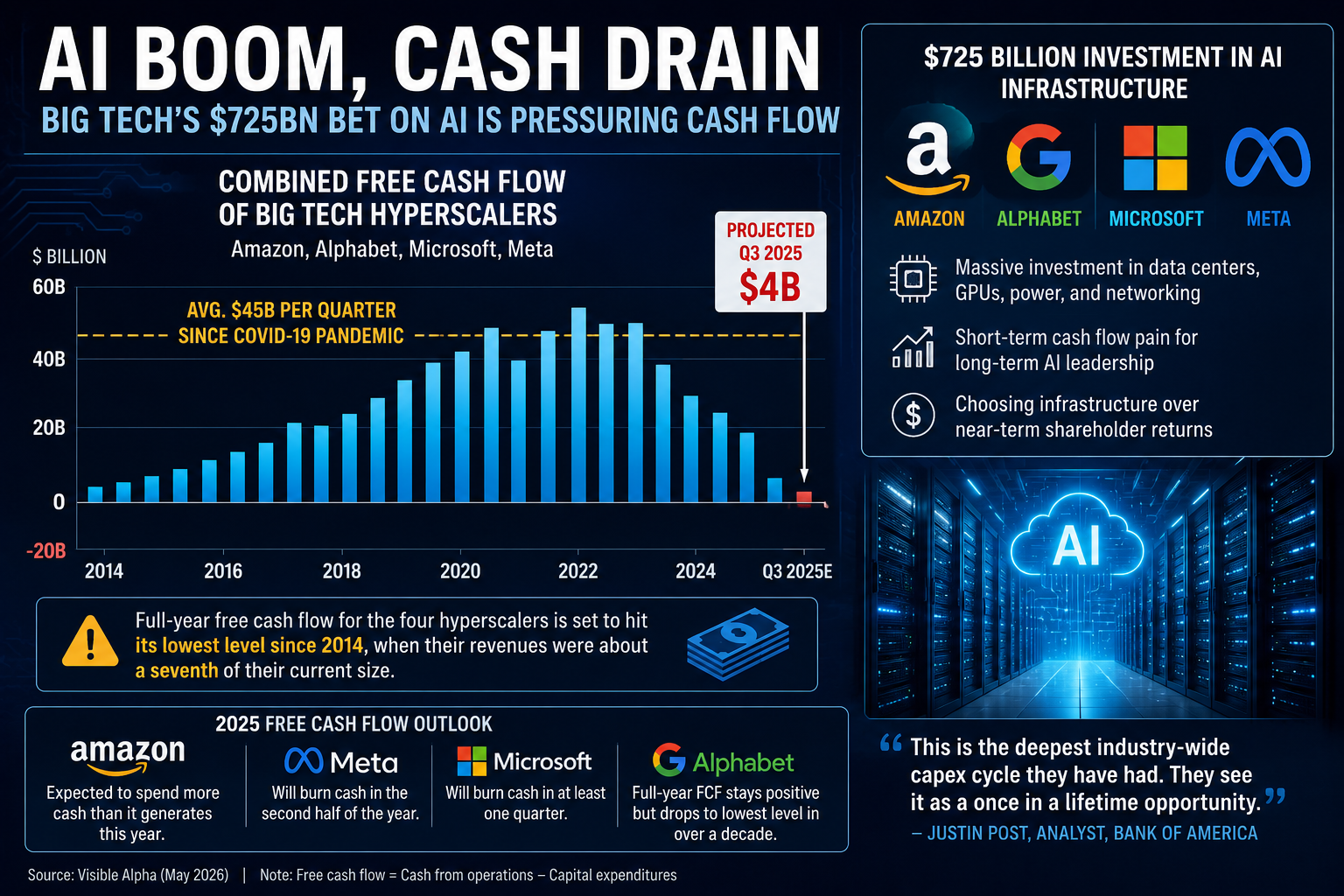
According to recent analyst forecasts, the combined free cash flow of Amazon, Alphabet, Microsoft, and Meta is projected to collapse to roughly $4 billion during the third quarter — down dramatically from an average of approximately $45 billion per quarter since the pandemic era.
The reason is simple: AI infrastructure spending has exploded.
What began as an AI software boom has evolved into one of the largest physical infrastructure buildouts in modern technology history.
AI Infrastructure Spending Is Reshaping Big Tech
For years, the largest technology companies operated as asset-light businesses capable of generating enormous amounts of free cash flow with relatively modest capital expenditures.
That dynamic has changed dramatically.
Today’s AI boom requires massive investments in:
- Data centers
- AI accelerators and GPUs
- Networking infrastructure
- Power systems
- Cloud computing capacity
- Advanced semiconductor architecture
This unprecedented wave of AI infrastructure spending is forcing companies to make difficult trade-offs that resemble traditional industrial businesses more than modern software firms.
Amazon is expected to spend more cash than it generates this year. Meta is projected to burn cash during the second half of the year, while Microsoft may post negative free cash flow during at least one quarter.
Even Alphabet, long considered one of the strongest cash generators in corporate America, is projected to produce its lowest free cash flow levels in more than a decade.
The AI Arms Race Is Becoming Capital Intensive
Wall Street often talks about artificial intelligence as a software revolution.
But traders are increasingly realizing that AI is also becoming an infrastructure war.
Companies are racing to build enormous physical systems capable of supporting AI demand before competitors gain a lasting advantage.
That means hyperscalers are now prioritizing AI infrastructure spending over near-term shareholder returns.
Instead of aggressively buying back stock or increasing dividends, many firms are redirecting capital toward data-center expansion and AI hardware deployment.
This helps explain why semiconductor companies like Nvidia, AMD, Broadcom, Qualcomm, and memory suppliers have experienced such explosive momentum.
The infrastructure buildout itself has become one of the largest investment themes in global markets.
Why This Matters for Traders
For active traders, this shift carries important implications.
Markets are beginning to reward companies tied directly to AI infrastructure while simultaneously scrutinizing whether spending levels are sustainable.
That creates volatility.
At TraderInsight, we often discuss how institutional money rotates aggressively toward sectors experiencing structural growth themes.
Right now, AI infrastructure spending remains one of the strongest structural themes in the market.
But elevated expectations also create risk.
As capital expenditures surge, investors may become increasingly sensitive to:
- Slowing AI revenue growth
- Weak free cash flow trends
- Debt issuance
- Rising interest rates
- Margin compression
- Delayed monetization of AI investments
That means traders should expect larger swings in major technology names as the market attempts to determine whether the spending surge will ultimately justify current valuations.
Semiconductor Stocks Remain at the Center
The biggest beneficiaries of this environment continue to be semiconductor and infrastructure-related companies.
AI demand is driving historic capital flows into:
- Nvidia
- AMD
- Broadcom
- Qualcomm
- Intel
- Memory manufacturers
- Optical networking firms
As hyperscalers continue deploying capital into AI systems, traders are likely to see ongoing momentum in sectors connected to data-center expansion.
However, traders should also recognize that parabolic rallies can become vulnerable to sharp reversals once expectations become too optimistic.
The First-Hour Trading Opportunity
One of the defining characteristics of AI-related stocks in recent months has been expanding intraday volatility.
Large-cap technology names are increasingly producing:
- Wide opening ranges
- Momentum continuation moves
- Gap reversals
- Volatility band expansions
- Institutional liquidity sweeps
These conditions often create ideal opportunities for disciplined first-hour traders using structured methodologies like:
- 2SD Opening Gap Reversions
- Nasdaq Volatility Bands
- Opening range breakouts
- Momentum exhaustion reversals
In highly emotional AI-driven markets, preparation and execution matter far more than prediction.
Related TraderInsight Articles
- TraderInsight Article Archives
- How Elite Traders Handle Volatility
- Harnessing Volatility in AI Stocks
- The First Hour Edge: How to Prepare Before the Bell and Execute Like a Pro
Final Thoughts
The AI boom is no longer simply about software innovation.
It has evolved into a massive global infrastructure race requiring unprecedented amounts of capital.
This historic wave of AI infrastructure spending is reshaping the financial profiles of the world’s largest technology companies and creating enormous ripple effects throughout the market.
For traders, the key is understanding that volatility often increases when markets transition from excitement to scrutiny.
And in today’s AI-driven environment, that transition may create some of the best trading opportunities of the decade.
Want help identifying high-probability opportunities in volatile AI markets?