
Chart of the Day
Market Liquidity Stress
Markets Caught Between AI Optimism and Liquidity Stress
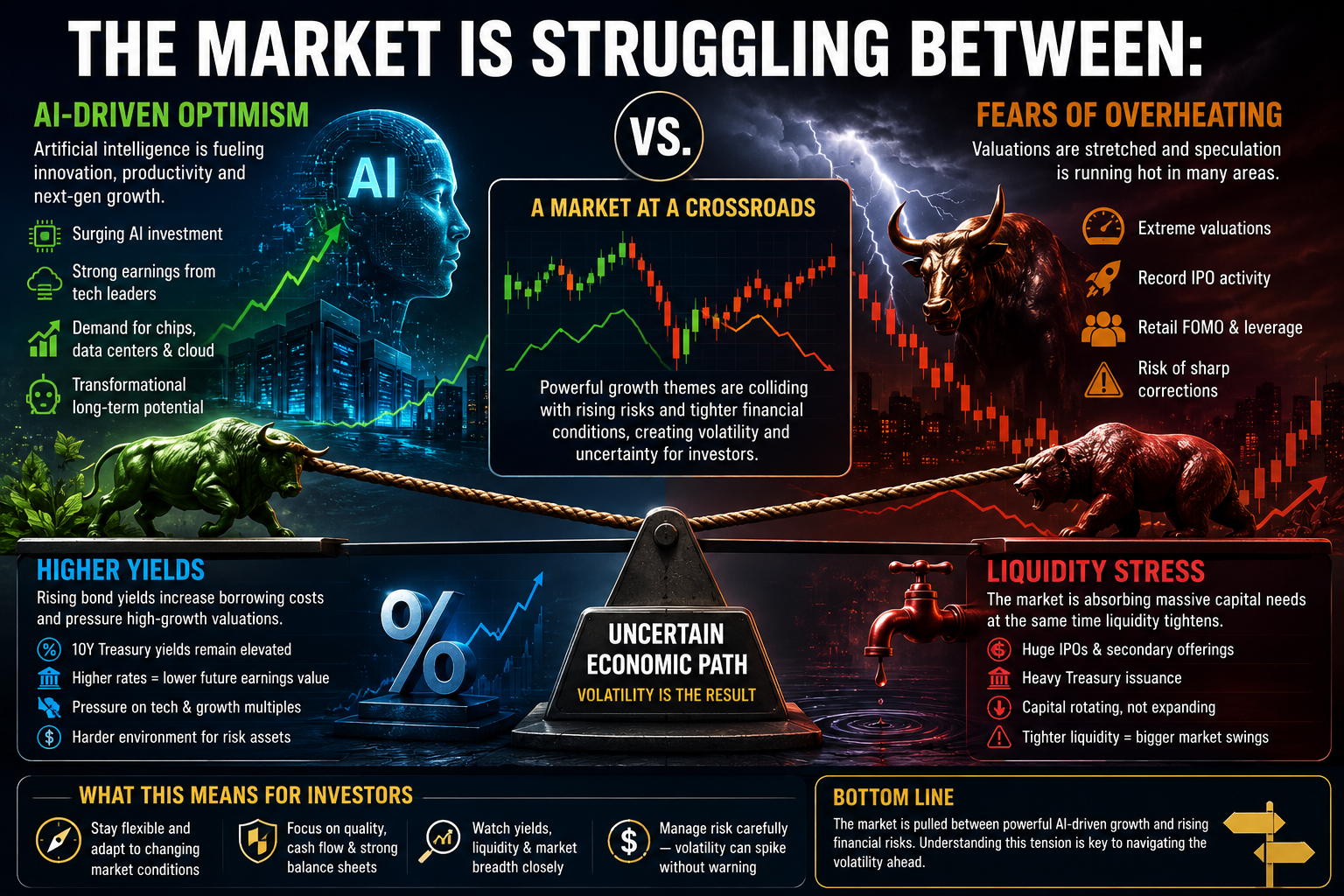
The stock market is entering one of the most psychologically difficult environments traders have faced in years. On one side stands enormous optimism surrounding artificial intelligence, technological transformation, and explosive corporate growth potential. On the other side are rising fears that markets may be overheating just as higher bond yields and tighter liquidity begin to pressure valuations.
That conflict is creating what many traders are now experiencing as growing market liquidity stress.
The result has been increasingly violent rotations beneath the market’s surface. One day, investors aggressively buy AI infrastructure, semiconductor, and cloud computing names. The next day, those same stocks experience sharp reversals as institutions raise cash, reduce risk, or reposition for new IPOs and capital raises.
The AI Boom Is Still Real
Despite the volatility, the underlying AI growth story remains powerful.
Global demand for semiconductors, servers, data centers, networking equipment, and AI compute infrastructure continues to expand rapidly. Corporate spending on artificial intelligence has accelerated worldwide, as governments and businesses race to build the next generation of computing power.
That optimism continues driving massive investor interest in:
- Semiconductor stocks
- Cloud infrastructure companies
- Data center operators
- AI software firms
- Energy and power suppliers
The enthusiasm is understandable. Investors believe AI may become one of the largest technological shifts since the internet itself.
But even transformative technologies can experience dangerous periods of speculation.
Fears of Overheating Are Growing
As valuations continue climbing, many investors are beginning to ask whether markets have moved too far, too fast.
Several warning signs have started appearing simultaneously:
- Extreme valuations in AI-related companies
- Massive IPO activity
- Aggressive retail speculation
- Heavy leverage in momentum trades
- Rapid concentration into a small group of technology leaders
Historically, periods of intense investor enthusiasm often coincide with expanding equity issuance. Companies and insiders naturally seek to raise capital when valuations are elevated and investor demand is strong.
That is exactly what markets are seeing now with enormous planned IPOs from companies such as SpaceX, OpenAI, and Anthropic, combined with multibillion-dollar share sales from existing technology giants.
Those developments are increasing concerns about market liquidity stress as investors scramble to fund new opportunities.
Higher Yields Are Complicating Everything
At the same time, bond yields remain elevated as markets continue debating inflation, economic growth, and future Federal Reserve policy.
Higher yields pose a major challenge for richly valued growth stocks because future earnings are discounted at higher interest rates.
That tension is especially important in AI stocks, where many valuations depend heavily on long-term growth projections.
Even if AI demand remains strong, higher yields can pressure:
- Technology multiples
- Growth stock valuations
- Speculative momentum trades
- Risk appetite across the market
This creates a difficult environment in which strong fundamentals do not always translate into higher stock prices.
Liquidity Is Becoming the Real Story
Underneath the headlines, the most important issue may actually be liquidity.
The market is now attempting to absorb:
- Massive AI infrastructure spending
- Record IPO issuance
- Large secondary offerings
- Ongoing Treasury financing needs
- Elevated interest rates
That combination increases the risk of market liquidity stress, where there is simply not enough excess capital available to support every speculative theme simultaneously.
When liquidity tightens, markets often become more selective. Former leadership stocks can suddenly turn into funding sources as investors rotate into newer opportunities.
This may help explain the sharp and sometimes confusing reversals recently appearing in many AI-related stocks.
Why Volatility May Continue
Markets tend to become unstable when investors are simultaneously optimistic and fearful.
Right now, traders are trying to reconcile several competing narratives:
- AI may reshape the global economy
- Valuations may already reflect years of future growth
- Interest rates remain restrictive
- Liquidity may be tightening beneath the surface
That tension often produces violent intraday swings, failed breakouts, rapid sector rotations, and emotional trading behavior.
Periods of market liquidity stress also tend to amplify technical price moves, as smaller amounts of buying or selling pressure can trigger outsized market reactions.
Day Trading Implications
For active traders, this environment requires flexibility and discipline.
Markets driven by liquidity conditions can reverse quickly, even when news appears bullish. Traders should pay close attention to:
- Bond yield movements
- IPO-related capital rotations
- Volume patterns
- Failed momentum breakouts
- Intraday liquidity conditions
Risk management becomes especially important during periods of market liquidity stress because price action may become more emotional and less orderly.
Traders who remain patient, size appropriately, and avoid chasing momentum may have a significant advantage as volatility increases.
Bottom Line
The market is currently balancing between extraordinary technological optimism and growing financial pressure beneath the surface.
AI continues to drive real economic growth and corporate investment, but fears of overheating, elevated yields, and tightening liquidity are creating increasingly unstable trading conditions.
The next phase of this market may not simply be about earnings growth or innovation. It may be about which companies can continue attracting capital in an environment where liquidity is becoming more selective.
For traders and investors alike, understanding market liquidity stress may become just as important as understanding artificial intelligence itself.
Equity Supply Shock
Equity Supply Shock: Why Mega IPOs Could Pressure the AI Trade

The U.S. stock market may be approaching a major turning point. After more than two decades in which buybacks, mergers, and private takeovers steadily reduced the supply of public equities, Wall Street is now facing the opposite problem: a potential equity supply shock.
SpaceX, Anthropic, and OpenAI are preparing massive public listings, while existing Big Tech companies are exploring multibillion-dollar share sales to fund their increasingly expensive artificial intelligence ambitions. That combination could test the market’s ability to absorb new shares without forcing investors to sell current holdings.
The End of the Buyback Era?
For years, one of the quiet supports beneath U.S. equities has been shrinking supply. Corporate buybacks removed stock from the market, helping lift earnings per share and supporting higher valuations. Goldman Sachs now estimates that net U.S. equity supply could be nearly flat in 2026 for the first time since 2003.
That matters because a flat or rising supply of stock changes the liquidity equation. If investors want exposure to SpaceX, Anthropic, or OpenAI, that capital has to come from somewhere. In many portfolios, the obvious funding source may be the same Magnificent Seven stocks that carried the market higher.
Why This Matters for AI Stocks
The AI trade has been built on scarcity, momentum, and the belief that a small group of dominant companies would capture most of the value. But an equity supply shock creates a new problem: investors may suddenly have more AI-related choices than they have available capital.
That could explain some of the recent pressure in large-cap technology. The Nasdaq’s sharp pullback, combined with heavy selling in names like Intel and Dell, suggests investors may already be rotating, raising cash, or reducing exposure to crowded winners.
The risk is not that AI suddenly becomes less important. The risk is that AI winners become too expensive, too crowded, and too dependent on endless inflows. When new supply arrives, even great stories can suffer if buyers are stretched.
Mega IPOs Could Pull Cash From the Market
SpaceX alone is reportedly aiming to raise up to $86 billion. Add potential listings from Anthropic and OpenAI, and the market is looking at a new-issue calendar unlike anything investors have seen before. Goldman expects U.S. IPO proceeds to potentially reach a record $225 billion by the end of 2026.
That is the heart of the equity supply shock: new shares are not just appearing at the edges of the market. They are coming from the most desirable, most hyped, and most institutionally demanded areas of the AI economy.
At the same time, public companies such as Alphabet and possibly Meta are looking to raise enormous sums to fund data centers, chips, infrastructure, and model development. That means investors are being asked to finance both the next generation of AI companies and the current generation of AI incumbents.
Classic Bubble Signal?
Historically, record new issuance has often appeared near periods of market excess. When valuations are high and investor demand is strong, insiders and companies have every incentive to sell stock. That does not automatically mark a top, but it does raise the risk of volatility.
Richard Bernstein’s warning that record new issues are a classic bubble signal should not be ignored. The comparison to the late 1990s is especially relevant because that era also combined revolutionary technology, enormous investor enthusiasm, and a flood of new public offerings.
The difference today is scale. The new AI IPO wave may dwarf the capital raised during the dot-com boom, even after adjusting for inflation. That makes this equity supply shock a serious issue for traders, not just long-term investors.
Day Trading Implications
For active traders, the key takeaway is that liquidity may become less forgiving. When markets are absorbing a huge new supply, crowded winners can sell off faster than expected. Former leadership names may become sources of cash rather than safe havens.
That means traders should watch for failed rallies, heavy volume reversals, and sector-wide selling in AI-linked names. Strength in IPO-related stories may come at the expense of existing mega-cap tech. If the market starts treating Mag Seven stocks as funding vehicles, intraday bounces may become opportunities to sell rather than buy.
The most important adjustment is psychological. A stock can have a great story and still go down if portfolio managers need liquidity. In an equity supply shock, price action may be driven less by fundamentals and more by cash needs, positioning, and forced rotation.
Bottom Line
The coming wave of AI IPOs and Big Tech share sales may mark a structural shift in the U.S. equity market. For years, shrinking supply has helped support valuations. Now, the market may be moving into a new regime where supply expands just as valuations are stretched.
That does not mean the AI trade is over. But it does mean traders should expect more volatility, sharper rotations, and less tolerance for crowded positions. The next phase of the AI boom may not be about who has the best story. It may be about who can attract capital without forcing investors to sell everything else.
Broadcom AI Revenue
Broadcom AI Revenue Surges, But Wall Street Still Punishes the Stock

Broadcom AI Revenue
Broadcom AI revenue exploded higher last quarter, but investors still sent the stock sharply lower after earnings as concerns over margins, competition, and customer concentration overshadowed the company’s impressive growth.
Broadcom shares tumbled more than 12% after the semiconductor giant reported fiscal second-quarter earnings that topped Wall Street expectations.
The reaction surprised many traders because the company delivered record quarterly revenue, record earnings, and massive growth in its artificial-intelligence chip business.
But in today’s AI market, simply beating estimates is no longer enough.
Broadcom Delivered Another Massive Quarter
Broadcom reported adjusted earnings of $2.44 per share on revenue of $22.19 billion for the quarter ended May 3.
That exceeded analyst expectations of $2.40 per share and $22.13 billion in revenue.
Revenue increased 48% from the prior year as demand for AI infrastructure continued driving growth across the semiconductor industry.
The biggest highlight was Broadcom AI revenue, which surged 143% year over year to $10.8 billion.
The company also projected that AI semiconductor revenue would exceed $16 billion next quarter, representing more than 200% growth from a year earlier.
Broadcom continues benefiting from the enormous AI data center buildout taking place across the technology industry.
Why the Stock Fell Anyway
Despite the strong quarter, investors focused on two major concerns during Broadcom’s earnings call:
- Potential customer diversification at Alphabet
- Pressure on gross margins from the AI business mix
Broadcom designs custom AI chips for six major customers, including Google’s parent, Alphabet, and OpenAI.
CEO Hock Tan acknowledged on the earnings call that Alphabet will likely diversify its AI chip supply chain over time, even as it maintains a substantial relationship with Broadcom.
That comment appeared to unsettle investors because Broadcom’s growth story is closely tied to AI capital spending from hyperscale technology companies.
At the same time, Tan explained that the rapid growth of AI semiconductor sales is diluting the company’s overall gross margins.
Broadcom’s software business historically helped stabilize profitability, but AI chips are now growing so quickly that software revenue is becoming a smaller percentage of the total business.
Last year, software represented approximately 42% of Broadcom revenue. Analysts expect that number to fall closer to 20% next year as semiconductor sales dominate growth.
Broadcom Is Becoming One of the Biggest AI Infrastructure Plays
The rapid acceleration in Broadcom AI revenue shows how important the company has become within the artificial-intelligence ecosystem.
While Nvidia remains the dominant AI GPU provider, Broadcom has quietly become a critical supplier of custom AI chips and networking infrastructure powering hyperscale data centers.
The company has worked with Alphabet for more than a decade and has helped develop multiple generations of Google’s TPU chips.
Broadcom also remains a leader in networking chips, which are increasingly essential as AI data centers require faster communication between massive computing clusters.
For additional TraderInsight coverage on the AI infrastructure boom, see:
- AI Stock Market Rally: Bulls Say the Run Has Further to Go
- Nvidia Just Derailed the Chip Rally
- Quantinuum IPO Gives Quantum Computing Stocks a New Public Market Test
Why Expectations Are Becoming Dangerous
The market reaction to Broadcom highlights an important shift taking place across AI-related stocks.
Expectations have become extraordinarily high.
Broadcom delivered:
- 48% revenue growth
- 143% AI revenue growth
- Raised guidance
- Projected acceleration next quarter
Yet the stock still fell sharply.
That tells traders something critical: valuations and positioning inside the AI trade are becoming increasingly sensitive to even minor concerns.
Investors are no longer rewarding companies simply for participating in AI growth. They now want:
- Explosive growth
- Expanding margins
- Stable customer concentration
- Clear visibility into long-term demand
- No signs of slowing momentum
That creates an environment where even excellent earnings reports can trigger aggressive selling.
Implications for Traders
The volatility following Broadcom’s report offers several important lessons for traders.
First, Broadcom AI revenue confirms that AI infrastructure spending remains extremely strong. Hyperscale technology companies are still spending aggressively on custom chips, networking systems, and data center expansion.
Second, AI stocks are entering a more difficult phase where expectations may matter more than the headline numbers themselves.
Traders should pay close attention to:
- Guidance quality versus analyst expectations
- Margin trends
- Customer concentration risks
- Supply chain diversification
- Capital spending from hyperscalers like Alphabet and Microsoft
Third, the reaction may suggest growing exhaustion within parts of the AI industry.
Stocks that have dramatically outperformed may now require nearly perfect execution to continue rallying.
That does not necessarily mean the AI bull market is ending, but it does suggest volatility may increase significantly.
For traders, that creates opportunities in both directions.
Momentum traders may still benefit from strong AI trends, but they should also be prepared for sharp post-earnings reversals even after impressive reports.
Swing traders may find better setups by waiting for emotional reactions and technical support levels rather than chasing earnings gaps.
The Bigger Picture
Broadcom AI revenue is becoming one of the clearest indicators of how rapidly artificial intelligence infrastructure spending is accelerating.
Broadcom is targeting $100 billion in AI chip sales by 2027, a remarkable figure that shows how large the AI opportunity may become.
But the market is also showing that AI stocks are no longer priced for simple growth — they are priced for dominance.
That means every earnings report, every customer comment, and every margin update could trigger significant volatility.
The AI boom remains intact. But as Broadcom just demonstrated, the market is becoming much less forgiving.
AI Stock Market Rally
AI Stock Market Rally: Bulls Say the Run Has Further to Go
Wall Street bulls are betting that the AI stock market rally still has room to run, even as concerns grow that massive gains in artificial intelligence-linked shares may signal market overheating.
The S&P 500 has climbed about 11% this year after closing at record highs 11 times in May. The Nasdaq has performed even better, rising roughly 16% as investors continue piling into technology and semiconductor stocks.
First-quarter earnings have also strengthened the bullish case. Corporate results beat Wall Street expectations, encouraging major banks, including Goldman Sachs and Morgan Stanley, to lift their year-end targets for US stocks.

AI Stocks Continue to Lead the Market
The biggest gains have come from companies tied to chips, data centers, storage, and AI infrastructure.
The Philadelphia Semiconductor Index has surged more than 80% since the start of the year, putting it on track for its strongest run since 1999. Sandisk has soared around 600% in 2026, while Micron, Dell Technologies, Intel, Seagate, and Western Digital have each gained more than 200%.
NVIDIA, now a $5 trillion chip giant, has gained around 13% this year as demand for AI computing power remains strong.
Why Bulls Say This Is Not a Bubble
Supporters of the rally argue that today’s market is very different from the dot-com bubble. Many of the leading AI companies are already highly profitable, with strong cash flow and real demand from businesses investing heavily in artificial intelligence.
Bullish investors believe AI spending on chips, cloud computing, data centers, software, and power infrastructure could support earnings growth for years.
They also argue that classic warning signs of a market top are not yet visible. Profit margins remain strong, the Federal Reserve is not aggressively raising interest rates, and corporate earnings continue to improve.
Valuations Are Getting Stretched
Still, valuations are becoming harder to ignore.
The S&P 500 is trading at about 21 times expected earnings over the next year, above its long-term average of roughly 17. AI-linked stocks are even more expensive, especially after the huge rally in semiconductors and data center names.
That does not necessarily mean the market is in a bubble, but it does mean expectations are high. If earnings disappoint, or if AI spending slows, some of the most crowded trades could face sharp corrections.
Bearish Investors Warn of Dot-Com Parallels
Some well-known investors remain cautious.
Michael Burry, who famously bet against the US housing market before the 2008 financial crisis, has warned that AI enthusiasm resembles the dot-com boom. Hedge fund billionaire Paul Tudor Jones has also described the current market environment as a “crazy, crazy time.”
The main concern is that investors may be assuming too much future growth too quickly. Even if AI becomes a major long-term economic force, stock prices can still move ahead of fundamentals in the short term.
Implications for Traders
For traders, the message is clear: momentum remains powerful, but risk management is becoming more important.
The AI stock market rally may continue as long as earnings stay strong, AI capital spending keeps rising, and investors remain willing to pay premium valuations for growth. Momentum traders may still find opportunities in semiconductor, data center, storage, and cloud infrastructure stocks.
However, the most extended names could be vulnerable to sudden pullbacks. Stocks that have already gained 200%, 300%, or even 600% this year may react sharply to any negative news, weaker guidance, or profit-taking.
Traders should watch several key signals:
- Earnings guidance: AI stocks need continued revenue growth to justify high valuations.
- Semiconductor demand: Chip orders remain a key indicator for the broader AI trade.
- Market breadth: A rally led by only a few stocks may become more fragile.
- Interest rates: Higher yields could pressure expensive growth stocks.
- Positioning: Crowded trades can reverse quickly when sentiment shifts.
Short-term traders may benefit from following momentum, but they should avoid assuming that every AI-linked stock will keep rising indefinitely. Pullbacks of 15% to 20% in individual names would not be surprising, even within a broader bull market.
For swing traders, buying after sharp corrections may offer better risk-reward than chasing stocks after vertical moves. For longer-term investors, the key question is whether earnings growth can continue catching up with valuations.
The Bottom Line
The AI boom appears real, but that does not eliminate the risk of excessive speculation.
Wall Street bulls believe the market is still in the middle of a long-term secular advance driven by artificial intelligence. Bears argue that valuations and investor enthusiasm are beginning to resemble past bubbles.
For now, the trend remains bullish. But for traders, the best approach may be to respect the momentum while preparing for volatility. The AI stock market rally can still move higher, but the margin for error is shrinking.
How Traders Can Profit from Trump’s 50% Copper Tariff and Market Volatility
How Traders Can Profit from Trump’s 50% Copper Tariff and Market Shock
What’s Driving Copper Prices Higher?
Trump’s action follows a still-unresolved Section 232 national-security investigation into copper, and while the official findings have yet to be released, the market is already reacting. Copper futures soared after the announcement, with traders rushing to front-run the August deadline by accelerating imports and stockpiling inventory. This frenzy has created a classic supply-demand dislocation that traders can exploit.
Copper is considered a bellwether for economic activity due to its extensive use in construction, semiconductors, batteries, and defense systems. While Trump framed the tariff as a move to rebuild American industrial dominance, critics argue that it could worsen inflationary pressures and supply chain disruptions in key sectors.

How Traders Can Benefit
- Trade Copper Futures and ETFs: Copper futures (HG contracts) on the CME and ETFs like the Global X Copper Miners ETF (COPX) or the United States Copper Index Fund (CPER) are experiencing increased volume. Traders can capitalize on breakout setups or fade overbought conditions with short-term scalps.
- Watch Mining Stocks: U.S.-based copper producers, such as Freeport-McMoRan (FCX), Southern Copper (SCCO), and Lundin Mining (LUNMF), are gaining attention. These companies may benefit from higher prices and the possibility of reshoring production, although permitting delays remain a bottleneck.
- Short Impacted Industries: Aerospace, electric vehicle, and heavy machinery manufacturers could face rising input costs. Traders may short vulnerable names or sectors temporarily exposed to copper price spikes.
- Volatility Strategies: The uncertainty surrounding international retaliation, potential exemptions, and long-term sourcing solutions fuels price swings. Options traders can capitalize on implied volatility in copper and mining stocks using straddles or strangles.
The Long-Term Outlook: Volatility Over Clarity
Although the White House cited national security and China’s dominance in copper refining as justifications, the reality is more complex. The U.S. imports most of its copper from allies such as Chile, Canada, and Mexico—all of which are under free-trade agreements. Building new domestic smelters or mines could take half a decade or more, meaning that higher copper prices are likely to remain in place for the near term.
From a trader’s perspective, that means elevated volatility, trending opportunities, and recurring headlines—fertile ground for short-term profits. However, traders should also be prepared for sudden reversals if legal challenges derail the tariffs or if diplomatic breakthroughs occur.
Conclusion
Whether or not the tariff leads to a “dominant U.S. copper industry,” one thing is clear: market chaos creates trading opportunities. With prices spiking and uncertainty high, traders who stay nimble and informed can turn Trump’s economic gamble into their next big win.
Key Takeaways:
- Trump’s 50% copper tariff takes effect August 1, sparking a supply scramble.
- Prices are surging as businesses rush to import before the deadline.
- Traders can capitalize via futures, ETFs, mining stocks, and options.
- Long-term clarity remains elusive—expect continued volatility.
Trump’s 35% Tariff on Canada
Trump’s 35% Tariff on Canada: What It Means for Trade, Markets, and Global Relations
The tariff, outlined in a letter to Canadian Prime Minister Mark Carney and posted on social media, replaces the previous 25% duty on non-USMCA goods and comes with a warning: any retaliation by Canada could result in even higher levies. Trump’s message also touched on unrelated grievances, including Canada’s dairy import restrictions and its role in the fentanyl crisis, further signaling that his administration is willing to blur the lines between trade and other geopolitical issues.

Economic Impact on Canada
Canada’s economy, already shaken by uncertainty in trade policy, is bracing for impact. With trade to the U.S. accounting for nearly 20% of Canada’s GDP, the new tariffs could significantly disrupt sectors such as manufacturing, agriculture, and the automotive industry. Canada’s unemployment rate has reached a nine-year high (excluding pandemic-era figures), and this latest development threatens to deepen the downturn.
In response, Canada is taking steps to maintain its diplomatic presence. Prime Minister Carney recently rescinded a controversial 3% digital services tax aimed at U.S. tech firms in an attempt to revive talks. His administration is also increasing investments in border security, appointing a “border czar,” and pledging $1 billion to address fentanyl trafficking—a key point of contention with Trump.
Markets React Cautiously
The Canadian dollar weakened sharply after the announcement before recovering modestly, as traders weighed the likelihood of Trump following through. According to Karl Schamotta, Chief Market Strategist at Corpay, “Traders remain broadly convinced that the President will ultimately fail to follow through on his threats, but this may not be a safe assumption.” U.S. businesses that rely on Canadian supply chains are also voicing concerns, warning that rising costs could impact both consumers and investment planning.
Tariffs as a Political Tool
This is not the first time President Trump has linked tariffs to issues beyond trade. From imposing duties on Brazil over the trial of Jair Bolsonaro to threatening Colombia and Mexico over immigration policies, Trump’s evolving use of tariffs represents a stark break from post-World War II norms of rules-based trade. Legal challenges are mounting: A U.S. appeals court is set to review several of these tariff actions on July 31, just one day before the Canadian tariffs are scheduled to take effect.
What’s Next?
Analysts and lawmakers remain divided. Supporters argue that Trump’s hardline stance gives the U.S. more negotiating power. Critics—including many in his own party—warn that unpredictable tariff policies create economic chaos and undermine long-standing trade partnerships. “If every foreign policy disagreement results in a 50% tariff, we’re going to lose our footing in global markets,” said Senator Rand Paul.
While the U.S.-Canada relationship has weathered tariff battles before, the inclusion of non-trade-related demands makes the path forward murkier. Whether this is a new era of transactional trade diplomacy or a temporary flashpoint remains to be seen.
Key Takeaways:
- Trump announced 35% tariffs on some Canadian imports, effective August 1, 2025.
- USMCA-compliant goods are temporarily exempt, but future changes are possible.
- The move is tied to political grievances, including fentanyl trafficking and dairy market access.
- Canadian officials are attempting to de-escalate by repealing digital taxes and increasing border efforts.
- Legal and market risks are increasing as Trump employs tariffs for political, rather than purely economic, leverage.
My Favorite Indicator
Diamons Aren’t A Markets Best Friend

In Line – Just In Time
Inflation Jitters Again