
Why Most Traders Fail Before the Market Opens (And How Professionals Prepare Differently)
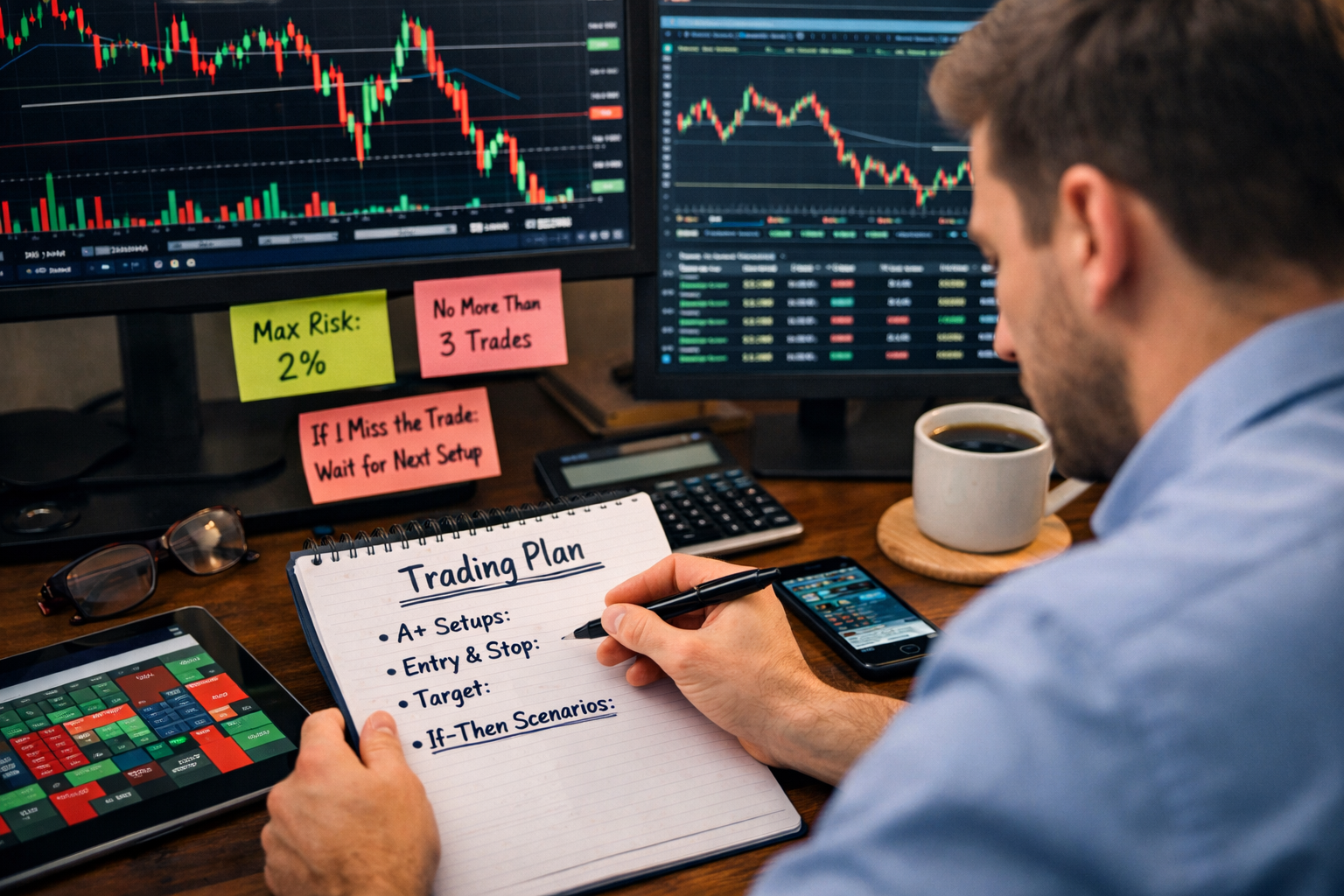
Most Traders Think the Problem Is Execution… It’s Not
If you ask most traders where things go wrong, they usually point to something that happened after the opening bell.
They say things like:
- “I chased that move.”
- “I hesitated and missed the entry.”
- “I got shaken out and then it worked.”
- “It took my money and I wanted it back.” Revenge Trading: The Psychological Trap – TraderInsight
But in many cases, the trade was already compromised before the market even opened.
That may sound blunt, but it should actually be encouraging.
Why? Because if the real problem is preparation, then the real solution is something you can control.
At TraderInsight, we believe consistency starts long before the first bar of the day begins to form. The trader who comes in prepared is not trying to invent a plan under pressure. They are there to execute a framework of professional trader preparation they have already built.
The Real Edge Happens Before the Bell
Professional traders do not sit down at the screen hoping the market will tell them what to do.
They come into the session with a working thesis, clearly defined levels, specific setups, and risk already mapped out. In other words, they have already done the hard thinking before the market begins moving fast.
This idea is supported by performance psychology.
Roy Baumeister’s work on willpower helped popularize the idea that self-control is a limited resource. Anders Ericsson’s research on elite performance emphasized structured preparation and deliberate practice over raw talent. Trading is no exception.
The takeaway is simple:
If you are relying on in-the-moment decision-making during the trading session, you are already giving yourself a harder job than necessary.
The market moves quickly. Volatility increases pressure. Emotions rise. This is not the ideal environment for building a plan from scratch.
Why Most Traders Feel Out of Control
Most traders do not actually have a discipline problem in the way they think they do.
More often, they have a clarity problem.
When there is no defined plan before the open, uncertainty takes over. And uncertainty has consequences.
It creates:
- Anxiety
- Hesitation
- Impulsive decisions
- Emotional reactions to normal price movement
This is how traders end up chasing moves they never planned to take. It is how they move stops because they suddenly “feel” the trade deserves more room. It is how they overtrade after missing a setup they had not fully thought through in advance.
Once uncertainty enters the process, emotion is rarely far behind.
What Professionals Do Differently
Professionals reduce uncertainty before it has a chance to affect execution.
They know what they are looking for before the market opens. They know what qualifies as an A+ setup. They know where they want to enter, where they are wrong, and where the trade is likely to go if it works.
Just as important, they know what they are not going to do.
That matters because good trading is not just about finding opportunity. It is also about filtering out everything that does not belong in your plan.
The Professional Pre-Market Standard
Strong professional trader preparation usually includes four things.
1. Identify A+ setups only
This means going into the session with a defined list of trade patterns or conditions that qualify for action. Not every chart is tradable. Not every move deserves attention.
2. Define the trade clearly
Before the open, professionals define:
- Entry
- Stop
- Target
The stop should come from the same timeframe being used for execution. If you are trading off a 5-minute chart, your stop should make sense on that 5-minute chart. The target should usually come from a larger timeframe, with daily structure often providing the cleanest context.
3. Build If–Then scenarios
Trading rarely unfolds perfectly. That is why professionals think ahead.
Examples include:
- If I miss the entry, then I do not chase.
- If volatility expands, then I reduce size or widen expectations based on structure.
- If I take the first loss, then I pause and reassess instead of forcing another trade.
4. Set firm limits
Before the session begins, professionals define:
- Maximum number of trades
- Maximum daily risk
- Conditions that would cause them to stop trading
This removes negotiation later, when emotion is more likely to interfere.
Why This Changes Everything
When the important decisions are already made, execution becomes cleaner.
- You are no longer improvising under pressure.
- You are no longer arguing with yourself mid-trade.
- You are no longer looking for the market to rescue a weak process.
Instead, you are doing what professionals do: executing a plan.
This is one of the biggest shifts a trader can make. Consistency does not begin with finding the perfect indicator or the hottest stock on the screen. It begins with reducing discretion and increasing clarity.
A Simple Exercise for Tomorrow’s Session
Before your next trading day, write down the answers to these four questions:
- What specific setups am I willing to trade today?
- Where is my stop based on my execution timeframe?
- Where is my target based on higher timeframe structure?
- What will I do if I miss the trade?
Do not just think about the answers. Write them down.
There is a major difference between having a vague intention and having a defined plan. If it is not written, it is usually not specific enough to hold up under pressure.
Where Most Traders Get Stuck
Many traders understand the importance of preparation intellectually. They know they should be more organized. They know they should define risk better. They know they should come in with more structure.
But knowing and doing are not the same thing.
Most traders struggle because they lack two things:
- Real-time structure
- Psychological self-awareness
Without those, even a good plan can break down quickly.
Why the Live Stream War Room Helps
One of the reasons traders join the Live Stream War Room is to stop preparing in isolation and start seeing how professionals organize a trading day in real time.
In the War Room, the goal is not to create noise or encourage random activity. The goal is to help traders think clearly before the market opens and stay grounded in process as the session unfolds.
That means focusing on:
- Pre-planned setups
- Important price levels
- Defined risk
- Structured trade ideas
- Execution rather than emotional reaction
For many traders, that kind of environment is the missing link between knowing what to do and actually doing it.
Why the MTRI Assessment Matters
Preparation is not only technical. It is psychological.
You can have a solid trade plan and still fail to execute it if your behavior under pressure is working against you.
That is why taking the MTRI assessment can be so valuable.
The MTRI is designed to help traders better understand how their current psychology aligns with the demands of professional trading. It helps identify areas such as:
- Impulse control
- Emotional reactivity
- Decision-making under pressure
- Self-regulation strengths and weaknesses
In other words, it gives traders a clearer picture of why they may be breaking down, even when they know better.
That kind of awareness is powerful, because once you can identify the real source of the problem, you can begin to fix it.
The Bottom Line
The market does not create most trading mistakes. It exposes the weaknesses that were already present in the process.
If you enter the session without clarity, structure, and defined risk, emotion will usually fill the gap.
That is why professional trader preparation matters so much.
It reduces uncertainty. It lowers emotional interference. It helps turn trading from a reactive activity into a deliberate one.
And that is where consistency begins.
What Comes Next
Preparation is the first pillar of the Professional Trader Performance Framework, but it is not the only one. Because even a good plan can fall apart if the process still relies too heavily on willpower.
In the next article, we will look at why discipline fails so many traders and why structure is often the real answer.
Take the Next Step
If you want to improve your preparation and see how this process looks in real time, joining the Live Stream War Room is a natural next step.
If you want a clearer understanding of how your psychology may be helping or hurting your performance, taking the MTRI assessment is a smart place to start.
Both are designed to help traders move beyond guesswork and build the kind of structure that supports long-term consistency.