
SpaceX IPO Trading Implications: Wall Street’s Biggest Private Trade Is About to Go Public
The upcoming SpaceX IPO could become one of the most important market events of the decade.
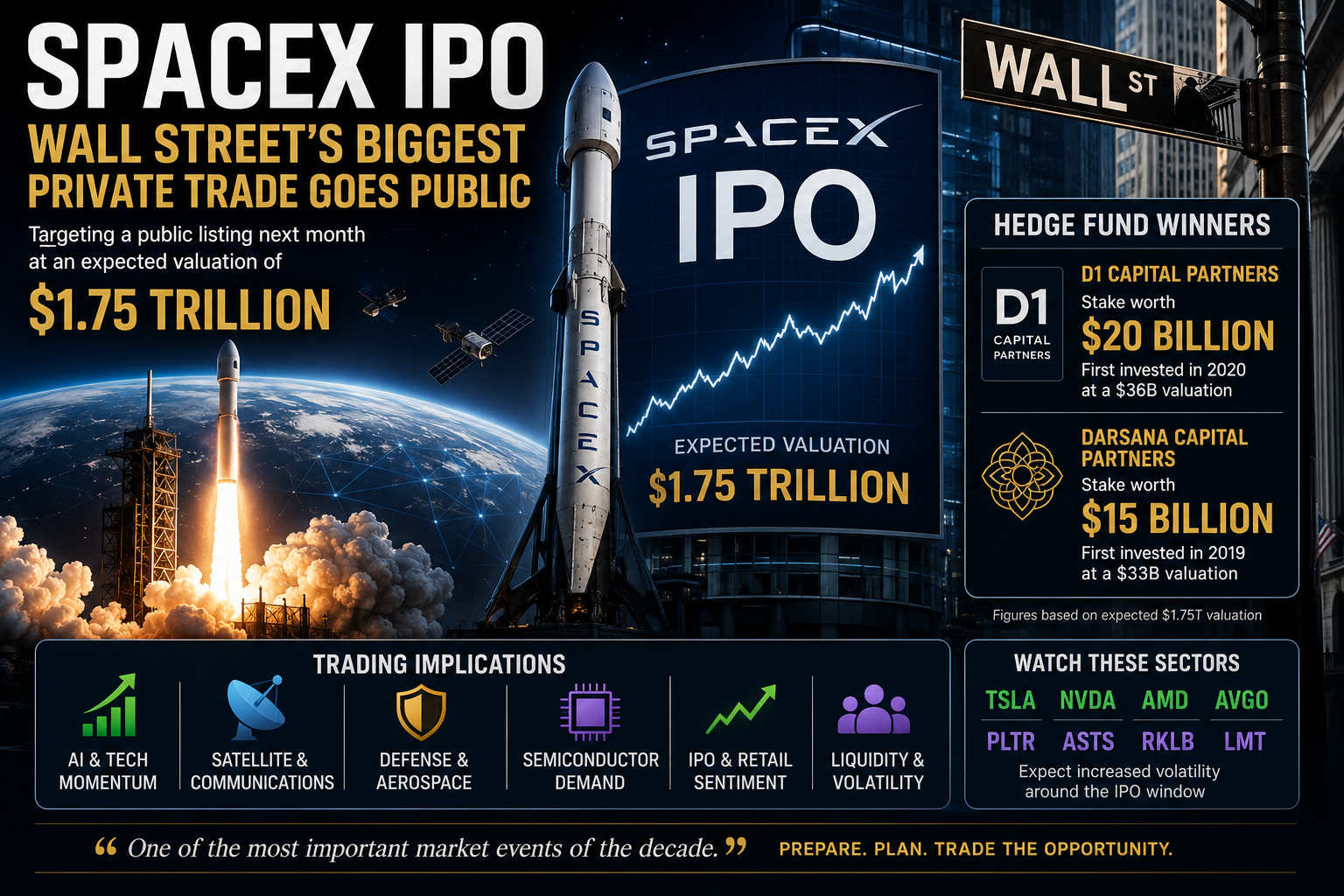
According to reports, Elon Musk is targeting a public listing next month that could value SpaceX at approximately $1.75 trillion. If that valuation holds, several hedge funds and private investors stand to generate extraordinary gains from positions accumulated years ago.
For traders, the real story is not just the IPO itself. The real story is the broader SpaceX IPO trading implications for momentum, liquidity, sector rotation, and speculative behavior across the market.
Wall Street’s Biggest Winners
Hedge fund D1 Capital Partners is expected to emerge as one of the largest beneficiaries. Dan Sundheim’s firm reportedly owns a stake worth roughly $20 billion at the anticipated IPO valuation.
D1 first invested in SpaceX in 2020 when the company was valued near $36 billion. That investment has become one of the most successful private market bets of the modern era.
Darsana Capital Partners is also expected to see massive gains, with holdings potentially valued near $15 billion if the IPO pricing holds.
The scale of these returns highlights how dramatically Wall Street has shifted toward private market investing over the last five years.
The Blurring of Public and Private Markets
The SpaceX IPO trading implications extend beyond aerospace.
Hedge funds, venture capital firms, and even crossover mutual funds have increasingly moved into private companies searching for returns unavailable in traditional equity markets.
That trend accelerated after 2020 as firms chased AI, defense technology, autonomous systems, and space infrastructure opportunities before public listings occurred.
SpaceX became one of the crown jewels of that movement.
Why Traders Should Care
SpaceX is no longer simply a rocket company.
Starlink now accounts for more than half of the company’s revenue, while Musk’s expanding ecosystem, including xAI, X, AI infrastructure, and satellite communications, provides exposure to multiple high-growth sectors simultaneously.
The SpaceX IPO trading implications could affect:
- AI infrastructure stocks
- Satellite and communications companies
- Defense contractors
- Semiconductor names
- Momentum-driven retail trading activity
- IPO-related speculation across growth sectors
Names like TSLA, NVDA, AMD, AVGO, PLTR, ASTS, RKLB, and defense-related momentum plays could all experience sympathy movement around the offering.
The Psychology Behind the IPO
One of the most important SpaceX IPO trading implications may be psychological.
Massive IPOs tend to create emotional market environments driven by:
- Fear of missing out
- Aggressive momentum chasing
- Excessive retail speculation
- Rapid sector rotation
- High intraday volatility
Traders should remember that emotionally charged IPOs often produce violent price movement both before and after the listing.
This is especially true when retail excitement collides with institutional positioning and limited float dynamics.
What Active Traders Should Watch
The best opportunities may not come from trading SpaceX directly.
Instead, active traders should monitor:
- Sympathy trades in aerospace and AI
- Liquidity rotation into speculative growth names
- Volume expansion in momentum sectors
- Institutional order flow around IPO-related headlines
- Potential volatility spikes in indexes heavily weighted toward technology
The first several sessions after pricing could become extremely important for intraday traders.
The key to navigating the SpaceX IPO trading implications will not be prediction. It will be preparation, structure, and disciplined execution.
The Bottom Line
The SpaceX IPO represents more than another large public offering.
It reflects the growing merger of private capital, AI speculation, technology infrastructure, defense spending, and retail momentum trading into one massive market event.
For traders, this could become one of the defining volatility and liquidity stories of the year.
And as always, when emotion rises, structure matters even more.