
The AI Memory Boom Is Minting New Trillion-Dollar Chip Giants
The AI trade has entered a new phase.
For much of the past two years, investors focused almost exclusively on companies building the “brains” of artificial intelligence — especially Nvidia, AMD, and the hyperscale cloud giants funding the data center buildout.
Now, Wall Street is aggressively rotating into another critical layer of the AI ecosystem: memory and storage.
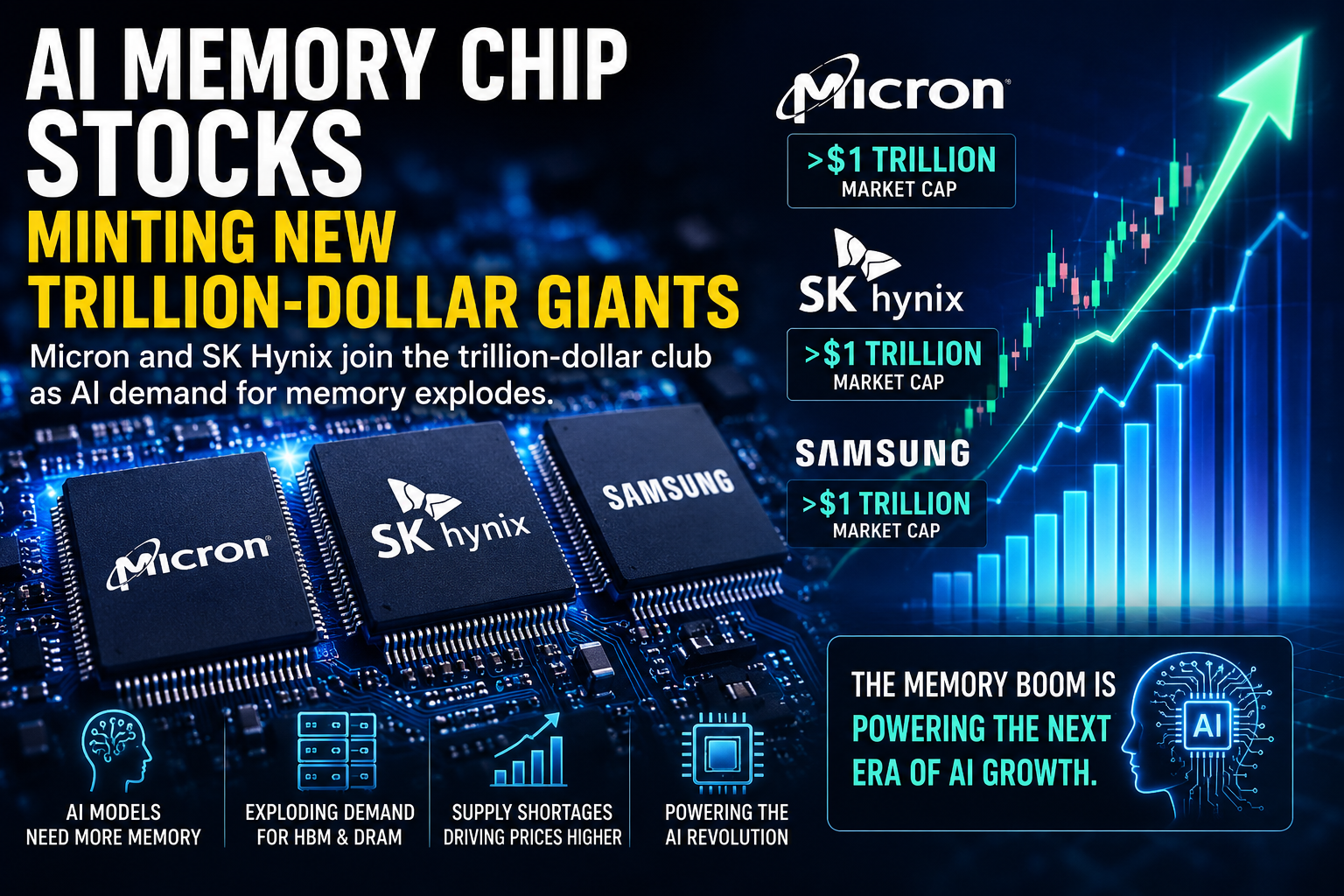
Micron and SK Hynix have now crossed the trillion-dollar valuation threshold in successive trading sessions, joining the elite group of companies whose market value reflects not just current earnings power, but the belief that they sit at the center of a generational technology shift.
This move shows that traders are no longer treating AI as a single-stock story. The AI infrastructure boom is broadening.
Why Memory Chips Have Become So Important
Early AI enthusiasm centered on GPUs and raw processing power. But as AI models become more advanced, another bottleneck has become increasingly important: memory.
Large language models such as ChatGPT, Gemini, and Claude require enormous amounts of high-bandwidth memory to process information quickly and efficiently. As AI usage moves beyond simple chatbot responses into coding agents, autonomous workflows, longer-running tasks, and reasoning models, systems need to retain and process more information in real time.
That has created explosive demand for advanced memory chips.
The biggest beneficiaries are companies such as Micron, SK Hynix, and Samsung, which provide the memory technology that allows AI systems to scale.
In other words, the market is beginning to realize that AI is not just about compute. It is about the entire infrastructure stack.
The AI Trade Is Broadening Beyond Nvidia
One of the most important developments for traders is that semiconductor leadership is expanding.
Earlier in the AI boom, Nvidia dominated the conversation. But more recently, institutional capital has started rotating into other AI beneficiaries, including memory suppliers, networking companies, CPU makers, data center infrastructure providers, and semiconductor equipment names.
That kind of broadening participation often tells traders that the theme is still alive.
Instead of collapsing, leadership is rotating.
We discussed a similar idea in our article on AI Chip Stock Pullback Signals a Critical Test for Traders, where the key issue was whether weakness in the sector represented the end of the AI trade or simply a healthy reset.
The current rally in memory stocks suggests that institutional money is still very interested in AI — but it is looking for the next layer of winners.
Why This Matters for Intraday Traders
For active traders, this kind of sector expansion creates opportunity.
When institutional money rotates aggressively through a major theme, it often produces the exact conditions intraday traders look for:
- Large opening gaps
- High-volume momentum moves
- Fast reversals
- Sector-wide sympathy trades
- Volatility around news and earnings
- Clean trend days when institutions are active
That is why semiconductor stocks remain one of the most important groups for traders to monitor.
Names tied to AI infrastructure can move sharply not only on their own news, but also on headlines from Nvidia, AMD, Micron, Samsung, SK Hynix, OpenAI, Microsoft, Google, Meta, and Amazon.
We explored this same relationship between AI spending and market volatility in AI Spending and Stock Market Volatility Explained.
Memory Shortages Could Keep the Theme Alive
The most important part of the memory-chip story is the supply-demand imbalance.
Demand for AI memory continues to outstrip available supply. If shortages continue into next year or even later in the decade, memory pricing could remain strong and earnings expectations could continue rising.
That is exactly the kind of backdrop that can keep a sector in play for traders.
Supply constraints, rising prices, strong earnings revisions, and massive institutional interest can create repeated trading opportunities — especially when stocks are already heavily watched and highly liquid.
This is also why traders should continue watching broader AI infrastructure names. The AI buildout is not limited to chips. It includes power, data centers, networking, cooling, cloud infrastructure, and storage.
For more on this broader theme, see our article AI Market Volatility: Understanding the Impact.
The Bigger Picture: AI Is Becoming Infrastructure
The market is increasingly treating AI as critical infrastructure rather than a speculative technology trend.
That matters.
When investors begin to view a technology as infrastructure, capital spending cycles can last much longer than most traders expect. Railroads, electricity, telecommunications, cloud computing, and now AI all followed a similar pattern: early excitement, massive investment, infrastructure bottlenecks, and then a long period of winners and losers emerging across the supply chain.
Memory-chip companies are now being rewarded because they solve one of the most important bottlenecks in the AI economy.
The trillion-dollar valuations for Micron and SK Hynix are not just about today’s earnings. They reflect the market’s belief that AI demand will continue reshaping the semiconductor industry for years.
Trading Implications
For traders, the message is clear: the AI trade is not over. It is evolving.
The opportunity is no longer just in one or two obvious leaders. It is spreading across the companies that provide the infrastructure required to keep AI systems running.
That means traders should continue monitoring:
- Micron
- SK Hynix
- Samsung
- Nvidia
- AMD
- Intel
- Semiconductor ETFs
- Cloud infrastructure stocks
- AI data center beneficiaries
At TraderInsight, this kind of environment is especially important because it often produces the volatility, liquidity, and institutional participation that create intraday opportunities.
We also covered similar trading implications in AI Chip Stock Selloff: What You Need to Know and Nvidia Stock Lagging in 2026: Key Reasons Explained.
Final Thoughts
The trillion-dollar rise of Micron and SK Hynix is another sign that AI is no longer just a software story or a GPU story.
It is an infrastructure story.
Memory, storage, compute, networking, and power are all becoming essential components of the AI economy. For investors, that creates new long-term themes. For traders, it creates movement, volatility, and opportunity.
The key is not to chase every headline.
The key is to understand where institutional money is flowing, identify the stocks most likely to move, and apply a disciplined trading process when opportunity appears.
That is where preparation matters most.
Related TraderInsight Articles
- Micron Stock Rally Reaches Historic Levels
- AI Chip Stock Pullback Signals a Critical Test for Traders
- AI Spending and Stock Market Volatility Explained
- AI Market Volatility: Understanding the Impact
- AI Chip Stock Selloff: What You Need to Know
- Nvidia Stock Lagging in 2026: Key Reasons Explained