
Apple Broadcom Chip Deal: $30 Billion Commitment Boosts U.S. Semiconductor Manufacturing
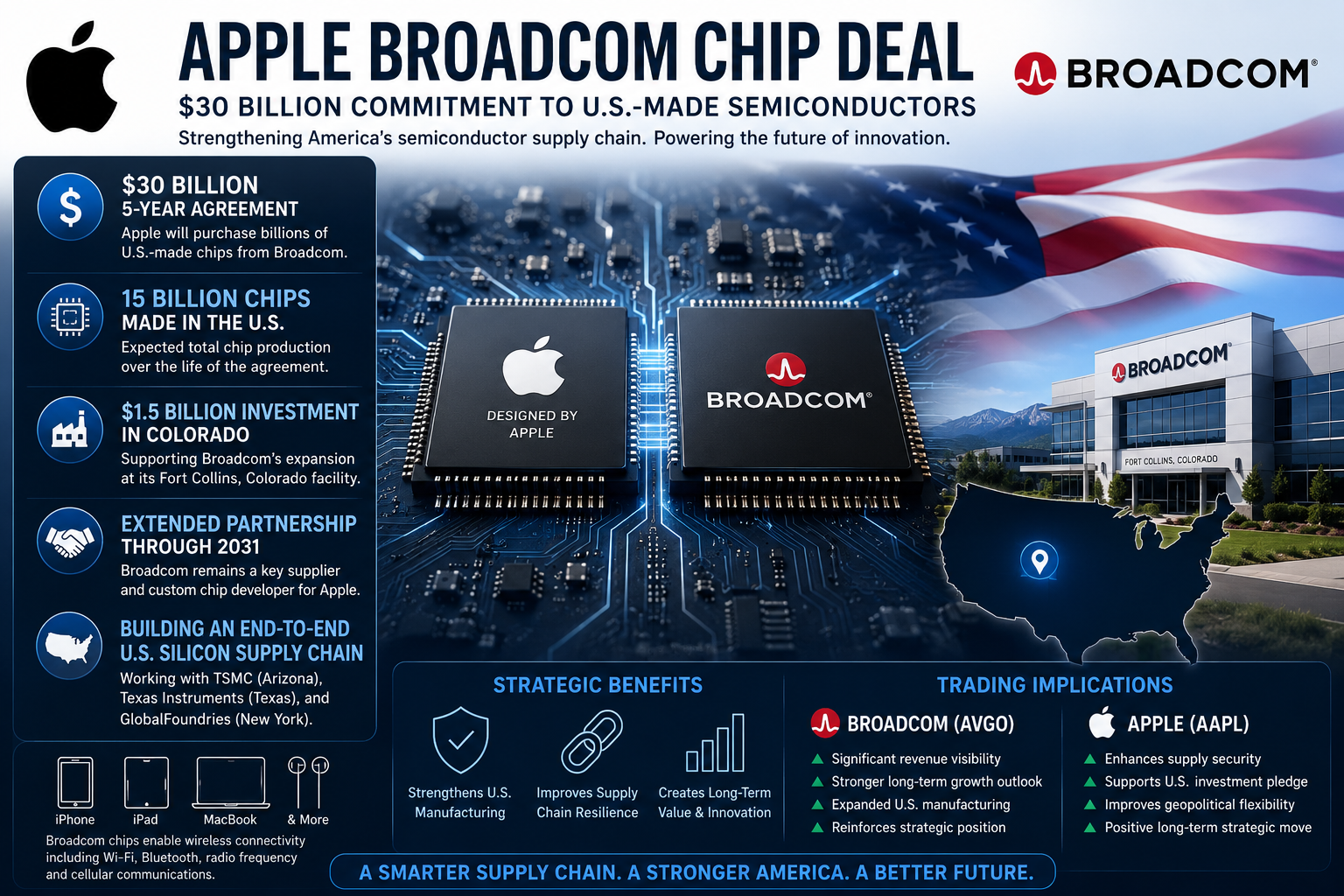
Apple has announced a landmark Apple Broadcom chip deal, committing $30 billion over the next five years to purchase billions of U.S.-manufactured semiconductor chips from Broadcom. The agreement represents the largest individual spending commitment under Apple’s previously announced $600 billion U.S. investment initiative and further strengthens America’s growing semiconductor industry.
The agreement also demonstrates Apple’s strategy of expanding domestic chip production without dramatically restructuring its global manufacturing footprint.
Apple Broadcom Chip Deal Expands Domestic Manufacturing
Under the Apple Broadcom chip deal, Apple expects approximately 15 billion chips to be manufactured in the United States during the life of the agreement.
The partnership will also fund a $1.5 billion expansion of Broadcom’s semiconductor manufacturing facility in Fort Collins, Colorado, creating additional domestic production capacity.
Broadcom supplies many of the wireless connectivity components found throughout Apple’s product lineup, including:
- Radio frequency chips
- Bluetooth controllers
- Wi-Fi connectivity chips
- Cellular communications components
These components are essential to virtually every iPhone, iPad, MacBook, and several other Apple devices.
Apple’s U.S. Silicon Strategy Continues to Grow
Rather than attempting the enormously difficult task of relocating final assembly away from Asia, Apple continues to focus on bringing production of its highest-value semiconductor components back to the United States.
The Apple Broadcom chip deal fits into a broader strategy of building what Apple calls an end-to-end American silicon supply chain.
In recent years, Apple has expanded partnerships with several major U.S.-based semiconductor manufacturers, including:
- TSMC’s Arizona fabrication facilities
- Texas Instruments’ Texas manufacturing operations
- GlobalFoundries in New York
Together, these investments strengthen domestic chip production while improving supply chain resilience.
Political and Economic Considerations
The announcement also carries political significance.
Apple previously pledged to invest $600 billion in the United States during President Donald Trump’s administration following increased pressure to expand American manufacturing.
The company faced potential tariffs after the administration warned that iPhone production remaining concentrated in Asia could result in higher import duties.
CEO Tim Cook acknowledged government support, stating that Apple is “grateful to the president and his administration for supporting important projects like this.”
Although Apple has highlighted numerous U.S. investments, the company has not detailed how much of the $600 billion commitment represents new spending versus investments already planned.
Broadcom Extends Long-Term Apple Partnership
Earlier this week, Broadcom also announced that its supply agreement with Apple has been extended through 2031.
Beyond supplying existing wireless chips, Broadcom will continue developing custom semiconductor solutions specifically designed for future Apple products.
The extended relationship provides Broadcom with exceptional revenue visibility while reinforcing its position as one of Apple’s most strategic suppliers.
Trading Implications
The Apple Broadcom chip deal could have meaningful implications for semiconductor investors and active traders.
Broadcom (NASDAQ: AVGO)
The announcement strengthens Broadcom’s long-term outlook by:
- Locking in significant recurring revenue.
- Supporting expansion of U.S. manufacturing capacity.
- Reinforcing its role as Apple’s preferred connectivity chip supplier.
- Increasing visibility into future earnings.
The contract extension through 2031 further reduces uncertainty surrounding one of Broadcom’s largest customers.
Apple (NASDAQ: AAPL)
For Apple, the agreement is less about near-term earnings and more about strategic positioning.
Benefits include:
- Improved semiconductor supply security.
- Reduced geopolitical risk.
- Stronger relationships with U.S. policymakers.
- Greater flexibility as advanced AI-enabled devices require increasingly sophisticated chips.
Investors are unlikely to see an immediate earnings impact, but the announcement supports Apple’s long-term supply chain resilience.
Semiconductor Sector
The agreement is another positive signal for domestic semiconductor manufacturing.
Companies benefiting from similar reshoring trends include:
- Taiwan Semiconductor Manufacturing
- Texas Instruments
- GlobalFoundries
The continued expansion of U.S. chip fabrication reinforces a multi-year investment theme that extends well beyond artificial intelligence alone.
Bottom Line
The Apple Broadcom chip deal represents far more than a supplier contract. It reinforces Apple’s long-term commitment to building a stronger domestic semiconductor ecosystem while providing Broadcom with one of the industry’s largest long-term customer commitments.
For traders, the agreement reinforces the structural strength of high-quality semiconductor companies involved in advanced chip manufacturing. While the news may not dramatically alter Apple’s near-term earnings outlook, it further supports the long-term bullish narrative surrounding semiconductor infrastructure, domestic manufacturing, and the continued reshoring of critical technology supply chains.