
The Everything Pill? Why GLP-1 Drugs May Be Healthcare’s Biggest Investment Story After AI
The GLP-1 investment opportunity is rapidly expanding beyond weight-loss medications into treatments for heart disease, kidney disease, sleep apnea, Alzheimer’s, addiction, cancer prevention and dozens of other conditions. As new clinical data continues to emerge, Wall Street is beginning to view these drugs less as obesity treatments and more as a platform technology capable of reshaping multiple industries.
That shift has already propelled Eli Lilly into the ranks of America’s largest profit generators, while rival Novo Nordisk continues to benefit from enormous global demand. Yet many analysts believe the industry’s growth is still in its early stages.
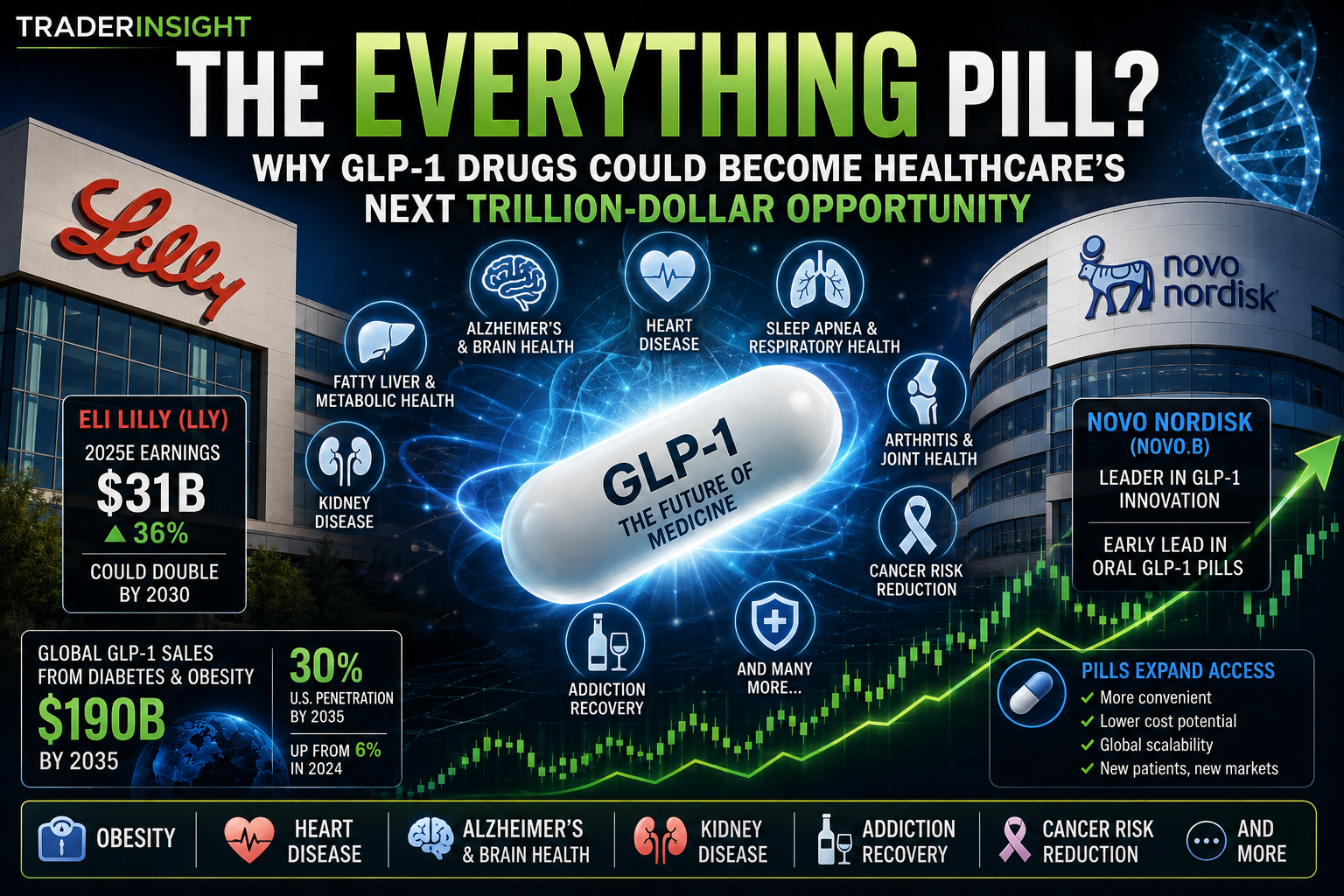
From Weight Loss to “The Everything Pill”
GLP-1 medications first captured public attention because of their remarkable ability to reduce body weight by controlling appetite and improving blood sugar regulation.
Drugs such as Eli Lilly’s Zepbound and Mounjaro, along with Novo Nordisk’s Ozempic and Wegovy, have become household names as demand has consistently exceeded manufacturing capacity.
But researchers are discovering that these medications influence far more than appetite.
GLP-1 receptors exist throughout the human body, including the brain, cardiovascular system, kidneys, lungs and immune cells. As scientists continue studying the class, evidence is mounting that these drugs may reduce inflammation—a biological process linked to many chronic diseases.
That expanding list of potential applications is why some analysts now describe GLP-1 therapies as becoming an “everything pill.”
One of Wall Street’s Fastest-Growing Profit Machines
The financial implications are enormous.
Eli Lilly is expected to generate approximately $31 billion in earnings this year, placing it among the largest profit-producing companies in the S&P 500. Analysts project that figure could nearly double by the end of the decade if demand continues expanding.
Morgan Stanley now estimates the combined market for GLP-1 medications treating diabetes and obesity alone could approach $190 billion annually by 2035—far above previous forecasts.
The GLP-1 investment opportunity continues growing because the addressable market keeps expanding. Obesity remains one of the world’s largest healthcare challenges, and treatment penetration remains relatively low despite rapid adoption.
Only a small percentage of eligible patients currently receive these therapies, leaving substantial room for long-term growth.
Insurance Is Finally Catching Up
One of the industry’s largest barriers has always been affordability.
That obstacle is beginning to disappear.
Earlier this year, Medicare expanded coverage for obesity treatments under a temporary program that is expected to become permanent after 2027. Meanwhile, employer-sponsored insurance plans continue increasing reimbursement for GLP-1 medications as long-term studies demonstrate improvements in overall health outcomes.
Lower out-of-pocket costs are expected to accelerate adoption significantly.
For pharmaceutical companies, broader insurance coverage means demand becomes driven less by personal wealth and more by medical necessity.
Pills Could Expand the Market Even Further
Until recently, GLP-1 therapies required weekly injections.
That changed with the arrival of oral formulations.
Novo Nordisk launched an oral version of Wegovy, while Eli Lilly followed with Foundayo, opening the market to patients who prefer pills over injections.
Oral medications also create new opportunities internationally, particularly in regions where refrigerated injectable products are more difficult to distribute.
Although injectable therapies remain the industry’s largest revenue source today, analysts expect pills to represent an increasingly important segment of future growth.
The Pipeline Keeps Getting Better
The current generation of GLP-1 medications may only represent the beginning.
Eli Lilly is developing retatrutide, a next-generation treatment that targets three metabolic pathways instead of one or two.
Clinical trials have demonstrated average weight loss approaching 28% of body weight—results rivaling bariatric surgery.
Researchers also believe retatrutide increases resting energy expenditure, allowing patients to burn more calories even while inactive.
Another experimental Lilly therapy, eloralintide, focuses on preserving muscle while maximizing fat loss. That addresses one of the most common concerns surrounding current GLP-1 therapies, where some patients lose meaningful muscle mass alongside body fat.
The GLP-1 investment opportunity therefore extends beyond today’s blockbuster drugs. Future generations may become even more effective while reducing side effects and improving long-term patient outcomes.
Beyond Obesity
Perhaps the most exciting aspect of GLP-1 research is the growing list of diseases under investigation.
Researchers are studying potential benefits for:
- Heart disease
- Sleep apnea
- Fatty liver disease
- Kidney disease
- Alzheimer’s disease
- Parkinson’s disease
- Drug and alcohol addiction
- Asthma
- Psoriasis
- Ovarian cysts
- Certain cancers
- Knee osteoarthritis
While not every clinical trial will prove successful, the sheer breadth of research highlights why investors increasingly view GLP-1 therapies as an entirely new therapeutic platform rather than a single drug category.
The Competitive Landscape
Although Eli Lilly currently leads many analysts’ rankings, competition remains intense.
Novo Nordisk continues developing improved formulations, including combination therapies designed to narrow the performance gap with Lilly’s products.
Meanwhile, smaller biotechnology companies including Structure Therapeutics and Viking Therapeutics are advancing their own oral GLP-1 programs, while larger pharmaceutical firms such as Amgen continue pursuing differentiated therapies.
Patent protection also remains favorable for current market leaders.
Lilly’s key U.S. patents extend into the mid-2030s, while additional manufacturing expertise creates another competitive advantage that generic producers may struggle to replicate quickly.
What Traders Should Watch
Investors should continue monitoring several key catalysts:
- Eli Lilly earnings and guidance.
- Clinical trial results for retatrutide and eloralintide.
- Expanded insurance reimbursement.
- Growth in oral GLP-1 adoption.
- Regulatory approvals for new indications.
- Manufacturing capacity expansion.
- Competitive pipeline developments from Novo Nordisk and emerging biotech companies.
Perhaps most importantly, traders should watch whether pharmaceutical companies continue demonstrating that GLP-1 medications improve outcomes across multiple disease categories rather than remaining primarily weight-loss treatments.
The Bottom Line
The GLP-1 investment opportunity is evolving into one of healthcare’s most compelling secular growth stories.
What began as breakthrough obesity treatments now appears capable of transforming numerous areas of medicine while creating one of the pharmaceutical industry’s largest profit opportunities in decades.
Artificial intelligence may remain Wall Street’s dominant investment narrative today, but GLP-1 therapies are quickly becoming healthcare’s equivalent—a platform technology with applications far beyond its original purpose.
For investors, the winners may not simply be the companies selling today’s blockbuster drugs. The greatest long-term opportunity could belong to those developing the next generation of metabolic therapies capable of improving health across an ever-expanding range of chronic diseases.