
Samsung AI Earnings Beat Expectations, but Shares Slide as Investors Worry About AI Spending
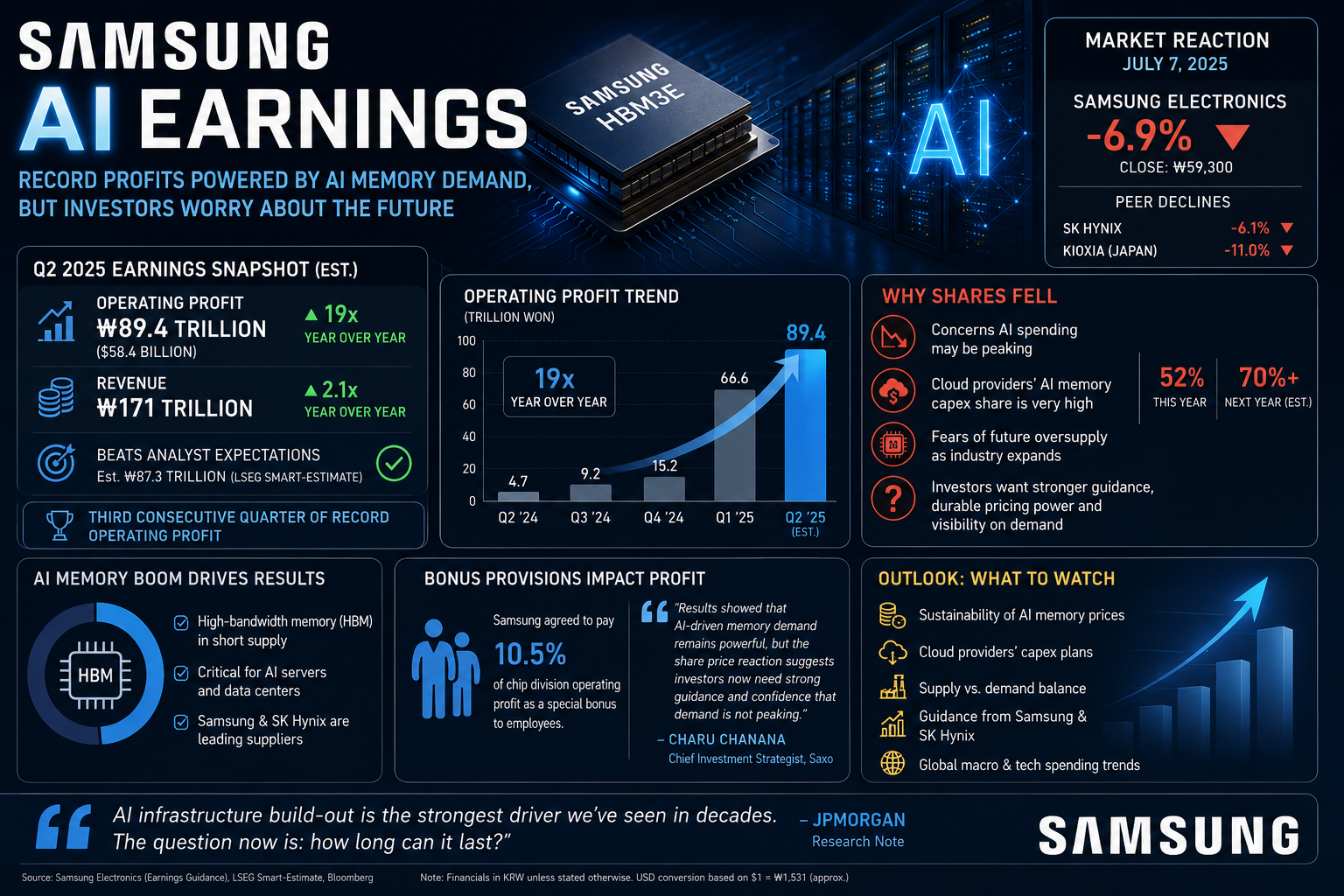
Samsung AI earnings topped Wall Street expectations for a third consecutive quarter, yet investors focused on a different story. Despite reporting record operating profits driven by booming demand for artificial intelligence memory chips, Samsung Electronics shares fell as much as 10% before closing down nearly 7%, reflecting growing concerns that the AI investment cycle may be approaching its peak.
The reaction highlights a changing market narrative. For much of the past two years, strong AI-related earnings have been enough to send semiconductor stocks higher. Now, investors are asking a more difficult question: how sustainable is the current pace of AI infrastructure spending?
Record Profits Fueled by AI Memory Demand
Samsung, the world’s largest memory chip manufacturer, forecast second-quarter operating profit of 89.4 trillion won ($58.4 billion), nearly nineteen times higher than the same period a year ago.
The result narrowly exceeded analyst estimates of 87.3 trillion won and surpassed the company’s total operating profit for all of last year. Revenue is expected to more than double year-over-year to approximately 171 trillion won.
The impressive Samsung AI earnings report reflects continued shortages of high-bandwidth memory (HBM) chips used to power artificial intelligence servers and data centers.
Samsung and fellow South Korean chipmaker SK Hynix remain the dominant suppliers of these advanced memory products, which have become essential components in AI systems built by cloud providers and hyperscalers.
Why the Stock Fell Anyway
Despite the record results, investors chose to sell the news.
Samsung shares closed down 6.9%, while SK Hynix lost more than 6% and Japan’s Kioxia dropped 11% in a broad semiconductor selloff.
The market’s concern is not about current profitability. Instead, investors are questioning whether today’s extraordinary AI spending levels can continue indefinitely.
Charu Chanana, Chief Investment Strategist at Saxo, noted that while demand for AI memory remains exceptionally strong, investors now want evidence that pricing power can remain durable and that demand is not beginning to peak.
The AI CapEx Question
The biggest issue surrounding Samsung AI earnings is whether hyperscale cloud companies can continue allocating such large portions of their capital budgets toward AI infrastructure.
According to JPMorgan, AI memory currently accounts for approximately:
- 52% of cloud providers’ capital expenditures this year
- More than 70% of projected capital expenditures next year
Those figures represent an extraordinary concentration of investment in one technology segment.
If enterprise AI adoption slows or cloud providers begin moderating infrastructure spending, memory pricing could come under pressure as manufacturing capacity continues expanding.
That possibility is increasingly becoming the market’s primary concern.
Margins Remain Strong
Even with investor concerns, Samsung continues benefiting from extremely favorable industry conditions.
High-bandwidth memory shortages have allowed manufacturers to raise prices significantly while expanding operating margins.
Samsung did note that operating profit was partially reduced by employee bonus provisions following a recent labor agreement. Under the new arrangement, employees in the semiconductor division will receive special bonuses equal to 10.5% of the division’s operating profit.
The company will provide additional financial details when it releases its full quarterly report later this month.
Trading Implications
The market’s reaction illustrates an important shift in investor psychology.
Strong earnings are no longer sufficient by themselves to drive semiconductor stocks higher. Instead, investors are increasingly focused on future guidance, capital spending trends, and the sustainability of AI demand.
For traders, key themes to monitor include:
- Future guidance from Samsung and SK Hynix
- Pricing trends for high-bandwidth memory chips
- Capital expenditure plans from major cloud providers
- AI infrastructure investment by Microsoft, Amazon, Alphabet, Meta, and Oracle
- Signs of supply catching up with demand
Semiconductor stocks remain highly sensitive to expectations, meaning even record earnings can trigger selling if investors believe peak growth may be approaching.
Bottom Line
Samsung AI earnings demonstrate that demand for AI memory chips remains exceptionally strong today. Record profits confirm that chipmakers continue benefiting from one of the largest infrastructure investment cycles in technology history.
However, markets are forward-looking. Investors are beginning to ask whether AI-related capital spending can continue growing at its current pace or whether the industry is moving closer to a period of supply-demand balance.
For now, Samsung remains one of the biggest winners of the AI revolution. But as yesterday’s sharp share price decline demonstrated, expectations have become so high that even outstanding earnings may not be enough unless companies can convince investors that the AI boom still has plenty of room to run.