
SpaceX Faces Its First Major Test as a Public Company
SpaceX will release its first earnings report as a public company after Tuesday’s closing bell, giving investors their first detailed look at the financial machinery behind one of the most heavily promoted—and most volatile—initial public offerings in market history.
The report arrives at a critical moment. SpaceX shares initially exploded higher following the company’s June IPO but have since fallen sharply as investors reconsider the valuation, the enormous cost of its artificial-intelligence ambitions, and the prospect of a flood of previously restricted shares entering the market.
SpaceX stock briefly touched a record low of $104.83 Monday before reversing sharply and closing at approximately $114.53, up 5.7% for the session. Even after that rebound, the shares remain roughly 15% below the $135 IPO price and nearly 50% below their June 16 intraday high of $225.64.
Tuesday’s results could determine whether Monday’s reversal represents the beginning of a tradable recovery—or merely short covering ahead of another major volatility event.
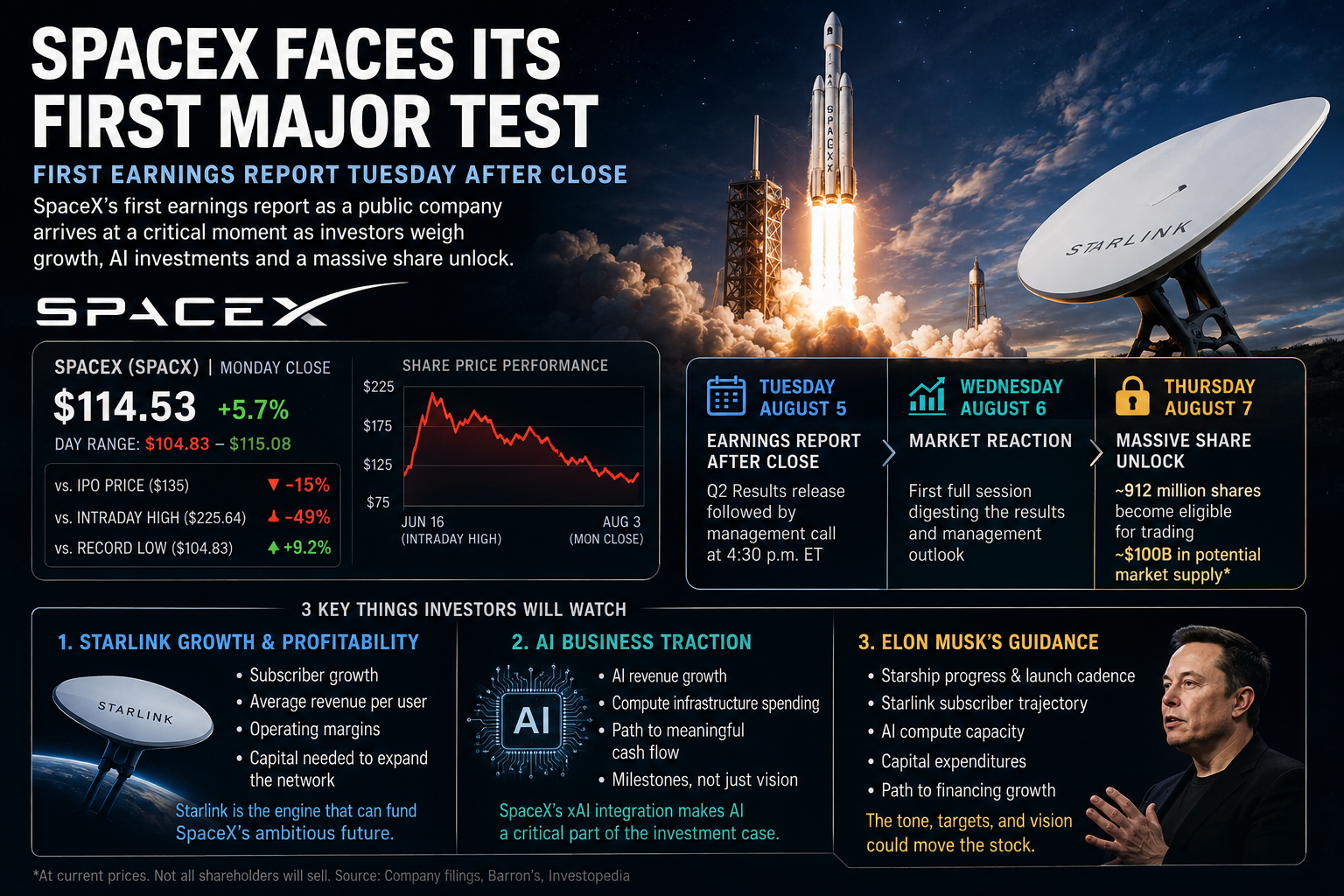
What Investors Will Watch in the SpaceX First Earnings Report
1. Can Starlink Support the Valuation?
Starlink remains the most established and economically visible part of the SpaceX business. Investors will be looking closely at subscriber growth, average revenue per customer, operating margins, equipment costs, and the capital required to continue expanding the satellite network.
The central question is no longer simply whether Starlink can grow. It is whether the business can generate enough recurring cash flow to help finance SpaceX’s launch operations, Starship development, terrestrial computing infrastructure, and increasingly ambitious AI projects.
Analysts are expecting substantial second-quarter revenue growth, although published estimates differ considerably because SpaceX is reporting publicly for the first time and analysts are still determining how to value the company’s newly combined businesses. SpaceX has confirmed that it will release second-quarter results after the close Tuesday, followed by a management webcast at 4:30 p.m. Eastern.
A strong Starlink report would help investors separate the company’s existing operating business from the more speculative projects embedded in its valuation. Slowing subscriber growth, contracting margins, or unexpectedly high network expenses could have the opposite effect.
2. How Much Is SpaceX Spending on Artificial Intelligence?
The SpaceX first earnings report will also provide an early test of Elon Musk’s decision to combine SpaceX with xAI. Regulatory filings describe xAI as an integral part of the consolidated company, including its AI-compute infrastructure, Grok chatbot, and X platform.
That combination dramatically changed the SpaceX investment story. The company is no longer valued only as a rocket-launch and satellite-connectivity business. Investors are also being asked to assign value to AI models, terrestrial computing clusters, future space-based data centers, and software applications that may take years to generate dependable profits.
The market will therefore focus on several AI-related questions:
- How quickly is AI revenue growing?
- How much capital is being consumed by computing infrastructure?
- When could the segment begin contributing meaningful cash flow?
- Will SpaceX provide measurable milestones rather than long-range aspirations?
SpaceX has also disclosed a compute-and-option agreement with Anysphere, the company behind Cursor. The filing describes Cursor as a potential extension of SpaceX’s strategy to integrate computing infrastructure, AI models, and software applications. It does not describe Cursor as a completed acquisition, making that distinction important when evaluating the company’s current operations.
This may be the most important risk in Tuesday’s report. Investors have demonstrated that they will tolerate tremendous spending when management can show accelerating revenue, expanding demand, and a believable path toward returns. They become far less patient when capital expenditures increase faster than evidence of commercial traction.
3. Will Musk Offer Concrete Guidance?
The headline earnings numbers may produce the initial after-hours move, but Elon Musk’s comments could determine whether that move holds.
Investors will listen for updates on Starship testing, launch cadence, Starlink subscriber growth, AI-compute capacity, capital expenditures, and the company’s ability to finance its expansion without repeatedly returning to the capital markets.
General statements about transforming civilization may excite long-term supporters, but the stock may now require more immediate operating milestones. After losing hundreds of billions of dollars in market value, SpaceX needs to demonstrate that its execution can begin catching up with the expectations built into its valuation.
This creates substantial headline risk during the call. A single comment about delayed projects, accelerating expenses, new financing needs, or slower-than-expected demand could quickly reverse the first move in the shares.
The Thursday Share Unlock May Matter as Much as Earnings
Tuesday’s earnings report is only the first of two major catalysts facing SpaceX this week.
On Thursday, August 6, approximately 912 million previously restricted shares are expected to become eligible for trading as IPO lockup provisions expire. At current prices, those shares represent roughly $100 billion in potential market supply.
Not every eligible shareholder will sell. Early investors, employees, and company insiders may continue holding their positions. Nevertheless, traders must account for the possibility that even a relatively small percentage of those shares could materially increase supply.
The unlock also creates competing forces.
Existing shareholders may use any post-earnings rally to reduce their exposure. At the same time, short sellers who have profited from the decline may cover positions before or during the unlock, creating sharp rallies inside an otherwise bearish structure.
That combination could produce unusually wide intraday ranges, rapid reversals, opening gaps, and price movements that appear disconnected from the company’s fundamental news.
Trading Implications for Tuesday
For Tuesday’s regular session, SpaceX will be trading ahead of an after-hours event rather than in response to completed earnings information. That distinction matters.
Monday’s reversal from $104.83 to a $114.53 close suggests that some traders may already be covering short positions or positioning for a better-than-feared report. The rebound creates positive short-term momentum, but it does not erase the larger decline from the IPO peak.
Tuesday traders should watch three areas of price behavior:
Monday’s High and Closing Range
If SpaceX holds above Monday’s closing area and begins accepting price above Monday’s high, buyers may attempt to extend the pre-earnings squeeze. A sustained move would suggest that traders are unwilling to remain aggressively short into the announcement.
The $110 Area
The region around $110 has become an important psychological and recent trading area. Holding above it would preserve Monday’s recovery structure. A decisive failure below it could indicate that the rebound was driven primarily by short covering rather than committed institutional accumulation.
Monday’s Low at $104.83
This is the most important nearby downside reference. A break below Monday’s low before earnings would place the stock at a new record low and signal that sellers remain in control despite the approaching announcement.
Because the report will not arrive until after the market closes, traders should be cautious about carrying oversized positions into the final minutes of the session. A profitable intraday trade can quickly become an uncontrolled earnings gamble when held beyond the closing bell.
What to Watch Wednesday Morning
Wednesday’s opening gap will reveal the market’s initial verdict on the SpaceX first earnings report—but the first move may not be the lasting move.
The report combines several businesses, a limited history of public financial disclosure, enormous capital requirements, and an unusually active retail shareholder base. That makes interpretation more difficult than a conventional earnings comparison involving revenue and earnings per share.
A strong opening gap should be evaluated against the after-hours high, premarket high, IPO price at $135, and any major volume concentrations created during the stock’s decline. If price gaps higher but cannot hold the opening range, the result could become a sell-the-news event.
A negative gap presents a different challenge. With short interest already elevated and the share unlock approaching Thursday, an initial collapse could attract both short sellers pressing the move and existing shorts attempting to take profits. That creates the conditions for violent countertrend reversals.
Rather than predicting which narrative will prevail, traders can allow the opening structure, liquidity, volume, and reaction around clearly defined price levels to determine whether the opportunity is continuation, gap reversion, or no trade at all.
The Bottom Line
The SpaceX first earnings report is about more than one quarter’s revenue or profit. It is the market’s first opportunity to evaluate whether the company’s operating results can begin supporting the enormous expectations created by its IPO.
Starlink must demonstrate durable growth. Management must explain how its AI investments can eventually generate returns. Elon Musk must give investors enough measurable guidance to support confidence beyond the immediate earnings call.
Even then, the company must navigate Thursday’s release of approximately 912 million locked-up shares.
That sequence makes SpaceX one of the market’s most important volatility stocks this week. The opportunity may be substantial, but so is the risk. Traders should focus on price structure, liquidity, predefined entries and exits, and disciplined position sizing rather than trying to predict what Musk—or the market—will say next.
Trade the reaction, not the story.
TraderInsight provides market commentary and trading education. Nothing in this article constitutes personalized investment advice or a recommendation to buy or sell any security.
Additional Reading:
SpaceX: A First Look At Financials (Pending:SPCX) | Seeking Alpha
SpaceX’s first-ever earnings report comes as stock hits new all-time low: Q2 preview
SpaceX – Financials
Prediction: Here’s What SpaceX Stock Will Do After Its First Earnings Report | The Motley Fool
Musk’s SpaceX Reveals Its Finances for the First Time as It Readies for IPO – The New York Times