
How Trump’s Speech Could Impact the Stock Market Tonight
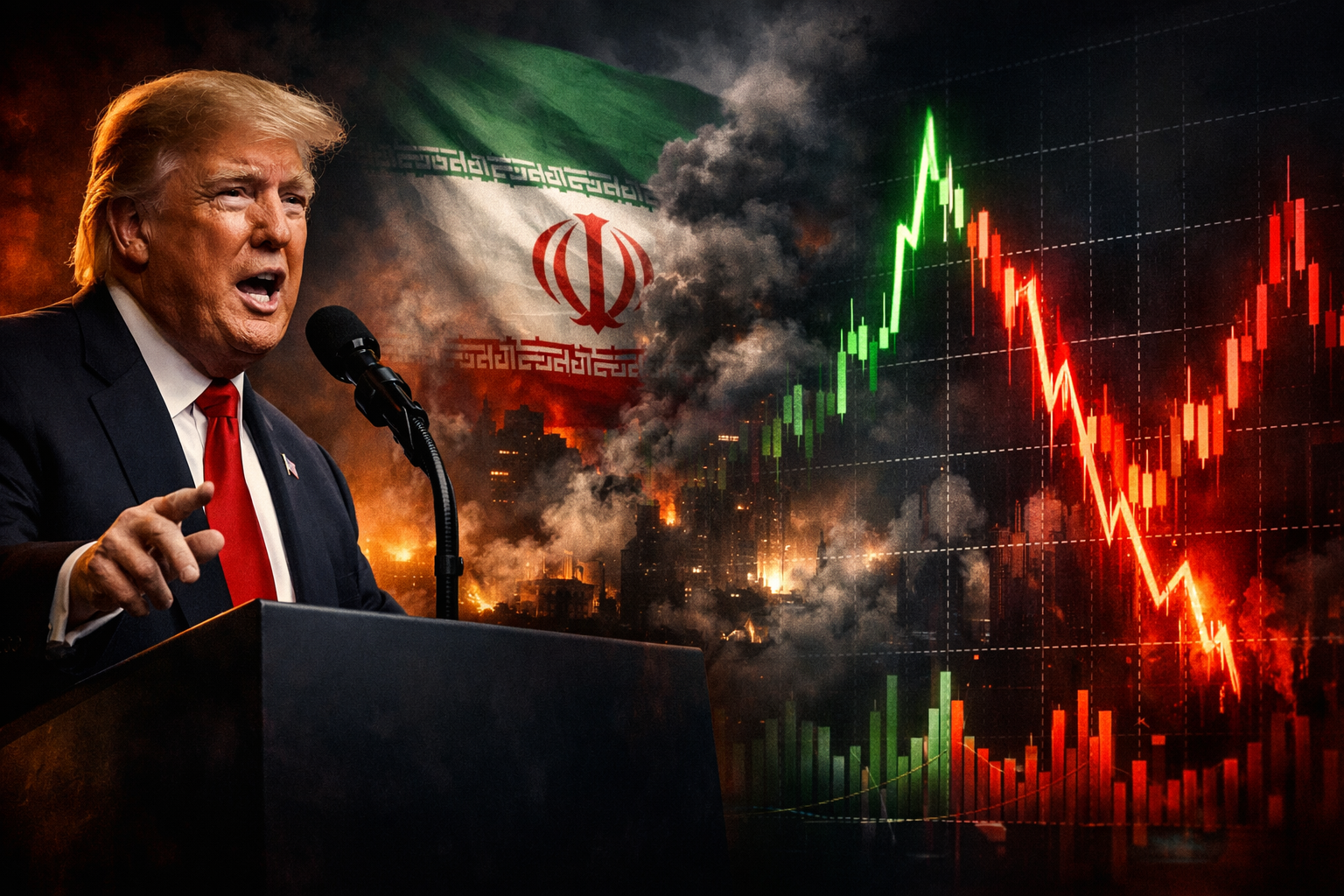
Why Tonight’s Speech Matters
Most presidential speeches do not move markets for very long.
But tonight may be different.
Markets are already trading on expectations tied to the war in Iran, oil prices, and the possibility of de-escalation. That means the Trump speech’s impact on the stock market could show up quickly in futures, sector rotation, and opening volatility tomorrow.
For traders, the issue is not politics.
It is price.
And price tends to move fastest when expectations are high, and positioning is vulnerable.
What the Market Is Pricing In Right Now
At the moment, the market appears to be pricing in at least the possibility that tensions could ease.
That has already shown up in falling oil prices, improving sentiment, and a relief bid in equities.
We have seen this kind of reaction before. When macro fear begins to soften, stocks can rally sharply even if the underlying uncertainty has not fully disappeared.
That is why traders need to stay focused on capital flows, not headlines alone.
If you want more context on how geopolitical headlines filter into price action, read Geopolitical Risk for Traders.
And if you want to understand how headline-driven reversals can develop when policy fears begin to ease, see Markets Rebound as Trade Tensions Ease.
Three Possible Market Scenarios After the Speech
1. Bullish Scenario: Clear De-Escalation Message
If Trump sounds confident that the conflict is nearing an end, markets may interpret that as a green light for risk-on positioning.
That would likely favor:
- Technology and growth stocks
- Consumer discretionary names
- Airlines and transport if oil continues lower
- Broad index strength in the S&P 500 and Nasdaq
In that case, the Trump speech’s impact on the stock market would likely be bullish at first, as traders would see lower energy prices, less geopolitical uncertainty, and less need for defensive positioning.
But that does not automatically mean a straight-up move.
A gap higher after a heavily anticipated speech can still produce an opening fade or reversal if too much optimism was priced in ahead of time.
2. Bearish Scenario: Escalation, Ambiguity, or Contradiction
If the speech turns more aggressive, leaves too many unanswered questions, or introduces new geopolitical uncertainty, the market could reverse quickly.
That would likely favor:
- Energy and defense
- Gold and safe-haven flows
- Higher volatility
- Pressure on indexes and risk assets
This kind of reaction is especially dangerous for traders who mistake a strong narrative for a confirmed trend.
Headline environments often produce false starts, emotional entries, and rapid reversals.
That is one reason structure matters so much when the market is reacting to macro uncertainty.
For more on that idea, read Structured Trading Execution for Better Results.
3. Most Likely Scenario: Volatility First, Direction Later
This may be the highest-probability outcome.
The speech creates an immediate reaction.
Futures move.
Overnight positioning shifts.
Then the market opens, and traders are forced to decide whether the initial move was justified.
That often leads to exactly the kind of trading environment active traders know well:
- fast moves at the open
- wide candles
- emotional chasing
- failed breakouts
- sharp first-hour reversals
This is where the Trump speech stock market impact may matter most—not in the speech itself, but in how traders react once cash trading begins.
What Traders Tend to Get Wrong in These Environments
Most traders think the edge comes from predicting what will be said.
Usually, it does not.
The edge comes from preparing for multiple outcomes and then executing the right plan when one of them begins to unfold.
That is why professional traders focus less on opinion and more on preparation.
If you have not already read it, Professional Trader Preparation explains why most traders fail before the market even opens.
And Using Structure in Trading: Why Execution Is Binary explains why execution matters more than outcome-based thinking when markets are moving fast.
How to Approach Tomorrow’s Open Professionally
Rather than trying to guess what the market should do, traders should prepare for what it could do.
A practical approach would include:
- mapping pre-market highs and lows
- identifying likely gap zones
- noting key index levels in QQQ, SPY, and ES
- watching oil and defense stocks for confirmation
- waiting for the structure before entering
This is not the kind of market where impulsive trading tends to hold up well.
When traders feel pressure to “do something” simply because the news is big, they often end up overtrading, chasing, or reacting to noise.
That is why these two articles are especially relevant here:
The Bigger Lesson
The real Trump speech stock market impact may not come from the words alone.
It may come from how those words interact with positioning, fear, hope, and existing capital flows.
That is how markets work in headline-driven environments.
They do not move only on facts.
They move on expectations, repricing, and emotion.
For traders, that means the goal is not prediction.
The goal is readiness.
Final Thought
If tonight’s speech leads to a strong move in futures, do not assume the first move is the final move.
Big macro events often create the greatest opportunities for traders who stay patient, define their risk, and let the market show its hand first.
That is where preparation becomes an advantage.
That is where structure beats emotion.
And that is where professionals separate themselves from reactive traders.
If you want more insight into how we think about news, volatility, and execution, explore these related articles from the TraderInsight archive: