
Westinghouse IPO Signals the Next Phase of the AI Power Boom
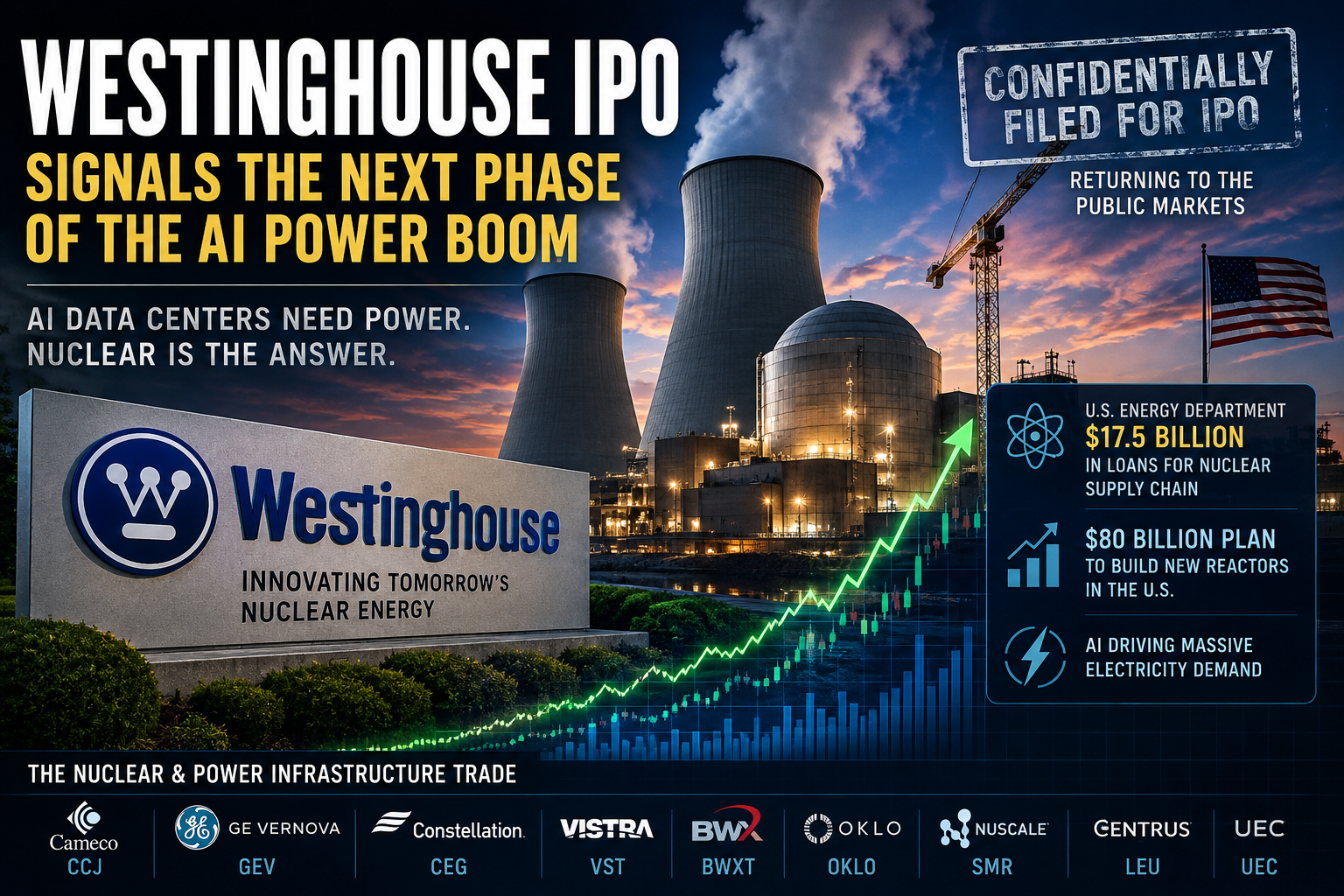
Westinghouse Electric has confidentially filed for an initial public offering, positioning one of the nuclear power industry’s most established companies to benefit from the enormous electricity requirements of artificial intelligence.
The proposed Westinghouse IPO arrives as investors, technology companies and the federal government increasingly view nuclear energy as a critical part of the infrastructure needed to support AI data centers, manufacturing growth and rising electricity demand.
Westinghouse has not yet disclosed how many shares it plans to offer, the expected price range or the timing of the listing. But the confidential filing represents an important step toward returning the company to the public markets nearly a decade after reactor construction problems pushed it into bankruptcy.
For traders and investors, the Westinghouse IPO may become one of the clearest signs yet that the AI investment cycle is expanding beyond semiconductors, software and data centers into the power systems required to keep those technologies running.
What Is Behind the Westinghouse IPO?
Westinghouse Electric is a Pennsylvania-based nuclear technology and services company jointly owned by Brookfield and uranium producer Cameco.
Brookfield controls 51% of Westinghouse, while Cameco owns the remaining 49%. The current owners completed their acquisition of the company in 2023 in a transaction valued at approximately $7.9 billion.
The decision to pursue a Westinghouse IPO could provide the company with access to a broader pool of capital as it prepares for what may become a significant expansion of nuclear power development in the United States and overseas.
Confidential IPO filings allow companies to begin working with the Securities and Exchange Commission without immediately disclosing detailed financial statements, risk factors or proposed offering terms to the public.
Westinghouse can now continue preparing for a listing while evaluating market conditions. The company is not required to complete the IPO, and the final timing will likely depend on investor demand, equity market conditions and progress on future reactor projects.
AI Is Creating an Electricity Problem
The AI boom is often discussed as a race for faster chips, more powerful models and larger data centers. But beneath all of those developments is a much more fundamental requirement: electricity.
AI data centers require enormous amounts of reliable, around-the-clock power. As technology companies invest hundreds of billions of dollars in computing infrastructure, access to electricity is becoming one of the industry’s most important constraints.
That has pushed nuclear energy back into the center of the investment conversation.
Unlike intermittent power sources, nuclear plants can produce large quantities of electricity continuously. That makes nuclear energy particularly attractive for data centers that cannot afford interruptions and require stable power every hour of the day.
The Westinghouse IPO could therefore give public-market investors exposure to a company positioned at the intersection of three powerful trends:
- Rapid growth in AI data-center construction
- Rising demand for dependable electricity
- A renewed US commitment to nuclear energy
The AI trade may have started with companies such as Nvidia, Microsoft, Amazon and other technology leaders. But the next phase increasingly involves utilities, grid equipment, natural gas, uranium, nuclear components and reactor technology.
Westinghouse Could Sit at the Center of the US Nuclear Revival
Westinghouse is best known for its AP1000 reactor, a large-scale nuclear design that has become central to plans for expanding US nuclear generating capacity.
Six AP1000 reactors are currently operating worldwide, while another 14 are reportedly under construction. Poland, Ukraine and Bulgaria have also selected or ordered Westinghouse reactor technology.
In the United States, the AP1000 is already operating at Georgia Power’s Plant Vogtle. The facility’s two newer reactors were the first newly constructed commercial nuclear units to enter service in the country in more than three decades.
The Vogtle project also illustrates the risks surrounding large nuclear construction projects. The reactors were completed years behind schedule and at a cost substantially above initial estimates.
Those delays contributed to Westinghouse’s 2017 bankruptcy and remain one of the central issues investors will need to consider when evaluating the Westinghouse IPO.
Supporters argue that building multiple reactors using a standardized design could reduce future costs and improve construction efficiency. Critics point out that large nuclear projects have repeatedly experienced delays, regulatory challenges and budget overruns.
The US Government Is Providing Major Financial Support
The proposed Westinghouse IPO is arriving alongside substantial federal support for rebuilding the American nuclear industry.
The US Department of Energy announced $17.5 billion in conditional nuclear supply-chain loans intended to finance long-lead components for 10 large-scale commercial reactors.
The program is designed to accelerate reactor deployment by as much as three years and rebuild domestic manufacturing capacity for specialized nuclear components.
Those proposed reactors are expected to use Westinghouse AP1000 technology, making Westinghouse one of the most direct potential beneficiaries of the initiative.
The government has also announced a broader partnership involving at least $80 billion of potential Westinghouse reactor construction in the United States. The initiative includes financial support associated with Japanese investment commitments.
If qualifying reactor orders are placed before 2029 and Westinghouse reaches certain valuation thresholds, the US government could receive rights connected to a future equity interest in the company.
That unusual arrangement could make the Westinghouse IPO very different from a conventional public offering. Investors will need to closely examine the ownership structure, warrants, government rights and potential dilution once the company releases its registration statement publicly.
The Westinghouse IPO Is Part of a Larger Nuclear Listing Wave
Westinghouse is not the only nuclear company seeking access to the public markets.
A growing group of reactor developers, fuel producers and nuclear supply-chain companies has recently pursued or announced public offerings as investor interest in the sector expands.
Holtec International filed for an IPO as it seeks capital for a multibillion-dollar small modular reactor program. X-energy raised capital through a Nasdaq listing, while nuclear fuel manufacturer Standard Nuclear has also filed to go public.
This growing pipeline suggests that the Westinghouse IPO is part of a broader effort to finance the next generation of American nuclear infrastructure.
Until recently, many publicly traded nuclear investments were concentrated in uranium miners, utilities and a relatively small group of speculative reactor developers. Westinghouse could offer something different: an established nuclear technology and services business with operating reactors, an installed customer base and recurring maintenance demand.
Westinghouse Is More Than a Reactor Construction Story
Investors may initially view the Westinghouse IPO primarily as a bet on new AP1000 reactor construction. But the company’s business extends beyond building new plants.
Westinghouse provides nuclear fuel, engineering, maintenance, replacement parts, outage services and technology to reactor operators around the world.
That installed base may provide recurring revenue even when new reactor construction is slow.
This distinction could become important when Westinghouse publishes its financial statements. New reactor projects can produce large but uneven revenue opportunities, while servicing existing reactors may provide a more stable source of cash flow.
The market will want to know how much of Westinghouse’s current business comes from recurring services compared with new construction, licensing and major government-supported projects.
What the Westinghouse IPO Could Mean for Cameco and Brookfield
The Westinghouse IPO could also have significant implications for Cameco and Brookfield.
Cameco gained exposure to the entire nuclear fuel cycle when it acquired its Westinghouse stake. The uranium producer already benefits from rising uranium demand, while Westinghouse adds reactor technology, fuel fabrication and nuclear services.
A strong public valuation for Westinghouse could increase the perceived value of Cameco’s 49% ownership interest.
Brookfield could also benefit by monetizing part of its position while potentially retaining a substantial ownership stake in the public company.
Investors should not assume that the IPO will result in either owner exiting completely. The number of primary shares issued by Westinghouse and secondary shares sold by existing owners will not be known until the registration documents become public.
Stocks That Could Move With the Nuclear AI Trade
The Westinghouse IPO may draw additional attention to publicly traded companies connected to nuclear power, uranium and electricity infrastructure.
Names traders may watch include:
- Cameco (CCJ): Uranium producer and 49% owner of Westinghouse
- Brookfield Renewable (BEPC/BEP): Part of the Brookfield ownership group behind Westinghouse
- BWX Technologies (BWXT): Nuclear components, fuel and services provider
- Constellation Energy (CEG): Major US nuclear power plant operator
- Vistra (VST): Power producer with nuclear generation exposure
- GE Vernova (GEV): Power equipment company with exposure to nuclear technology through GE Hitachi
- Oklo (OKLO): Advanced nuclear reactor developer
- NuScale Power (SMR): Small modular reactor technology company
- Centrus Energy (LEU): Supplier of enriched uranium fuel
- Uranium Energy Corp. (UEC): US-focused uranium mining company
These companies have different business models and risk profiles. Some generate meaningful revenue and cash flow today, while others depend heavily on future regulatory approvals, financing and successful project development.
The announcement of a Westinghouse IPO could create renewed momentum across the group, but traders should avoid treating every nuclear-related stock as interchangeable.
What Traders Should Watch Before the Westinghouse IPO
Because the filing is confidential, many of the most important details are not yet available.
Before evaluating the Westinghouse IPO, traders should watch for the public release of the company’s registration statement and examine several key areas.
1. Revenue and Profit Growth
Investors will want to know how quickly Westinghouse is growing, whether it is profitable and how much cash the company generates from its existing operations.
2. Dependence on Government Support
Federal backing could accelerate Westinghouse’s growth, but investors should determine how much of the company’s future outlook depends on government loans, reactor orders and political commitments.
3. Construction and Execution Risk
Westinghouse’s bankruptcy remains a reminder that nuclear construction can expose companies to enormous cost overruns. The registration statement should explain whether Westinghouse will take construction risk directly or focus on licensing, engineering, equipment and services.
4. Ownership and Potential Dilution
The IPO documents should clarify how much of the company Brookfield and Cameco plan to retain, whether the US government could receive equity and how warrants or other agreements may dilute future shareholders.
5. Proposed Valuation
A strong business can still be a poor investment when the offering price assumes too much future growth. Reports have pointed to a potential valuation measured in the tens of billions of dollars, but no official range has been announced.
6. The IPO Lockup Period
Traders should monitor when existing owners and insiders will be permitted to sell shares following the offering. Lockup expirations can create additional supply and volatility.
7. Initial Trading Structure
The first several sessions following a major IPO can produce wide price ranges, limited historical reference points and aggressive momentum. Traders should wait for clear structure rather than chasing an emotionally charged opening move.
The Risks Behind the Nuclear Renaissance
The investment case for nuclear energy is powerful, but it is not without substantial risk.
Large reactor projects require enormous amounts of capital and can take many years to complete. They face regulatory requirements, specialized labor shortages, complex supply chains and potential political opposition.
Investors must also consider:
- Construction delays and cost overruns
- Changes in federal energy policy
- Competition from natural gas and renewable power
- Interest-rate and financing risk
- Nuclear fuel availability
- Waste disposal and decommissioning obligations
- Public opposition and safety concerns
AI electricity demand may strengthen the economic argument for nuclear power, but it does not eliminate the operational and financial challenges of building reactors.
The Westinghouse IPO will need to be evaluated as both an AI infrastructure opportunity and a capital-intensive industrial investment.
The AI Trade Is Expanding Beyond Technology Stocks
The most important message from the Westinghouse IPO may be that the AI trade is entering a new phase.
The first phase rewarded semiconductor companies and cloud-computing providers. The next phase is increasingly focused on the physical infrastructure required to support continued AI growth.
That includes:
- Electricity generation
- Natural gas turbines
- Nuclear reactors
- Uranium and nuclear fuel
- Transformers and grid equipment
- Cooling systems
- Data-center construction
- Transmission infrastructure
AI models may operate in the digital world, but the infrastructure supporting them is highly physical, expensive and energy intensive.
Westinghouse is attempting to enter the public markets at a moment when the market is beginning to recognize that electricity may be one of the most valuable resources in the AI economy.
What the Westinghouse IPO Means for Traders
The Westinghouse IPO could become one of the most closely watched industrial and energy offerings of the current market cycle.
It combines several themes that are already attracting significant investor attention: artificial intelligence, nuclear power, energy security, infrastructure spending and government-supported manufacturing.
That combination may generate substantial enthusiasm when shares begin trading. It may also produce an aggressive valuation and considerable volatility.
For traders, the filing is a reason to begin building a watchlist—not a reason to blindly buy every nuclear-related stock.
The strongest opportunities may emerge in companies demonstrating improving revenue, confirmed orders, growing cash flow and technically sound price structure.
As always, the story creates attention. Price action determines whether that attention becomes a trade.
Key Takeaways
- Westinghouse has confidentially filed for a proposed US initial public offering.
- The Westinghouse IPO is designed to provide access to capital during a resurgence in nuclear investment.
- AI data centers are increasing demand for reliable, around-the-clock electricity.
- The US government has announced $17.5 billion in nuclear supply-chain loans supporting 10 proposed AP1000 reactors.
- A broader $80 billion partnership could support additional Westinghouse reactor construction.
- Cameco owns 49% of Westinghouse, while Brookfield controls the remaining 51%.
- Investors should closely evaluate valuation, government rights, construction exposure and potential shareholder dilution.
- The Westinghouse IPO demonstrates that the AI investment cycle is expanding from chips and software into power generation and electrical infrastructure.
This article is for educational and informational purposes only and should not be considered investment advice. Trading and investing involve risk, including the possible loss of principal.
“`