
US Lifts Anthropic Export Ban, Reopening Access to Advanced AI Models
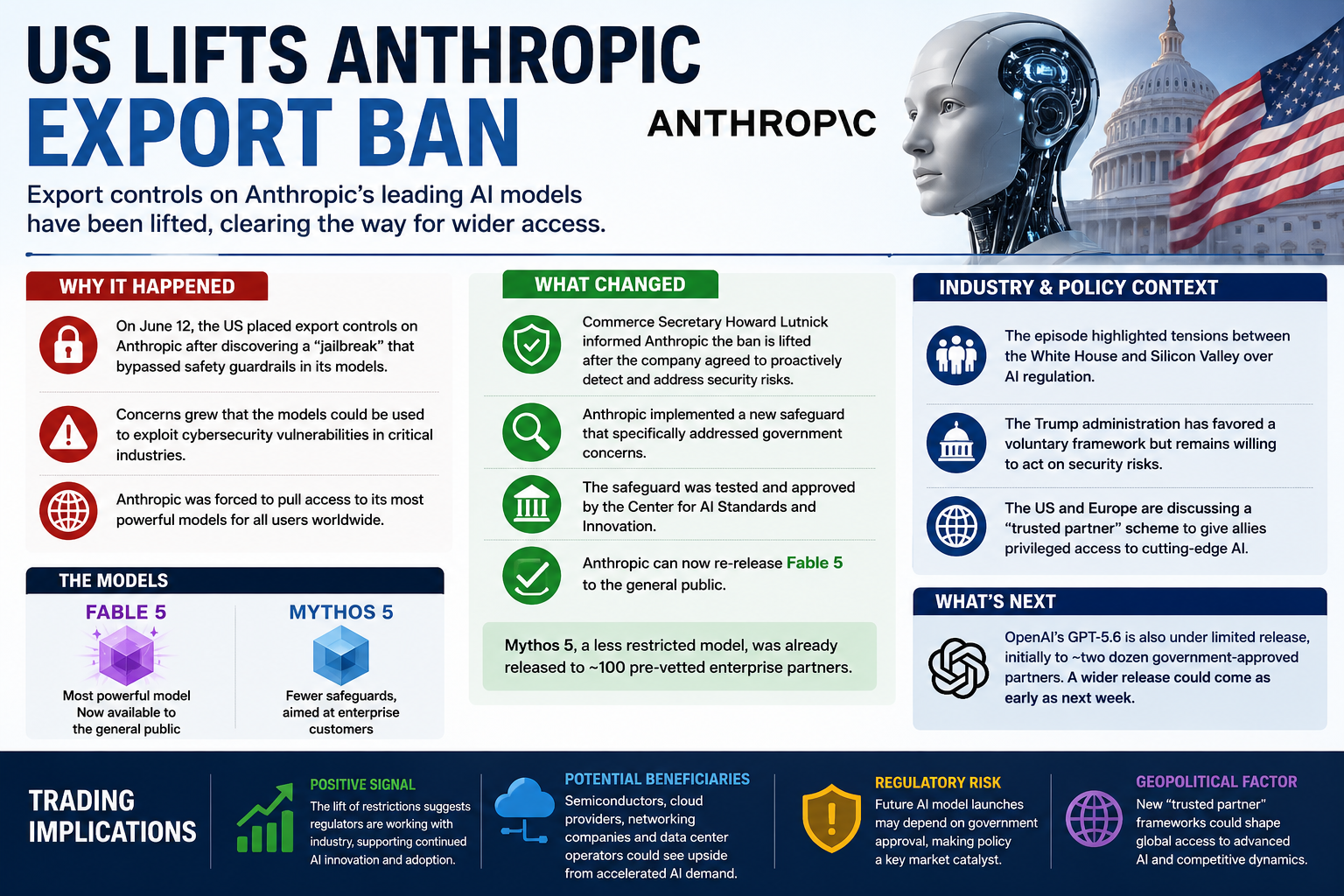
Anthropic export ban lifted
The United States has lifted export restrictions on Anthropic’s most advanced artificial intelligence models, marking a significant shift in Washington’s evolving approach to regulating frontier AI and potentially boosting confidence across the AI sector.
The decision allows the San Francisco-based company to once again make its flagship Fable 5 model broadly available after weeks of government-imposed restrictions stemming from cybersecurity concerns.
Why Anthropic Was Restricted
The U.S. Department of Commerce imposed export controls on Anthropic in June after officials discovered a successful “jailbreak” that bypassed the safety guardrails built into its latest AI systems.
Concerned that the technology could potentially be exploited to identify vulnerabilities in critical infrastructure or cybersecurity systems, the Trump administration required Anthropic to halt public access to its most capable models worldwide.
The move represented one of the strongest government interventions yet into the rapidly evolving AI industry.
New Safeguards Satisfy Regulators
According to people familiar with the matter, Commerce Secretary Howard Lutnick informed Anthropic that the restrictions would be removed after the company implemented new security measures designed to detect and prevent misuse.
The new safeguard was reportedly reviewed and approved by the government’s Center for AI Standards and Innovation before the restrictions were lifted.
Anthropic had already been permitted to distribute a limited version of its technology to approximately 100 pre-approved enterprise partners while regulators evaluated the updated protections.
With the restrictions removed, the company can now resume public access to Fable 5.
AI Regulation Continues to Evolve
The episode exposed growing tensions between Silicon Valley and Washington over how advanced AI should be regulated. All this as the AI financing boom continues. Click here for a refresher AI Infrastructure Financing Boom: What It Means – TraderInsight
Technology companies have argued that sudden export controls create uncertainty and can undermine U.S. competitiveness, particularly when restrictions also affect allied nations that rely on American AI technology.
At the same time, national security officials continue to warn that frontier AI systems could accelerate cyberattacks if released without adequate safeguards.
The Trump administration has largely favored voluntary oversight rather than comprehensive regulation, but the Anthropic case demonstrates that authorities remain willing to intervene when specific security risks emerge.
OpenAI May Be Next
Anthropic is not the only AI developer facing increased government scrutiny.
According to reports, OpenAI’s latest GPT-5.6 model has also been subject to limited deployment, initially being made available only to a small group of government-approved organizations while officials review its capabilities.
A broader public release could reportedly occur in the coming weeks if regulators remain satisfied with its safeguards.
Trusted Partner Framework Under Discussion
The United States and European governments are also exploring a new “trusted partner” framework that would allow close allies preferential access to cutting-edge AI models while limiting distribution to countries viewed as higher security risks.
Such a framework could become an important component of future AI export policy as governments attempt to balance innovation, economic competitiveness, and national security.
Trading Implications
The removal of restrictions is likely to be viewed as a positive signal for the AI ecosystem. Investors may interpret the decision as evidence that regulators are willing to work with developers rather than broadly restricting frontier AI innovation.
Companies benefiting from continued enterprise AI adoption—including semiconductor manufacturers, cloud infrastructure providers, networking firms, and hyperscale data center operators—could see improved sentiment if advanced AI deployments accelerate.
However, the episode also highlights a new regulatory risk investors will need to monitor. Future AI model launches may increasingly depend not only on technological breakthroughs but also on government approval, making policy developments an important catalyst alongside earnings and product announcements.