
AI Infrastructure Financing Boom: Wall Street’s $35 Billion Bet on Anthropic Shows the Trade Is Entering a New Phase
The AI infrastructure financing boom just moved from hype to hard money.
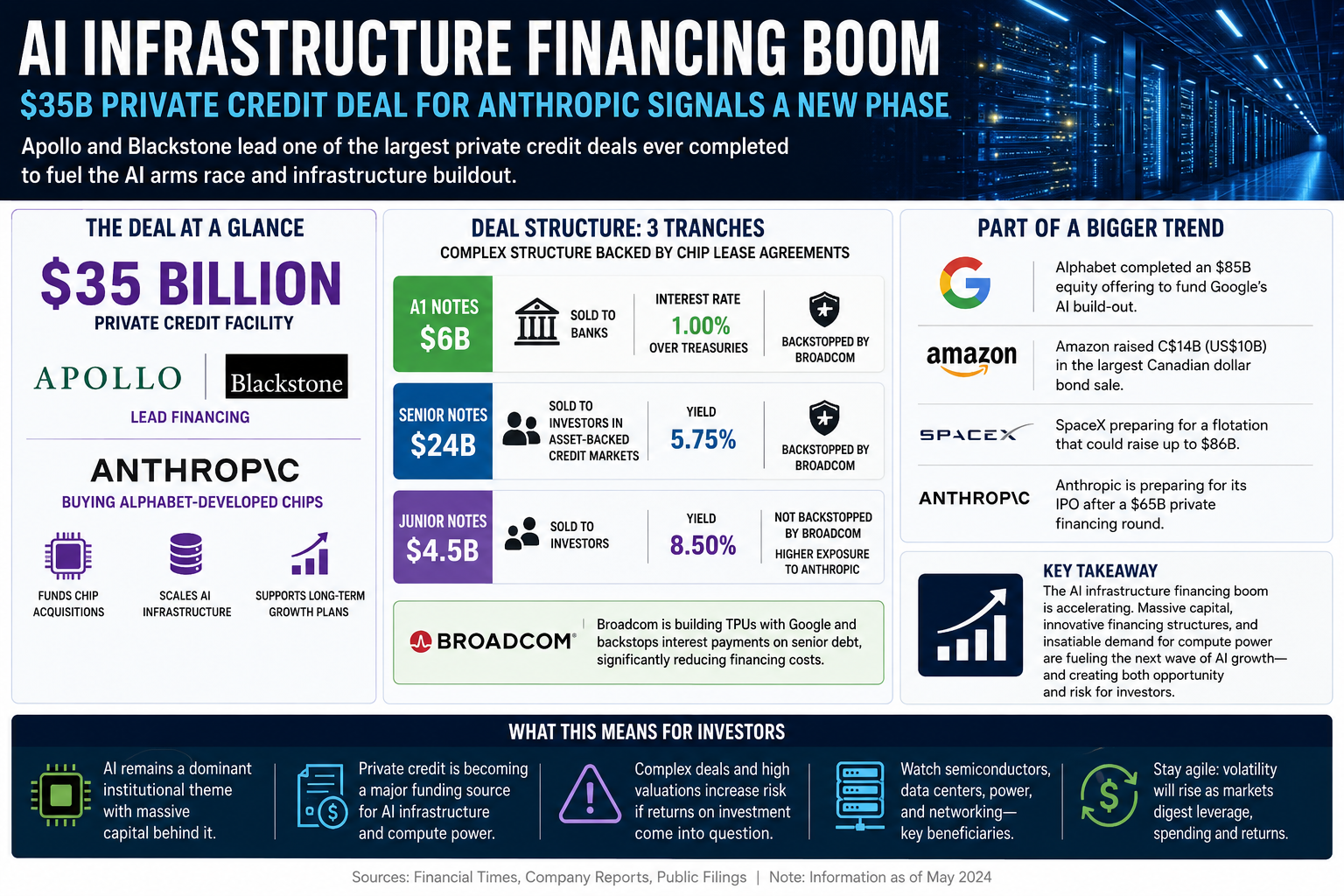
Apollo and Blackstone have finalized a massive $35 billion private credit deal designed to help finance Anthropic’s growth plans, including the purchase of Alphabet-developed AI chips. The deal, known as Project “Big Sky,” is one of the largest private credit transactions ever completed and shows how aggressively Wall Street is now funding the artificial intelligence arms race.
For traders, this is not just another AI headline. It is a signal that the AI trade is evolving from a stock-market momentum story into a full-scale capital markets cycle involving private credit, asset-backed debt, chip financing, cloud infrastructure, data centers, and equity issuance.
That shift matters because the next phase of the AI trade may not be driven only by software announcements or earnings beats. It may be driven by who can secure enough computing power, who can finance it, and who can monetize it before the market starts questioning the cost.
Wall Street Is Financing the AI Arms Race
The Apollo-Blackstone financing for Anthropic highlights the sheer size of the capital required to compete in artificial intelligence. Anthropic, OpenAI, Meta, Amazon, Google, and other AI leaders all need access to massive compute capacity. That means chips, data centers, power, cooling, networking equipment, and long-term financing.
This is why the AI infrastructure financing boom is so important. AI is not simply a software story. It is an infrastructure story.
Large language models require enormous computing power to train and operate. The companies that want to lead in AI must spend extraordinary amounts of money before they can fully prove the long-term economics of the business. That creates opportunity, but it also creates risk.
In Anthropic’s case, the financing structure reportedly relies on a special purpose vehicle created by Apollo’s Atlas SP Partners. The debt and equity raised through that vehicle will be supported by lease agreements tied to the chips. In other words, the chips themselves become part of the financial structure backing the deal.
That is a major development. The AI boom is now producing complex financing arrangements that look less like ordinary corporate borrowing and more like asset-backed infrastructure finance.
Broadcom’s Role Makes This Deal Even More Important
Broadcom’s involvement adds another important layer to the story. The company is helping produce tensor processing units, or TPUs, with Google. In this financing arrangement, Broadcom reportedly provided support for interest payments on senior portions of the debt if Anthropic misses a payment.
That backstop helped reduce financing costs and made the transaction more attractive to lenders.
For traders watching Broadcom, Nvidia, Micron, and other AI-linked semiconductor names, this is critical. Chipmakers are no longer simply selling hardware into the AI boom. They are becoming central players in the financing and scaling of the AI ecosystem.
That helps explain why the market has treated semiconductor stocks as more than cyclical hardware companies. They are now being valued as essential infrastructure providers in a generational technology buildout.
Related reading: AI Memory Chip Stocks
The Deal Structure Shows Both Confidence and Risk
The Anthropic financing was reportedly divided into three major debt tranches. Senior debt sold to banks carried a relatively low spread over Treasuries. A larger portion was sold into asset-backed credit markets with a yield of 5.75%. Junior debt, which lacked Broadcom support and exposed lenders more directly to Anthropic, carried an 8.5% interest rate.
That structure tells traders two things at once.
First, there is enormous institutional confidence in AI infrastructure demand. Apollo, Blackstone, banks, and private credit investors are willing to provide capital at huge scale because they believe the demand for compute will remain strong.
Second, the risks are not small. The junior debt pricing shows that lenders still require extra compensation when they are more directly exposed to Anthropic’s own credit profile.
That is the tension at the heart of the AI infrastructure financing boom. Capital is flowing aggressively, but the deals are becoming more complex, more leveraged, and more dependent on assumptions about future demand.
The GPU and TPU Collateral Question
One of the biggest debates around AI financing is whether chips can remain reliable collateral.
That question matters because technology evolves quickly. A chip that is cutting-edge today may be far less valuable in a few years if newer, faster, more efficient processors become available. This creates a depreciation risk that is not always easy to model.
That is why chip-backed lending has become such an important issue. If lenders are financing AI infrastructure partly on the value of the chips, they must believe those chips will retain sufficient economic value over time to service the debt.
This is very different from financing a building, a pipeline, or a traditional piece of industrial equipment. AI chips may generate enormous cash flow while in demand, but their resale or leasing value could change quickly as the technology cycle advances.
For traders, this is a reminder that the AI trade contains both growth-stock momentum and credit-cycle risk.
Why This Matters for AI Stocks
The market has rewarded AI leaders because demand appears enormous. But the Apollo-Blackstone-Anthropic deal also reminds traders that the AI boom is becoming capital-intensive at an almost unprecedented scale.
Alphabet recently completed a massive equity offering to fund Google’s AI buildout. Amazon raised a large Canadian-dollar bond. Meta has been exploring ways to raise additional capital for AI spending. SpaceX and other AI-adjacent companies are preparing or exploring major capital markets transactions.
The message is clear: AI leadership requires money. A lot of it.
The bullish interpretation is that this confirms the size of the opportunity. If the largest technology firms and private capital giants are willing to deploy tens of billions of dollars, then AI demand may remain a powerful long-term force.
The bearish interpretation is that the trade may be getting crowded, over-financed, and increasingly dependent on easy access to capital.
That is why the AI infrastructure financing boom should be watched closely by active traders. It can fuel upside, but it can also create sharp air pockets when investors begin questioning returns on capital.
Related reading: AI Infrastructure Spending Is Draining Big Tech Cash Reserves
Broadcom’s Selloff Shows the Market Is Not Blind to Risk
The Anthropic financing comes shortly after a sharp selloff in Broadcom and other AI-linked chip stocks. That timing is important. The market still wants exposure to the AI theme, but investors are becoming more selective about valuation, margins, competition, and sustainability.
Broadcom’s role in the Anthropic financing may ultimately prove bullish if it strengthens the company’s position in custom AI chips and TPUs. But traders must separate the long-term story from the short-term tape.
A stock can be tied to one of the market’s most important themes and still sell off violently when expectations become too high.
That is why traders should avoid treating AI as a one-way trade. The better approach is to respect levels, volume, volatility, dealer positioning, and institutional flows.
Related reading: AI Chip Stock Pullback Signals a Critical Test for Traders
Private Credit Is Becoming Part of the AI Story
One of the most important parts of this story is the role of private credit.
Private credit has grown rapidly as companies look beyond traditional bank lending and public bond markets. Now, private credit firms are becoming major financiers of the AI buildout.
That changes the way traders should think about the AI cycle. The funding is not coming only from public equity investors buying Nvidia, Broadcom, Meta, or Alphabet. It is also coming from private credit firms, structured finance desks, banks, pension capital, and asset-backed markets.
This means AI is becoming embedded across the financial system.
That can extend the boom because more capital is available. But it can also increase systemic sensitivity if investors begin to doubt the value of the underlying assets or the pace of AI monetization.
The Trading Implications
For active traders, the key takeaway is that AI remains the dominant institutional theme, but the character of the trade is changing.
In the early phase, the trade was simple: buy the obvious AI winners and ride the momentum. In this next phase, traders need to understand the capital structure behind the boom.
That means watching:
- Semiconductor earnings and guidance
- Cloud capital expenditure plans
- Private credit financing announcements
- AI infrastructure debt deals
- Data center spending trends
- Memory chip demand
- Power and cooling constraints
- Market reaction to dilution or bond issuance
The AI infrastructure financing boom is bullish when investors believe capital spending will produce future growth. It becomes dangerous when the market starts to question whether that spending is producing enough return.
This is exactly where traders must stay flexible. The same headline can be bullish in one market environment and bearish in another.
What Traders Should Watch Next
The next major tell will be how the market reacts to additional AI financing deals. If more chip-backed loans, equity raises, and private credit structures are announced and stocks continue to rally, the market is likely still rewarding the buildout phase.
But if financing announcements start to pressure stocks, that would suggest investors are becoming more concerned about leverage, dilution, and return on invested capital.
Traders should also watch whether AI hardware suppliers continue to benefit from these deals. Broadcom, Nvidia, Micron, and other semiconductor names may remain in focus as the market tries to determine which companies are truly indispensable to the AI infrastructure stack.
Related reading: AI Stock Trading Outlook
The Bottom Line
The Apollo and Blackstone financing for Anthropic is more than a large private credit deal. It is a signal that the artificial intelligence boom has moved into a new phase.
AI is no longer just a software growth story. It is a capital markets story, a credit story, a chip story, and an infrastructure story.
For traders, that creates an opportunity. It also demands discipline.
The AI infrastructure financing boom may continue to drive powerful rallies in semiconductor and infrastructure-related stocks. But as the deals get bigger and the structures get more complex, traders must be ready for volatility when the market begins to question valuation, leverage, or the useful life of the technology being financed.
The AI trade is still alive. But it is no longer simple.