
Meta AI Cloud Business Could Reshape the AI Infrastructure Race
The prospect of a Meta AI cloud business sent shares of Meta Platforms soaring after reports that the social media giant is exploring plans to sell excess artificial intelligence computing capacity to outside customers.
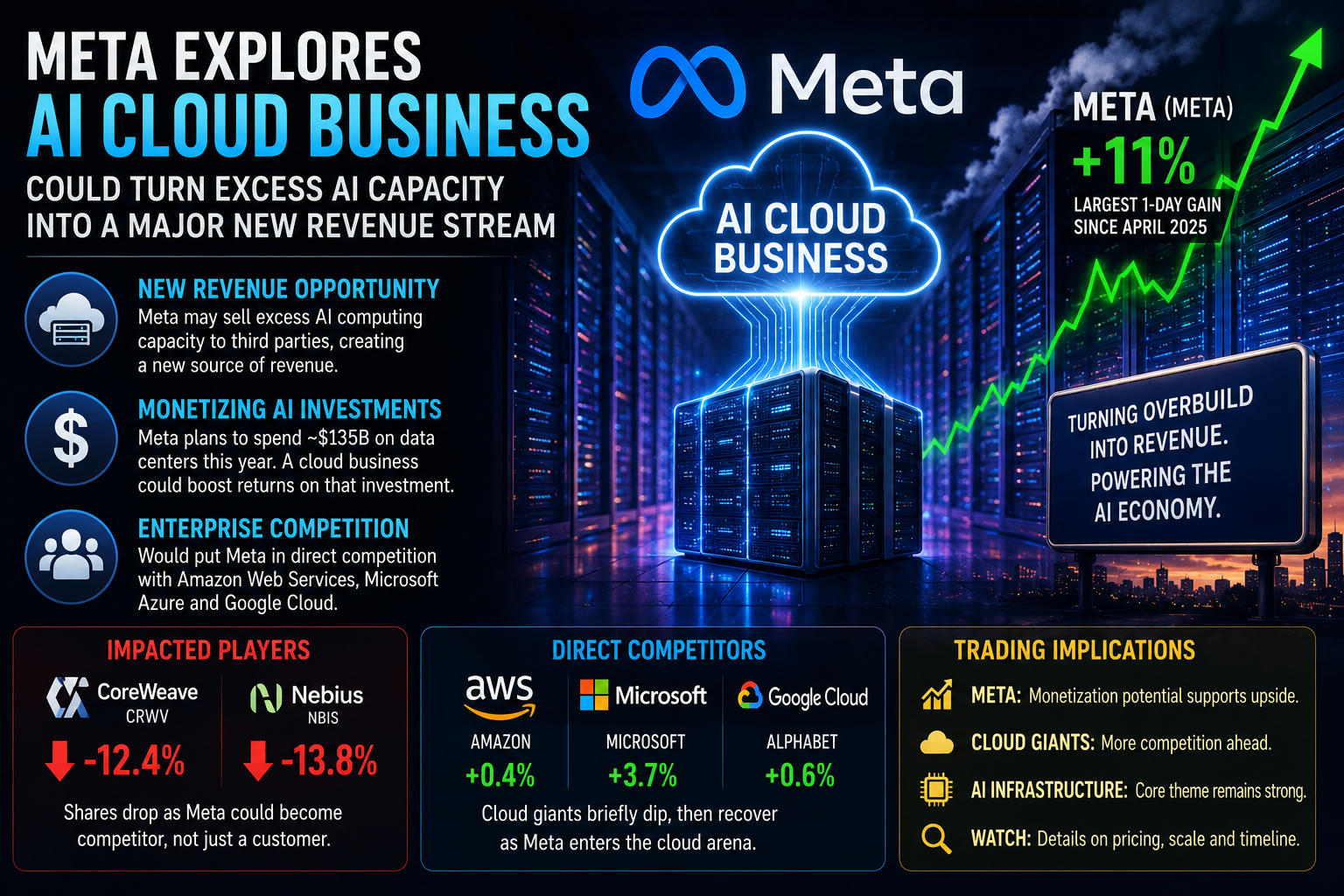
Meta shares jumped roughly 11% following the report, marking the company’s largest single-day gain since April 2025. Investors welcomed the possibility that Meta could begin generating revenue from the enormous AI infrastructure it has been building over the past several years.
If launched, the move would represent a significant strategic shift for Meta, transforming its AI infrastructure from an internal cost center into a potential profit-generating business.
A Major Strategic Pivot
Unlike Amazon Web Services, Microsoft Azure and Google Cloud, Meta has traditionally built data centers primarily to power its own products, including Facebook, Instagram, WhatsApp and its growing portfolio of AI models.
The proposed Meta AI cloud business would allow the company to monetize unused computing capacity by offering AI infrastructure or hosted AI services to third-party developers and enterprises.
Such a move would create an entirely new revenue stream while helping offset the massive capital expenditures Meta has committed to AI.
Meta AI Cloud Business
Turning AI Spending Into Revenue
Meta is expected to spend approximately $135 billion this year expanding its AI infrastructure, making it one of the world’s largest buyers of graphics processors, networking equipment and data center capacity.
Investors have increasingly questioned whether those investments will produce sufficient returns.
A commercial Meta AI cloud business could answer that question by generating recurring revenue from assets that might otherwise sit idle during periods of lower internal demand.
The strategy mirrors how Amazon transformed excess internal computing resources into Amazon Web Services, which eventually became one of the most profitable businesses in the technology sector.
Pressure on AI Infrastructure Providers
The market reaction wasn’t limited to Meta.
Shares of AI infrastructure providers CoreWeave and Nebius fell sharply as investors considered the possibility that one of their largest customers could eventually become a competitor.
Meta currently has long-term infrastructure agreements with both companies. If it begins offering commercial AI computing services itself, demand for third-party AI cloud providers could become more competitive over time.
Competition With Cloud Giants
A successful Meta AI cloud business would also place the company in direct competition with Amazon Web Services, Microsoft Azure and Google Cloud.
Those three companies have built highly profitable cloud platforms that already provide AI infrastructure, model hosting and enterprise computing services.
Meta would enter the market with one significant advantage: one of the largest AI compute footprints in the world. However, building enterprise relationships, support services and commercial cloud software represents an entirely different business than running consumer social media platforms.
Trading Implications
For traders, the news reinforces one of the biggest themes driving technology stocks: investors increasingly reward companies that demonstrate a clear path to monetizing AI investments.
Meta’s sharp rally reflects the market’s belief that AI infrastructure can become a revenue-generating asset rather than simply an expensive capital investment.
The announcement also highlights several areas traders should monitor:
- Meta (META): Continued upside may depend on whether management confirms commercial cloud plans and provides details on expected revenue opportunities.
- Cloud providers: Amazon, Microsoft and Alphabet may see increased competitive pressure if Meta successfully enters enterprise AI infrastructure.
- AI infrastructure companies: Stocks such as CoreWeave and Nebius could remain volatile as investors reassess future demand from one of their largest customers.
- Semiconductor suppliers: Companies supplying GPUs, networking equipment, memory and data center hardware could continue benefiting regardless of which cloud provider ultimately wins market share.
Perhaps most importantly, the report suggests that the AI investment cycle is entering its next phase. Markets are beginning to focus less on who is spending the most and more on who can successfully convert that spending into recurring revenue.
The Bottom Line
The potential Meta AI cloud business represents far more than a new product announcement. It signals that Meta may be following the path pioneered by Amazon, turning massive internal infrastructure investments into a commercial platform.
If successful, the strategy could improve returns on Meta’s enormous AI spending while intensifying competition across the cloud computing industry. For investors and traders, it is another reminder that the next chapter of the AI boom will likely be defined not just by building infrastructure, but by monetizing it.