
SpaceX’s $1.78 Trillion AI Bet May Be the Boldest Valuation Story of the Decade
SpaceX is no longer simply a rocket company.
If Goldman Sachs’ projections are even remotely accurate, Elon Musk’s empire is being valued not on launches, satellites, or even Starlink — but on artificial intelligence.
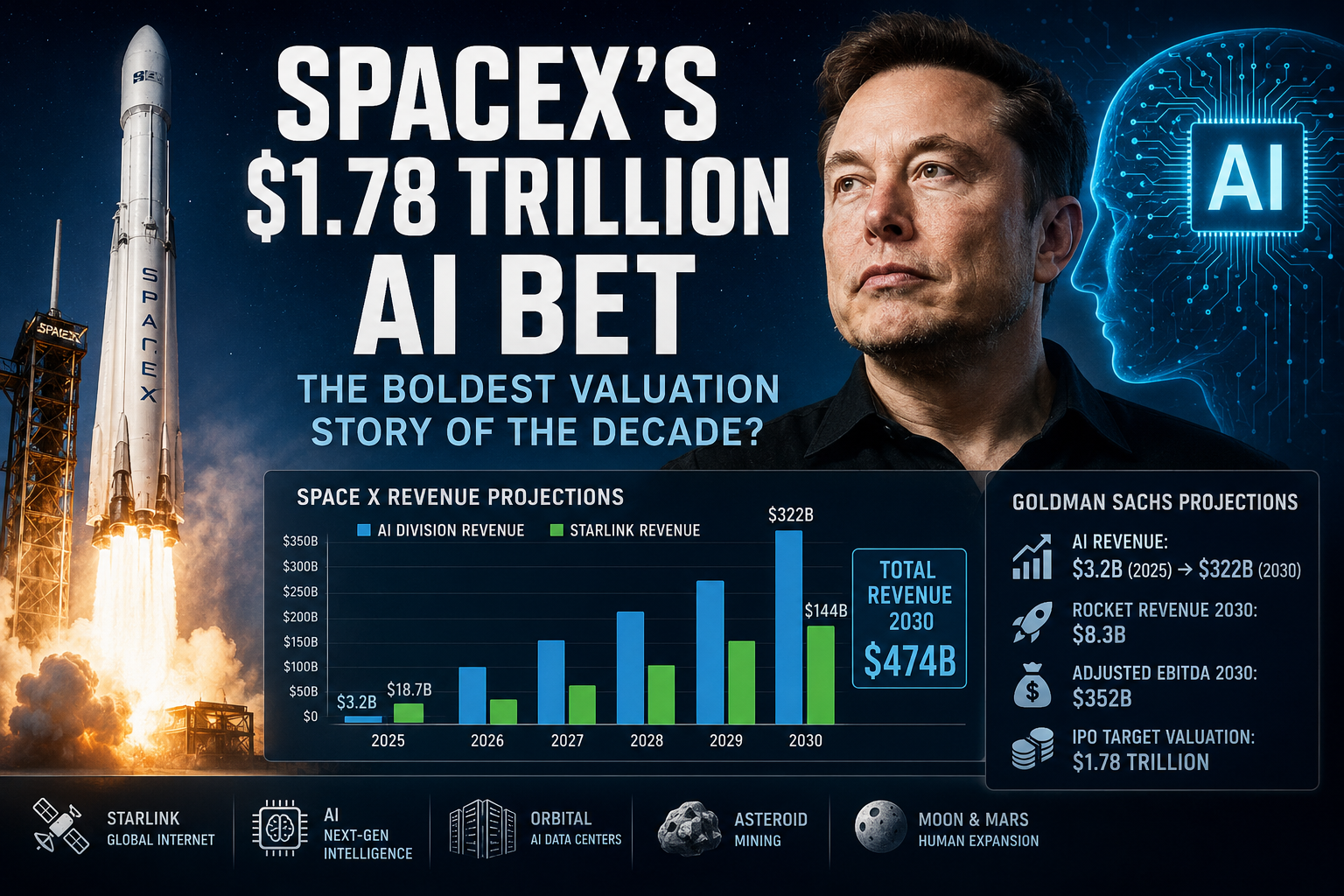
As SpaceX begins pitching investors on a staggering $1.78 trillion valuation ahead of its anticipated IPO, the underlying assumptions reveal just how aggressive the next phase of the AI boom has become.
According to projections presented by Goldman Sachs during the company’s IPO roadshow, SpaceX’s AI division is expected to grow revenue from approximately $3.2 billion in 2025 to an astonishing $322 billion by 2030.
That is not incremental growth.
That is a nearly 100-fold expansion in just five years.
To put those numbers into perspective, Goldman expects the AI division alone to generate more than twice Starlink’s revenue by the end of the decade. The bank forecasts Starlink revenue at roughly $144 billion in 2030, while the rocket business itself is projected to contribute only $8.3 billion.
In other words, investors are no longer being asked to value SpaceX as a space exploration company.
They are being asked to value it as one of the dominant AI infrastructure and intelligence platforms on Earth.
That distinction matters enormously for traders and investors trying to understand where capital flows are heading in this market cycle.
The AI narrative has already transformed semiconductor stocks, cloud infrastructure providers, energy companies, and data center operators into some of the market’s largest winners. Now the same speculative energy appears to be expanding into entirely new categories — including aerospace.
The assumptions embedded in the SpaceX valuation are breathtaking.
Goldman’s projections imply that SpaceX’s AI unit — formerly known as xAI — will eventually compete directly with OpenAI, Google DeepMind, Anthropic, and other elite AI labs across critical industries including coding, autonomous agents, cybersecurity, chatbot systems, and enterprise AI infrastructure.
That is a massive leap.
Especially considering the division reportedly lost $6.4 billion in 2025 and still trails leading competitors in commercial adoption and model performance.
The company’s Grok AI platform has attracted attention, but it has not yet demonstrated the dominant market position that would normally justify a multi-hundred-billion-dollar revenue forecast.
And there are operational concerns as well.
Reports indicate that Musk pushed out all ten of xAI’s original co-founders within two years. Meanwhile, the company’s massive Colossus 1 data center in Memphis was reportedly underutilized enough that capacity was rented to competitor Anthropic.
Those are not the characteristics of a mature, dominant AI franchise — at least not yet.
Still, investors continue to assign extraordinary value to the possibility that Musk could once again disrupt an industry, much as Tesla reshaped electric vehicles and SpaceX transformed launch economics.
The pitch being made to institutions goes far beyond chatbots and large language models.
Investors are reportedly being sold on a futuristic ecosystem that includes orbital AI data centers, asteroid mining, satellite-powered intelligence systems, and, eventually, lunar and Martian transportation infrastructure.
At times, the vision sounds less like a traditional IPO roadshow and more like science fiction colliding with Silicon Valley venture capital.
But that may be exactly the point.
Modern markets increasingly reward vision, scale potential, and total addressable market size far more aggressively than current profitability. In this environment, the perception of future dominance can create extraordinary present-day valuations.
That has already happened across the AI landscape.
NVIDIA became one of the most valuable companies in history, largely on projected growth in AI demand. Memory chip manufacturers such as Micron and SK Hynix surged as traders priced in future AI infrastructure demand. Software companies with even modest AI exposure saw multiples expand dramatically.
Now SpaceX appears positioned to become the next major test of how far investors are willing to extrapolate the AI narrative.
For traders, the implications are important.
This IPO is not simply about one company going public. It may become a referendum on the durability of the AI investment boom itself.
If investors enthusiastically embrace Goldman’s projections, it could reinforce the idea that markets are still willing to aggressively price in futuristic AI growth stories years before profits materialize.
But if skepticism begins to emerge around execution risk, competitive pressures, or unrealistic revenue assumptions, it could signal that the market is finally questioning some of the more speculative corners of the AI trade.
Because ultimately, a $1.78 trillion valuation requires near-perfect execution.
It requires SpaceX not only to dominate launch systems and satellite internet, but also to become one of the most successful artificial intelligence companies in history.
That is an extraordinary bet — even by Elon Musk standards.