
The End of the PDT Rule: Greater Freedom, Greater Risk for Modern Traders
The trading world is about to undergo one of the most significant regulatory changes in decades.
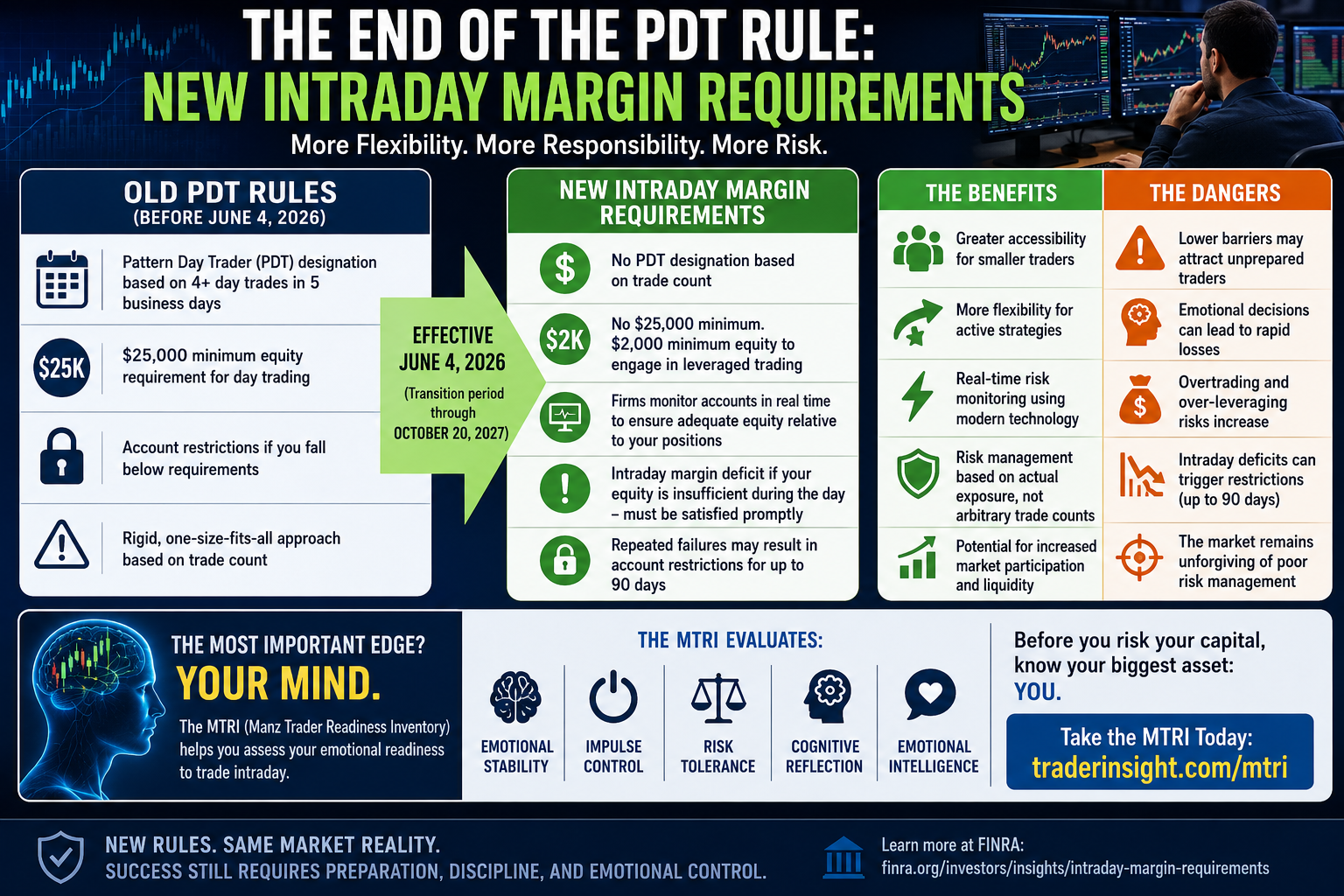
Beginning June 4, 2026, FINRA’s new intraday margin requirements will replace the long-standing Pattern Day Trader (PDT) rule framework that has shaped active trading accounts for more than 20 years. Investors can learn more directly from FINRA here: FINRA Intraday Margin Requirements.
For many traders, the elimination of the PDT designation represents a dramatic shift toward greater flexibility and accessibility in the financial markets. But while the changes remove one barrier to entry, they also create new risks that many inexperienced traders may not fully appreciate.
The removal of the PDT rule does not suddenly make intraday trading easy.
In many ways, it may make preparation, discipline, and emotional readiness more important than ever.
What Is Changing?
Under the old PDT rules, traders who executed four or more day trades within five business days in a margin account could be designated as “pattern day traders” and were required to maintain at least $25,000 in account equity.
The new FINRA intraday margin requirements replace that rigid trade-counting approach with a real-time, risk-based system.
The most important changes include:
- No more automatic Pattern Day Trader designation based solely on trade frequency.
- No more mandatory $25,000 minimum equity requirement for day trading.
- Brokerage firms will instead monitor accounts intraday to ensure traders maintain sufficient equity relative to their open positions.
- If an account falls below required intraday maintenance levels, the trader may receive an intraday margin deficit.
- Repeated failures to satisfy margin deficits promptly can result in account restrictions lasting up to 90 days.
The new intraday margin requirements are designed to modernize margin oversight by leveraging today’s real-time monitoring technology rather than relying on static rules established decades ago.
In theory, this gives active traders more freedom and flexibility.
But freedom in trading is a double-edged sword.
The Benefits of the New Rule
There are undeniable advantages to the new intraday margin framework.
For years, many smaller traders argued that the PDT rule unfairly restricted their ability to participate in the markets. A trader with $24,000 could face severe limitations, while someone with $25,000 could trade freely despite having a virtually identical risk profile.
The new system is designed to align risk management more closely with actual account exposure rather than arbitrary trade counts.
This creates several potential benefits:
- Greater accessibility for smaller traders.
- More flexibility for active intraday strategies.
- Reduced administrative complexity surrounding PDT violations.
- More accurate real-time risk monitoring by brokerage firms.
- Potentially improved market participation and liquidity.
Technology has evolved dramatically since the original PDT rules were implemented in 2001.
Today’s brokerage infrastructure can monitor risk dynamically and instantly in ways that were impossible two decades ago. From that perspective, modernizing the rules makes sense.
But technology alone does not create trading competence.
And that is where the real danger begins.
The Hidden Risk of Easier Access
The elimination of the PDT rule will almost certainly attract a new wave of aspiring traders into the markets.
Many will view the change as an invitation to actively day trade with smaller accounts and greater leverage. Social media will likely amplify this trend, with YouTube, TikTok, Discord, and other platforms continuing to promote trading as a fast path to financial freedom.
The problem is that easy access can create the illusion that trading itself has become easier.
It has not.
Intraday trading remains one of the most psychologically demanding activities in finance. Success requires far more than simply finding chart patterns or copying strategies from social media influencers.
Professional trading involves:
- Risk management under uncertainty.
- Emotional regulation during volatility.
- Pattern recognition developed through experience.
- Probabilistic decision-making.
- Discipline and consistency.
- The ability to tolerate losses without emotional collapse.
The statistics surrounding active trading remain harsh. A significant percentage of traders lose money, and many accounts fail entirely. The removal of the PDT rule does not change that reality.
In fact, lower barriers to entry created by the new intraday margin requirements may increase the number of traders entering the market before they are truly prepared.
Why Emotional Readiness Matters More Than Ever
One of the most overlooked aspects of trading success is emotional readiness.
Many traders focus exclusively on strategies, indicators, or setups while ignoring the psychological demands of real-time decision-making under pressure.
That is one reason we developed the MTRI — the Manz Trader Readiness Inventory.
The MTRI is designed to help traders evaluate whether they possess the psychological characteristics associated with disciplined trading performance. Rather than measuring intelligence alone, the assessment examines several dimensions that often determine whether traders can consistently execute under stress.
The MTRI evaluates areas including:
- Emotional stability.
- Impulse control.
- Risk tolerance.
- Cognitive reflection.
- Emotional intelligence.
These dimensions become critically important in an intraday environment where traders may experience rapid swings in profit and loss within minutes.
A trader may understand a strategy intellectually but still struggle emotionally with fear, overconfidence, revenge trading, impulsive entries, or the inability to follow a plan consistently.
The new intraday margin requirements increase opportunity — but they also increase the temptation for emotionally unprepared traders to overtrade, overleverage, or expose themselves to risks they cannot psychologically manage.
If you would like to learn more about the MTRI and evaluate your own trader readiness profile, you can learn more here: Manz Trader Readiness Inventory (MTRI).
In many cases, the greatest danger in trading is not the market itself.
It is the trader’s inability to regulate their own reactions to the market.
Greater Freedom Requires Greater Responsibility
FINRA’s new intraday margin requirements represent a major evolution in how active trading accounts will be regulated going forward.
The removal of the PDT designation will likely be celebrated by many retail traders who have long viewed the old rules as restrictive and outdated.
And in many respects, the modernization is justified.
But traders should not confuse easier access with easier success.
The markets remain highly competitive, emotionally demanding, and unforgiving of poor risk management. Technology has lowered the cost of participation, but it has not lowered the level of skill required to survive.
For traders willing to approach the profession seriously, the new rules may create meaningful opportunities.
For those who enter the markets without preparation, discipline, or emotional readiness, the risks may be even greater than before.
The PDT rule may be ending.
But the market’s ability to punish lack of preparation remains very much intact.