
Quantinuum IPO Gives Quantum Computing Stocks a New Public Market Test
The Quantinuum IPO gave Wall Street one of its most important public market tests yet for the quantum computing industry.
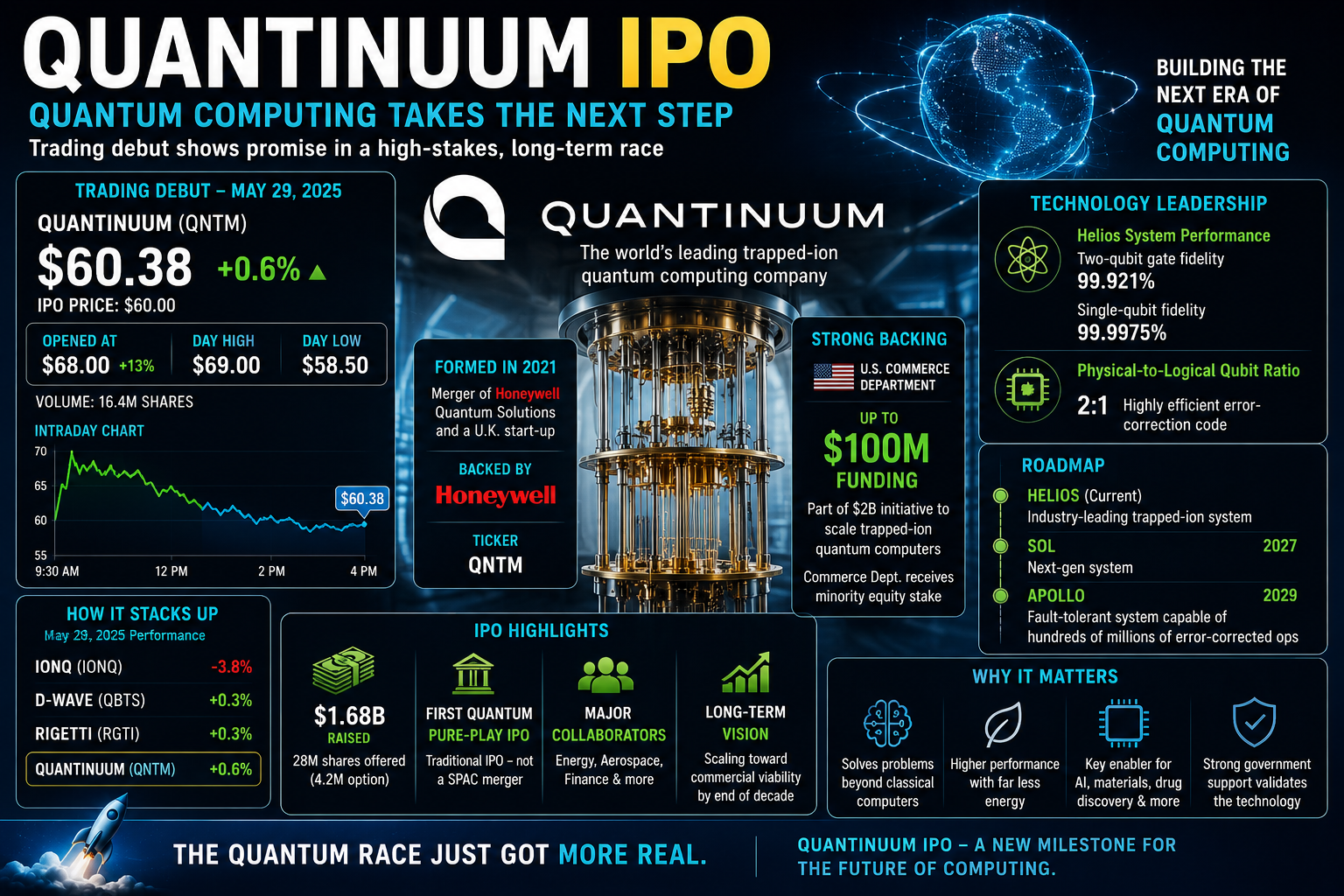
Shares of Quantinuum opened at $68 on Thursday, roughly 13% above the company’s $60 IPO price. That early surge suggested strong investor appetite for one of the most closely watched technology listings of the year.
But the momentum quickly faded.
Quantinuum shares ended the session at $60.38, up just 0.6% on the day. The muted finish was a reminder that, while quantum computing remains one of the market’s most exciting long-term themes, it remains a highly speculative and volatile sector.
Quantinuum Makes Its Public Debut
The Quantinuum IPO raised approximately $1.68 billion after the company sold 28 million shares in an upsized offering. Underwriters also received the option to sell an additional 4.2 million shares depending on demand.
Quantinuum was formed in 2021 through the merger of Honeywell International’s quantum computing division and a U.K.-based quantum start-up. Honeywell will retain a majority stake in the company, giving Quantinuum a level of corporate backing that many pure-play quantum companies lack.
That backing matters because quantum computing is still a long-duration investment story. Most companies in the sector are not profitable, and broad commercial adoption is not expected until later this decade.
Even so, Quantinuum’s debut was closely watched because it became the first major quantum pure-play to go public through a traditional IPO rather than a blank-check merger.
Why Investors Are Watching Quantinuum
The company is focused on trapped-ion quantum computers, a technology that uses charged atoms to perform quantum calculations.
Quantinuum’s Helios system has reached a two-qubit gate fidelity of 99.921% and single-qubit fidelity of 99.9975%. In simple terms, fidelity measures how accurately a quantum system performs operations compared with the intended result.
The company is also developing a full stack of hardware, software, and applications. Its next-generation Sol system is expected in 2027, followed by Apollo in 2029. Apollo is intended to be a fault-tolerant quantum machine capable of running hundreds of millions of error-corrected operations.
The company has also secured government support. As part of a broader $2 billion funding package, Quantinuum is expected to receive up to $100 million from the Commerce Department to help scale its trapped-ion quantum systems.
Quantum Computing Remains a Waiting Game
The Quantinuum IPO highlights both the promise and the uncertainty of quantum computing.
Supporters believe quantum systems could eventually solve problems that are far beyond the reach of classical computers. That could have major implications for artificial intelligence, drug discovery, financial modeling, materials science, aerospace, cybersecurity, and energy.
Quantinuum CEO Rajeeb Hazra has framed quantum computing as a potential answer to the growing demand for more powerful and energy-efficient computing.
That argument is especially important as artificial intelligence pushes traditional data centers to consume more power and require more advanced chips.
For related TraderInsight coverage on the AI infrastructure boom, see:
- AI Stock Market Rally: Bulls Say the Run Has Further to Go
- Nvidia Just Derailed the Chip Rally
- Autodesk MaintainX Acquisition Sparks Investor Concerns
Why the Stock’s First-Day Fade Matters
The early pop and late fade in the Quantinuum IPO tells traders something important about the quantum sector.
Investor interest is real, but conviction remains fragile.
Other quantum names also showed mixed action on the day. IonQ closed lower, while D-Wave Quantum and Rigetti Computing posted only modest gains. That shows the market is not yet treating quantum computing as a broad, risk-on theme in the same way it has treated AI chips or data center infrastructure.
Quantum stocks still trade heavily on sentiment, technical momentum, government funding headlines, and expectations about future breakthroughs.
That makes them attractive to traders but dangerous to investors who ignore risk.
Implications for Traders
For traders, the Quantinuum IPO creates a new benchmark stock for the quantum computing industry.
Because Quantinuum has Honeywell’s backing, government support, and a traditional IPO structure, it may trade differently from smaller quantum companies that came public through SPAC deals.
Traders should watch several key factors:
- IPO price support: The $60 IPO price may become an important psychological level.
- Quantum sector sympathy: Moves in Quantinuum could influence IonQ, Rigetti, D-Wave, and other quantum-related names.
- Government funding headlines: Federal support could remain a major catalyst for the sector.
- AI infrastructure demand: Quantum could benefit if investors look for the next major compute theme after AI chips.
- Commercialization timelines: Any delays in the development of scalable systems could pressure valuations.
Short-term traders should treat quantum stocks as high-volatility instruments rather than stable technology investments. These names can move sharply on headlines, but the industry is still years away from broad commercial profitability.
Swing traders may find better opportunities by waiting for post-IPO volatility to settle rather than chasing first-day momentum.
Longer-term investors should focus less on the first-day stock move and more on whether Quantinuum continues hitting its technical milestones for Sol in 2027 and Apollo in 2029.
The Bigger Picture
The Quantinuum IPO is an important milestone for quantum computing, but it does not mean the sector has fully arrived.
The technology remains early. The losses will likely continue. Commercial adoption is still uncertain. But the level of investor interest, government support, and corporate backing suggests quantum computing is moving closer to the center of the market’s long-term technology narrative.
That puts quantum in the same broader conversation as AI, advanced semiconductors, and next-generation computing infrastructure.
For related themes, read:
- Global Economic Outlook 2026: Jobs, Inflation, and Oil Shock Risks
- AI Chip Stock Pullback Signals a Critical Test for Traders
- Private Company Prediction Markets: A New Trading Signal or a New Source of Risk?
The quantum computing story may still be in its early innings. But after the Quantinuum IPO, traders now have another major public stock to watch as the race for next-generation computing accelerates.