
SpaceX Lockup Expiration: What Day Traders Should Watch on August 6
A massive block of insider shares is becoming eligible for sale. That does not guarantee a selloff—but it could create exactly the kind of volatility, liquidity and intraday structure active traders look for.
The first major SpaceX lockup expiration arrives on Thursday, August 6, just two trading days after the company released its first quarterly earnings report as a publicly traded company.
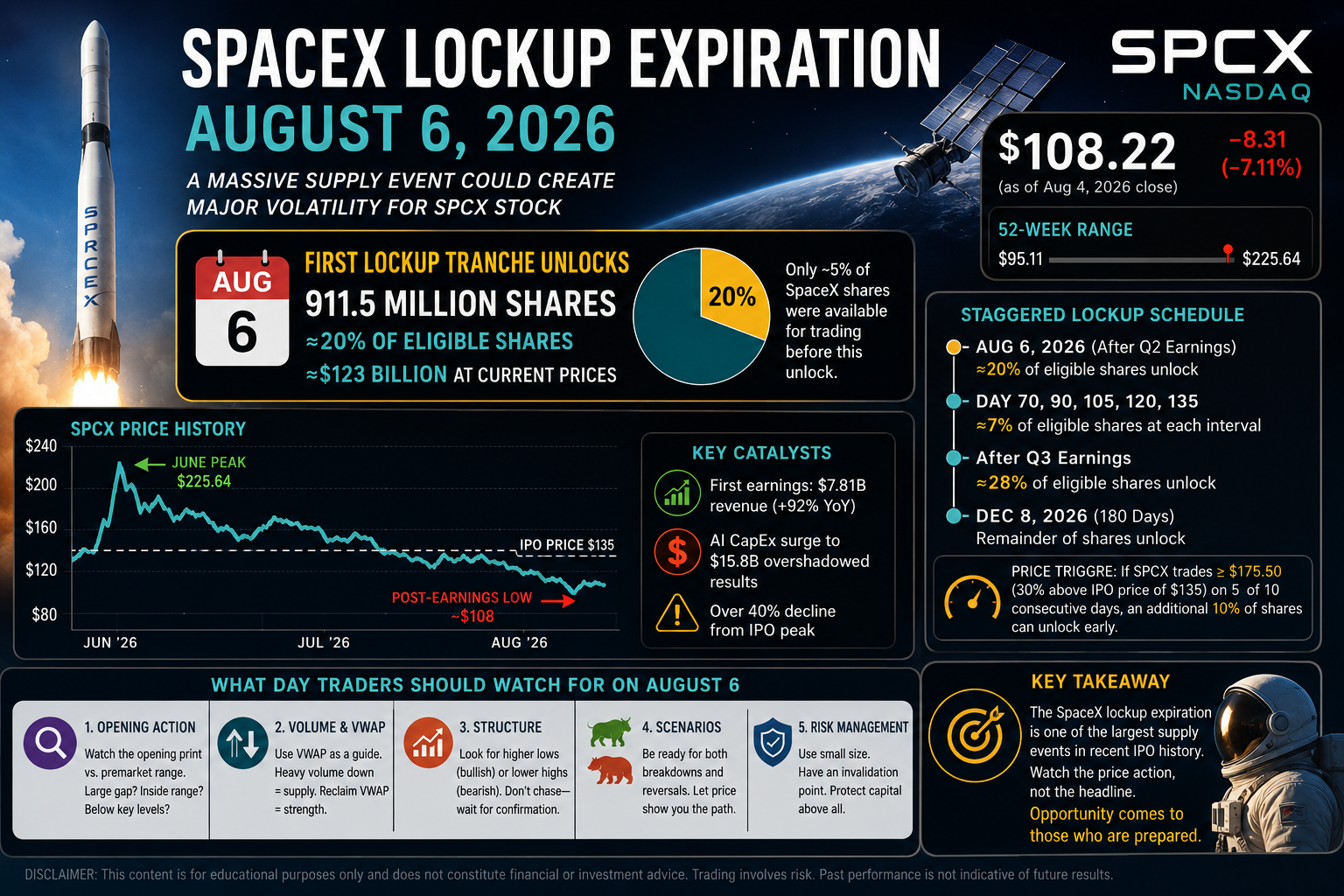
Approximately 911.5 million shares held by employees, early investors and other insiders are expected to become eligible for sale.
That is an enormous potential increase compared with the relatively small number of SpaceX shares that have been available for public trading since the company’s June initial public offering.
But day traders should be careful about jumping to the obvious conclusion.
A lockup expiration does not mean 911.5 million shares will be sold on Thursday.
It means those shares can be sold.
The difference between potential supply and actual selling pressure will likely determine whether SPCX experiences another sharp decline, an early washout and reversal, a short squeeze—or a surprisingly quiet session.
Why the SpaceX Share Unlock Matters
SpaceX completed its initial public offering at $135 per share in June. The stock initially surged to more than $225 before reversing sharply and falling below its IPO price.
Following the company’s first earnings report, SPCX dropped to approximately $108 as investors reacted to extraordinarily high capital spending, particularly spending connected with artificial intelligence infrastructure.
The company reported strong revenue growth, but the market focused on the amount of money SpaceX expects to spend building its next generation of businesses.
That leaves the stock entering the unlock from a technically vulnerable position:
- It is well below its post-IPO high.
- It is below the $135 IPO price.
- It has already experienced a substantial post-earnings decline.
- It remains heavily influenced by retail speculation and headline-driven trading.
- Its relatively small public float could change dramatically as shares become eligible for sale.
For investors, the event raises questions about valuation and insider confidence.
For day traders, the more immediate questions concern volume, volatility, liquidity and price structure.
A Supply Event, Not Necessarily a Bearish Prediction
The basic lockup argument is straightforward.
Employees and early investors may own shares at prices substantially below the IPO price. Once their restrictions expire, some may choose to sell in order to diversify, pay taxes, return capital to investors or realize gains accumulated over many years.
That can create price-insensitive supply.
These sellers may not be making a judgment about whether SpaceX will become a more valuable company five years from now. They may simply have financial reasons to convert part of a concentrated position into cash.
But the market already knows the unlock is coming.
SPCX has fallen dramatically from its June peak, and some of the expected selling may already be reflected in the current price.
That creates two competing possibilities.
The bearish scenario: Actual insider selling overwhelms demand, causing repeated breakdowns, failed bounces and continued price discovery to the downside.
The reversal scenario: Selling is lighter than feared, early weakness is absorbed and traders who entered short based solely on the headline are forced to cover.
The opportunity is not in predicting which scenario must happen.
The opportunity is in recognizing the price structure that reveals which scenario is actually developing.
Why This Event Is Particularly Important for Day Traders
The SpaceX lockup expiration combines several ingredients that can produce active intraday trading:
- A widely anticipated corporate event.
- A newly public and emotionally traded stock.
- A potentially dramatic change in available supply.
- A sharp post-earnings decline immediately before the event.
- Heavy retail interest.
- Elevated options activity.
- Uncertainty about how much insider selling will actually occur.
This combination can produce large opening gaps, rapid changes in direction and unusually heavy trading volume.
It can also produce traps.
A stock can open weak, attract aggressive short sellers and then reverse sharply when the expected wave of selling fails to appear.
It can open higher, appear to have survived the event and then collapse when supply begins hitting bids after the first few minutes.
That is why traders should avoid treating the unlock itself as a trading signal.
The event creates the potential for opportunity.
Price action must define the trade.
What to Check Before the Opening Bell
The first step is to determine how SPCX is trading before the regular session begins.
Day traders should mark:
- The premarket high.
- The premarket low.
- The prior day’s high and low.
- The post-earnings low.
- Any overnight consolidation range.
- The previous closing price.
- Nearby whole-dollar and half-dollar levels.
- The $135 IPO price as an important longer-term reference point.
Relative volume will be especially important.
A large premarket decline on unusually heavy volume would suggest that meaningful supply is already entering the market.
A modest decline on relatively ordinary volume may indicate that the market is waiting for the opening auction before committing.
A positive premarket move would be particularly interesting because it could signal that the expected selling has been absorbed—or that traders are positioning for a “sell the rumor, buy the event” reaction.
None of these observations is enough to justify a trade by itself.
They provide the context for interpreting what happens after the bell.
The Opening Auction Could Be Extremely Important
Lockup events can attract large institutional orders, making the Nasdaq opening auction more meaningful than it might be on an ordinary trading day.
The opening print may reflect a substantial imbalance between shares offered for sale and buyers willing to absorb them.
Traders should pay close attention to whether SPCX opens:
- Below the premarket low.
- Inside the premarket range.
- Near the premarket high.
- At a large discount to the previous close.
- With unusually high opening volume.
A weak opening does not automatically mean the stock should be shorted.
In fact, blindly selling short after a large gap down can expose traders to an aggressive reversal.
The better question is whether the stock can attract and hold buyers after the opening supply is processed.
Scenario One: The Opening Breakdown Holds
The most straightforward bearish setup would begin with a weak opening followed by an inability to reclaim the premarket low or opening price.
Characteristics could include:
- Heavy volume on downward price bars.
- Weak rebounds that fail below VWAP.
- Repeated lower highs.
- Breakdowns from short sideways consolidations.
- Large offers repeatedly appearing above the market.
- New intraday lows accompanied by expanding volume.
A trader might wait for the first emotional decline to pause, then watch for a structured consolidation beneath VWAP or beneath the opening range.
A breakdown from that consolidation can offer a more clearly defined short than chasing the initial plunge.
The risk can be measured against the consolidation high, VWAP or another clearly identified invalidation point.
The important distinction is that the trader is shorting a confirmed continuation pattern—not simply shorting because insiders are allowed to sell.
Scenario Two: An Opening Flush Reverses
This may be the more interesting setup if the market has already priced in much of the expected selling.
SPCX could open sharply lower as overnight traders and short sellers react to the unlock headline. If the initial supply is absorbed, however, the stock may stop declining even while volume remains elevated.
Potential reversal evidence could include:
- A sharp opening decline that quickly loses momentum.
- Repeated tests of the low that fail to produce new downside progress.
- Heavy volume without continued price deterioration.
- A reclaim of the opening price.
- A move back above the premarket low.
- A successful VWAP reclaim followed by a higher low.
This would suggest that buyers are absorbing shares more effectively than the headline implied.
A disciplined trader could then look for a defined reversal structure rather than attempting to catch the exact bottom.
Possible targets could include VWAP, the opening price, the premarket midpoint, the previous close or the premarket high—depending on where the reversal begins.
This type of move could become especially powerful if a large number of traders entered short expecting an automatic lockup selloff.
Scenario Three: Strength Fails After the Open
SPCX may open higher if traders decide the post-earnings decline has already discounted the unlock.
That does not eliminate the supply risk.
A strong opening can provide employees and early holders with better prices at which to sell.
Day traders should therefore watch whether an early rally:
- Holds above VWAP.
- Produces higher lows.
- Maintains momentum after the first pullback.
- Breaks and holds above the premarket high.
- Continues attracting volume as price rises.
If the stock rallies early but repeatedly fails at the same level, loses VWAP and breaks the first meaningful higher low, the initial strength could become a failed-move short setup.
That would indicate that demand was present at the open but could not absorb the supply available at higher prices.
Scenario Four: The Stock Does Almost Nothing
Traders should also prepare for the possibility that the event produces less volatility than expected.
Options markets and financial headlines may advertise a dramatic move, but anticipated events sometimes become disappointing trading sessions because both buyers and sellers have already positioned in advance.
SPCX could spend much of the morning oscillating around VWAP without developing a sustained trend.
In that environment, repeatedly buying breakouts or shorting breakdowns could lead to a series of small losses.
No trade is also a valid outcome.
A professional trader does not need the event to produce an opportunity simply because the event looked important on the calendar.
VWAP May Help Reveal Who Is in Control
VWAP could become one of the most useful intraday reference points during the unlock session.
If SPCX remains below a declining VWAP and repeatedly fails when attempting to reclaim it, sellers may be maintaining control.
If the stock flushes lower but then reclaims VWAP and begins holding above it, the market may be absorbing the additional supply.
Traders should not use VWAP as an automatic buy-or-sell signal.
Its value comes from combining it with:
- Volume behavior.
- Opening-range structure.
- Premarket support and resistance.
- Higher lows or lower highs.
- The character of pullbacks and rebounds.
The location of price matters, but the way price behaves around that location matters even more.
Watch Volume, but Interpret It Correctly
The actual trading volume on August 6 may provide the clearest evidence of how much the unlock matters.
Heavy volume combined with a steady decline would indicate that available supply is overwhelming demand.
Heavy volume with little additional downside could indicate absorption.
Heavy volume followed by a reversal could indicate that the market processed the selling faster than expected.
Relatively light volume would suggest that many eligible holders are not rushing to sell immediately.
Volume should therefore be interpreted alongside price—not treated as a standalone signal.
The First Move May Not Be the Best Move
The opening minutes could be highly emotional.
Market orders, opening-auction imbalances, options hedging and speculative positioning may all influence the first move.
That move may reveal the direction of the session.
It may also be completely wrong.
Waiting for the first five- or fifteen-minute range to develop can give traders a clearer framework.
Rather than attempting to predict the opening print, traders can ask:
- Is price accepting or rejecting the opening range?
- Are rallies being sold?
- Are declines being absorbed?
- Is VWAP acting as support or resistance?
- Is volume expanding when price moves in one direction?
- Is the stock making meaningful progress, or simply producing noise?
The goal is to let the market disclose whether the additional supply is actually changing the balance between buyers and sellers.
Options Could Amplify the Intraday Move
SPCX options may contribute to volatility as traders position for a large move and market makers adjust their hedges.
That can create rapid extensions in either direction, particularly near heavily traded strike prices.
Day traders using options should be aware that elevated implied volatility can make contracts expensive and spreads wider than usual.
A trader can correctly anticipate the stock’s direction and still experience a disappointing result if implied volatility falls or execution costs are excessive.
For many traders, the stock itself may provide a cleaner way to observe and trade the intraday structure.
The Unlock Does Not End on August 6
The SpaceX lockup expiration is structured as a staggered release rather than a single 180-day cliff.
Following the initial earnings-related tranche, additional portions of restricted shares are scheduled to become eligible for sale at several intervals through the fall.
Another significant release is connected with third-quarter earnings, and remaining employee shares are expected to unlock around the 180-day point in December.
That means the potential supply overhang will not disappear after Thursday’s closing bell.
August 6 is the first major test.
Subsequent unlocks may create additional periods of volatility—particularly if SPCX attempts to rally into one of those dates.
The $175.50 Performance Trigger
SpaceX’s lockup agreement also contains a price-based provision that could accelerate the release of another portion of restricted shares.
The trigger requires SPCX to trade at least 30% above the $135 IPO price—approximately $175.50—for five of ten consecutive trading days.
With the stock currently far below that threshold, the provision is not an immediate concern.
It could become relevant later if SPCX stages a substantial recovery.
For traders, that threshold could eventually function as more than a technical level. A sustained move above it could have consequences for the future supply of shares.
SPCX: Trigger Dead, Lockup Alive, Launch Slipped | VaaSBlock
Common Mistakes Traders Should Avoid
Assuming the Stock Must Decline
The expiration creates permission to sell, not an obligation to sell.
Entering short without a price-based setup exposes the trader to a reversal if actual selling is lighter than expected.
Chasing a Large Opening Gap
A stock that opens sharply lower may already reflect a substantial amount of fear. Chasing after the first decline can produce poor risk-to-reward and leave the trader vulnerable to a squeeze.
Ignoring the Earnings Reaction
The unlock is occurring immediately after a major post-earnings repricing. Traders must evaluate the two events together rather than pretending the stock entered August 6 with a neutral setup.
Using Normal Position Size
A newly public stock experiencing an extraordinary supply event can move faster than expected. Wider ranges do not justify greater risk.
They usually justify smaller size.
Trading Without an Invalidation Point
“The lockup is bearish” is not a stop-loss strategy.
A trade should have a clearly defined price level that proves the setup is no longer behaving as expected.
A Practical Day-Trading Checklist
Before trading SPCX, identify:
- Premarket high and low.
- Previous close.
- Prior day’s high and low.
- Opening price.
- First five- and fifteen-minute ranges.
- VWAP.
- Relative volume.
- The direction and quality of the first pullback.
- The point at which the trade thesis becomes invalid.
- The maximum dollar risk you are willing to accept.
Then determine which structure is actually developing:
- Opening breakdown and continuation.
- Opening flush and reversal.
- Early strength followed by failure.
- Range-bound VWAP trading with no sustained advantage.
Do not decide the pattern before the market displays it.
One Thing to Think About
The headline tells us that hundreds of millions of shares may become available.
The chart will tell us whether sellers are actually overwhelming buyers.
Day traders do not need to predict how every employee, venture fund or early investor will behave.
They need to recognize what that behavior looks like when it reaches the tape.
Bottom Line
The first major SpaceX lockup expiration could create one of the most actively traded sessions SPCX has experienced since its public debut.
The stock is already under pressure following earnings, sentiment is fragile and the potential increase in available shares is enormous relative to the existing public float.
That creates legitimate downside risk.
It also creates the possibility of an opening washout, supply absorption and a powerful reversal if actual insider selling is lighter than the market expects.
The professional approach is not to assume that SPCX must fall or that it must rebound.
Prepare for both.
Mark the important levels, watch relative volume, evaluate the opening auction and wait for price to develop a recognizable structure.
The event may provide the volatility.
The trader still needs a plan.