
Tesla Crushes Delivery Estimates as Q2 Sales Rebound Sharply
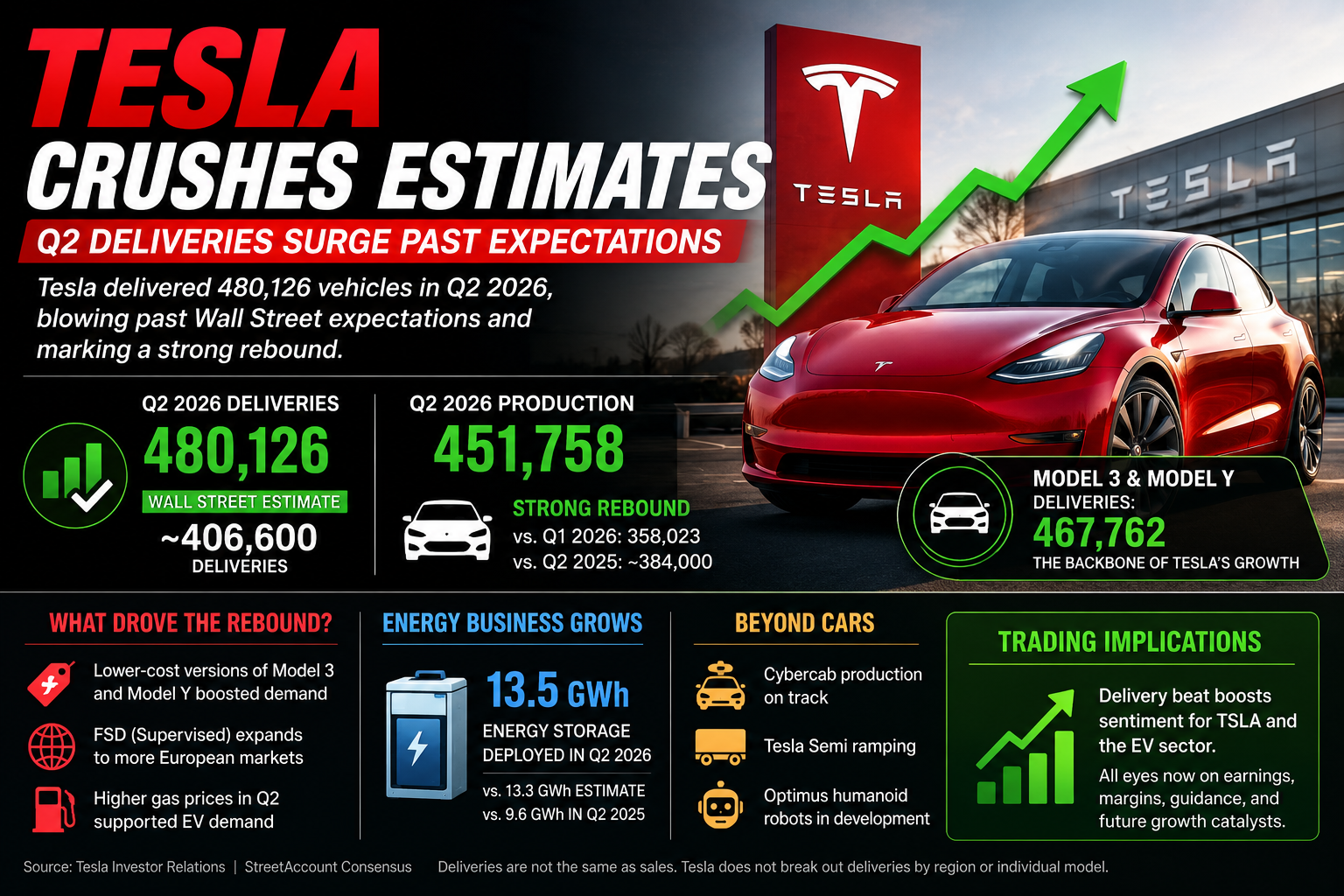
Tesla Q2 deliveries surprised Wall Street, reporting 480,126 vehicles, far exceeding analyst expectations of roughly 406,600 and marking a significant rebound after several quarters of slowing sales.
The stronger-than-expected results sent Tesla shares higher as investors welcomed evidence that demand may be stabilizing despite increasing competition, political controversy surrounding Elon Musk, and the loss of key government incentives.
Tesla Q2 deliveries
Tesla Delivers Massive Beat
Tesla reported:
- Q2 Vehicle Deliveries: 480,126
- Q2 Vehicle Production: 451,758
Wall Street had been expecting approximately 406,600 deliveries, making the quarter one of Tesla’s largest positive delivery surprises in years.
The results also represented a sharp improvement from 358,023 deliveries in the first quarter of 2026 and approximately 384,000 deliveries in the same quarter last year.
Model 3 and Model Y Lead the Rebound
Tesla’s Model 3 and Model Y remained the backbone of the business, accounting for 467,762 deliveries during the quarter.
That continued strength underscores the importance of Tesla’s mass-market lineup as the company works to regain sales momentum in an increasingly competitive electric vehicle market.
Signs of a Turnaround
Tesla has spent much of the past year battling slowing demand as the EV market became more crowded and price-sensitive.
Several factors pressured sales, including the expiration of U.S. federal EV tax incentives, intensifying competition from Chinese manufacturers such as BYD, Nio and Xiaomi, and expanding EV offerings from Hyundai and Volkswagen.
To stimulate demand, Tesla introduced lower-priced versions of the Model 3 and Model Y while expanding availability of its Full Self-Driving (Supervised) software into additional European markets.
Higher gasoline prices earlier in the quarter may also have encouraged some consumers to reconsider electric vehicles, particularly across Europe.
Energy Storage Business Keeps Growing
Tesla’s energy storage business also continued to expand.
The company deployed 13.5 gigawatt-hours of battery storage during the quarter, slightly above analyst expectations of 13.3 GWh and well ahead of the 9.6 GWh deployed during the same period last year.
The energy division has become an increasingly important part of Tesla’s long-term growth story as demand for grid-scale battery storage continues to accelerate.
Looking Beyond Vehicle Sales
While vehicle sales remain Tesla’s largest business, investors continue to focus on several future growth initiatives.
Management has reiterated plans to begin volume production of the Cybercab, the Tesla Semi, and Optimus humanoid robots.
The company has also said it is optimizing its vehicle portfolio around a fully autonomous future, suggesting robotaxis and automation may become increasingly important to Tesla’s valuation story.
Trading Implications
Tesla’s delivery beat removes one of the biggest concerns hanging over the stock and may improve investor sentiment toward both Tesla and the broader electric vehicle sector.
The results suggest that demand remains stronger than many investors feared, despite macroeconomic headwinds and rising competition.
For traders, attention now shifts to Tesla’s upcoming earnings report, where investors will closely watch automotive gross margins, full-year delivery guidance, Cybercab production timelines, Optimus development progress, and commentary around AI and Full Self-Driving.
From a technical perspective, stronger-than-expected deliveries can often trigger institutional buying as analysts revise revenue and earnings forecasts higher. Traders should monitor key resistance levels and options positioning, as positive delivery surprises frequently lead to increased volatility in Tesla shares over the following several sessions.