
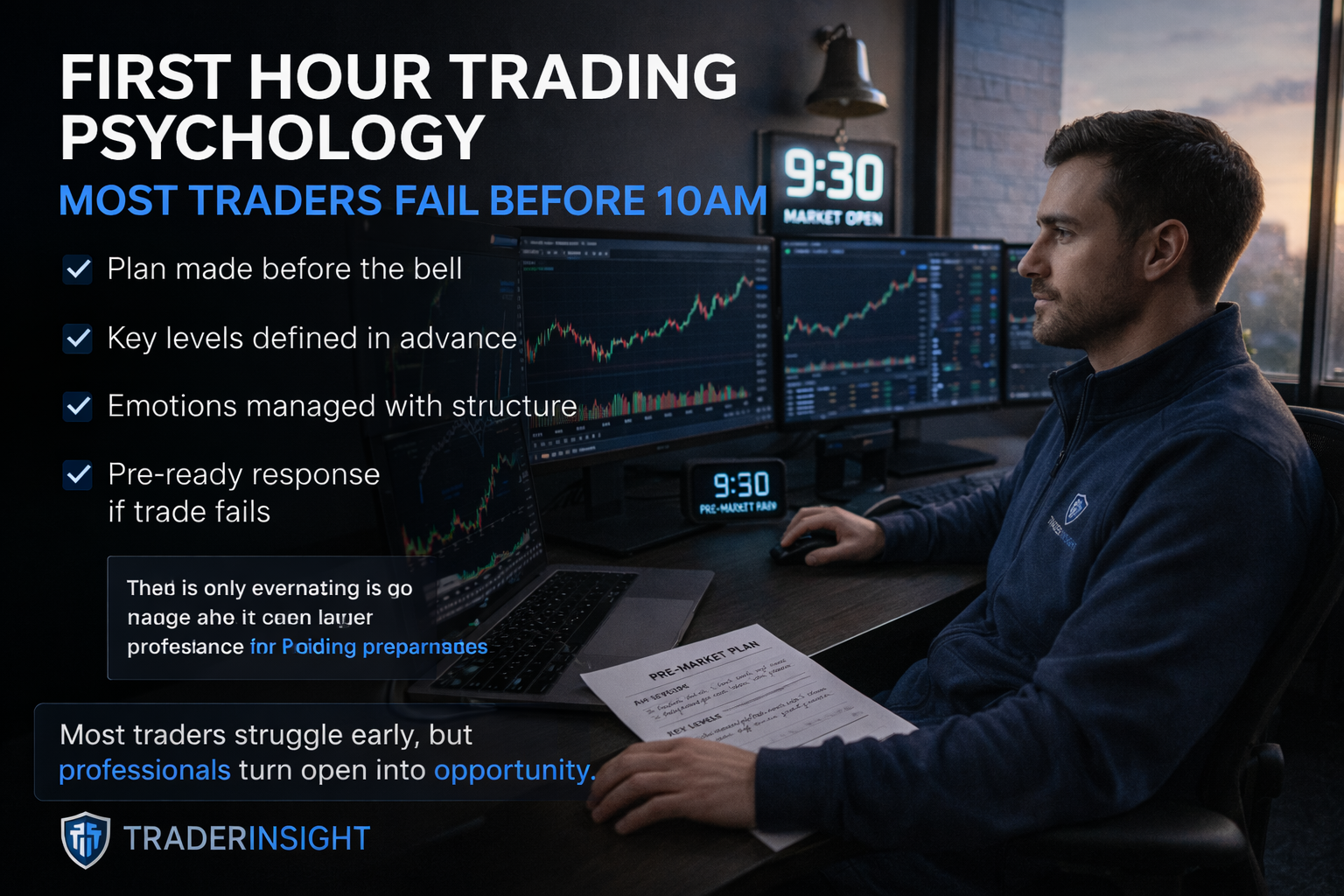
Why the opening hour exposes every weakness in a trader’s process—and how professionals handle it differently
The first hour of the trading day offers some of the biggest opportunities in the market.
It also creates some of the biggest mistakes.
If you want to understand first hour trading psychology, you have to understand what makes the open so difficult.
The market is moving fast. Volatility is elevated. Emotions are high. News is fresh. Gaps are in play. And traders feel like they have to act immediately or miss the day.
That combination is exactly why so many traders fall apart early.
Why the First Hour Feels So Intense
The opening hour is not just another part of the session. It compresses uncertainty, speed, and pressure into a very short window.
That is what makes first hour trading psychology so important.
During the first hour, traders are often dealing with:
- overnight news and market gaps
- fast-moving price action
- fear of missing the best move of the day
- impatience to make something happen early
- pressure to recover quickly if the first trade fails
In that environment, small weaknesses get exposed very quickly.
Why Most Traders Fail Before 10AM
Most traders do not fail before 10AM because there are no opportunities.
They fail because the open magnifies every flaw in their process. This is the core of first hour trading psychology.
- If a trader lacks preparation, the open feels chaotic.
- If a trader lacks structure, the open becomes reactive.
- If a trader lacks execution discipline, the open becomes emotional.
And because the first hour moves quickly, there is less time to recover from those mistakes.
The Open Punishes Uncertainty
The first hour is especially hard on traders who are unclear. If you do not know:
- what setup you want
- where you are entering
- where you are wrong
- what invalidates the idea
- what your maximum risk is
then the opening hour will feel overwhelming.
That is why first hour trading psychology connects so directly to trading preparation psychology. Calm at the open is usually built before the bell rings.
Speed Increases Emotional Errors
At the open, traders do not have the luxury of slow decision-making. That is not necessarily a problem for prepared traders.
But for reactive traders, speed turns small hesitation into big mistakes. They chase entries. They widen stops. They grab profits too early. They take a second trade to repair the first one.
This is why first hour trading psychology is so important. The open does not create bad habits. It reveals them.
Cognitive Load Is Highest at the Open
The first hour also creates a cognitive load problem.
Traders are trying to process too much at once:
- gap direction
- market tone
- sector strength
- watchlist movement
- news flow
- entries and exits
If the process is not simple, the trader starts to freeze or force action.
That is why first hour trading psychology ties closely to cognitive load in trading. Simplicity is not optional at the open. It is a performance tool.
What Professionals Do Differently in the First Hour
Professional traders do not approach the open hoping to figure it out live.
They come in with structure.
That usually means:
- a short list of high-quality opportunities
- clear levels mapped in advance
- predefined entries, stops, and targets
- if-then responses for common scenarios
- risk already determined before the bell
This is why first hour trading psychology is less about emotional toughness and more about preparation and design.
Professionals do not simply feel calmer. They have fewer unresolved questions when the open begins.
The First Trade Can Shape the Entire Day
The first trade often carries outsized emotional weight.
A loss can trigger urgency. A win can trigger overconfidence. A missed move can trigger frustration.
That is why first hour trading psychology is not just about setups. It is about what happens immediately after the first important moment of the day.
Prepared traders already know how they will respond.
Reactive traders improvise.
How to Improve First Hour Performance
1. Prepare Before the Open
Know your setups, levels, and risk before the market opens.
2. Simplify Your Process
Reduce symbols, indicators, and variables during the opening hour.
3. Predefine Your Response to Common Problems
Examples:
- If I miss the entry, I do not chase
- If the first trade loses, I pause before acting again
- If the setup is not there, I do nothing
4. Judge Success by Execution
This is where trading execution discipline matters most. A well-executed first hour builds confidence and consistency.
5. Use Better Structure, Not More Willpower
The open moves too fast to rely on self-control alone. That is why trading structure over discipline matters so much in the first hour.
The Real Opportunity of the First Hour
The first hour is not just where mistakes happen.
It is also where edge becomes visible.
When traders are prepared, clear, and structured, the open can become one of the most productive parts of the day.
That is why first hour trading psychology matters so much. The opening hour rewards clarity and punishes confusion.
The Bottom Line
First hour trading psychology explains why so many traders fail early in the day.
They are not necessarily using bad strategies.
They are entering the most demanding part of the session without enough clarity, structure, or preparation.
That is a hard way to trade.
Final Thought
If your worst mistakes happen early, do not just ask: What went wrong after the bell?
Ask: What was missing before the bell? That is usually where the real answer lives.
Trade with Us
If you want to see what strong first hour trading psychology looks like in real time…
Where trades are planned before the open,
Key levels are mapped in advance,
And the first hour is approached with clarity instead of chaos—
You’ll quickly see:
The traders who do best at the open are usually the most prepared before it begins.