
Dow Closes at Record as Iran Talks Ignite Rally: What Traders Should Watch Tuesday
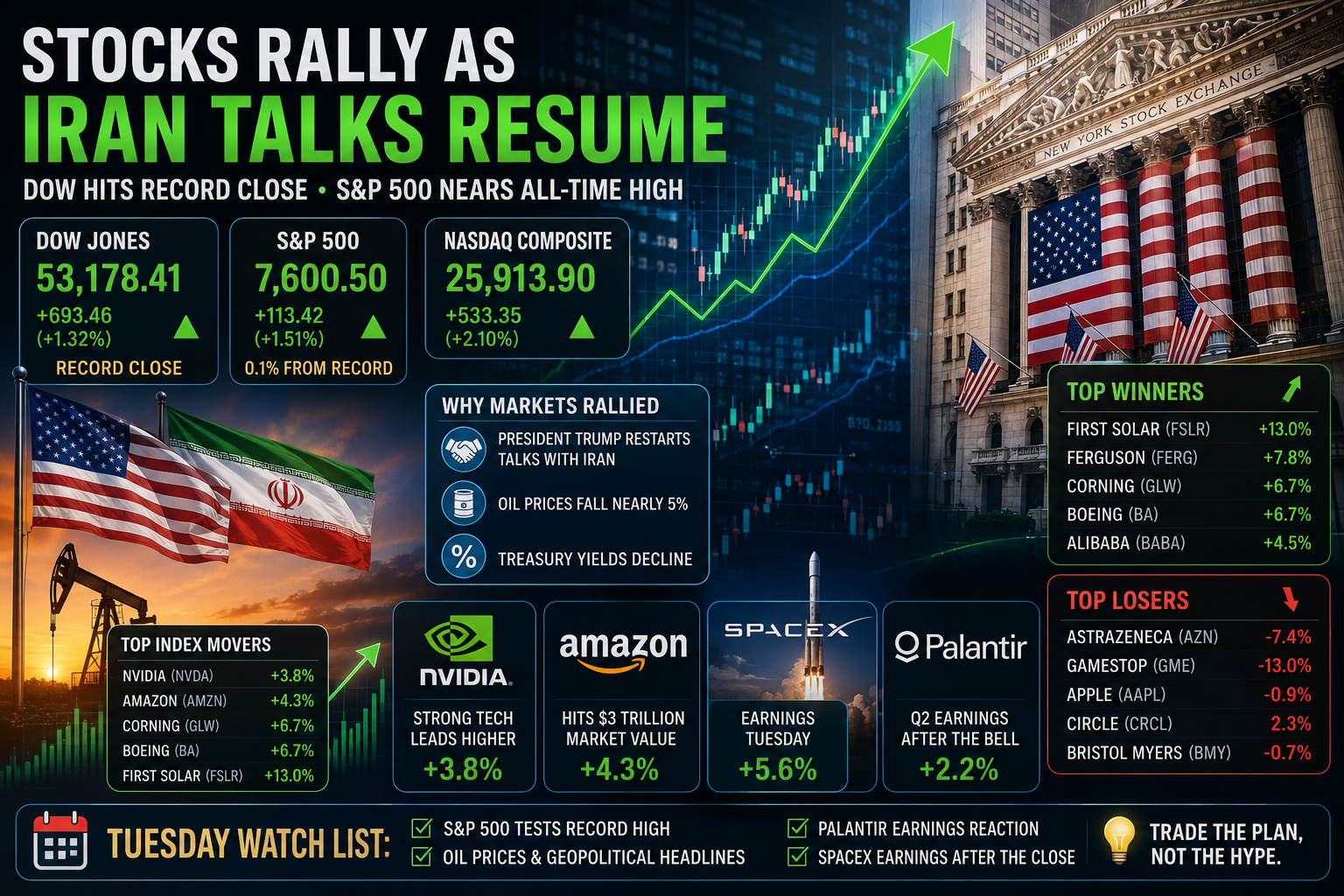
Wall Street began the week with a powerful risk-on move as renewed hopes for diplomacy between the United States and Iran sent oil prices lower, Treasury yields down, and technology stocks sharply higher. The Dow Jones Industrial Average finished Monday at a record closing high, while the S&P 500 moved to within striking distance of its own record.
The Dow advanced 693 points, or 1.3%, to close at 53,178.41. The S&P 500 gained 1.5% to 7,600.50, finishing approximately 0.1% below its all-time high. The Nasdaq Composite led the major averages with a 2.1% advance to 25,913.90. Market participation was also constructive, with advancing stocks significantly outnumbering decliners on the New York Stock Exchange.
The strong close creates a positive backdrop for Tuesday, August 4, but traders should be careful about automatically assuming that Monday’s momentum will continue without interruption. The market is approaching important record levels after a large one-day advance, making Tuesday’s opening price action especially important.
Iran Diplomacy Sends Oil Prices Lower
The primary catalyst for Monday’s rally was President Donald Trump’s announcement that the United States would pause planned military action against Iran and restart negotiations.
The possibility of an agreement that could help reopen the Strait of Hormuz reduced fears of an extended disruption to global energy supplies. Brent crude fell nearly 5%, while West Texas Intermediate moved back toward $80 per barrel. Treasury yields also declined as falling energy prices reduced some of the market’s immediate inflation concerns.
This combination was particularly supportive for growth stocks. Lower oil prices can reduce inflationary pressure, while declining Treasury yields increase the relative value of future earnings from technology and other high-growth companies.
For Tuesday, geopolitical headlines remain the most immediate macroeconomic risk. Monday’s rally priced in meaningful optimism about de-escalation. Any indication that negotiations are progressing could support another test of the highs. A breakdown in talks, renewed military threats, or a sharp rebound in oil could quickly reverse part of Monday’s move.
Technology Stocks Return to Leadership
The Nasdaq’s outperformance was an important feature of Monday’s session. Nvidia gained approximately 3.8%, Amazon advanced more than 4%, and several cybersecurity and software stocks also posted strong gains.
Amazon reached a market capitalization of approximately $3 trillion for the first time as its shares moved toward a record close. Nvidia’s advance helped restore confidence in semiconductor and artificial-intelligence stocks following recent concerns about the scale and profitability of AI-related investment.
Monday’s technology rally suggests that investors were willing to return to risk once oil prices and yields moved lower. However, one strong session does not necessarily resolve the recent volatility in the group.
For the stock market outlook for Tuesday, traders should watch whether Nvidia, Amazon, Microsoft, Meta, Alphabet, and the broader Nasdaq can hold above Monday afternoon support. Continued relative strength in these names would confirm that institutional money is returning to growth stocks rather than simply covering short positions.
The S&P 500 Faces a Record-High Test
The S&P 500 closed only a small distance below its previous record. That creates an obvious decision point for Tuesday.
A clean move through the record, supported by strong breadth and sustained participation from technology, financial, industrial, and consumer stocks, could attract momentum buyers. A brief pullback that holds above Monday’s breakout area could also provide a more constructive entry than chasing an opening surge.
However, traders should be alert for a failed breakout. Markets frequently become vulnerable when an index gaps into a widely watched record after a large prior-day move. If the S&P 500 trades above the old high but cannot hold there, the failed breakout could trigger profit-taking and a return toward Monday’s closing range.
The Dow’s record close is encouraging, but Tuesday’s ability to hold the breakout will be more important than the record itself.
Palantir Earnings Could Influence the AI Trade
Palantir Technologies gained 2.2% during Monday’s regular session before releasing second-quarter results after the closing bell. The company had guided to approximately $1.8 billion in quarterly revenue, reflecting exceptionally strong year-over-year growth.
Palantir’s Tuesday reaction could influence sentiment across software, data analytics, cybersecurity, and other AI-related stocks. ServiceNow, Palo Alto Networks, and CrowdStrike all gained sharply Monday, suggesting that traders were already positioning for continued strength in enterprise technology.
The critical issue Tuesday will not simply be whether Palantir beat expectations. Traders should compare the opening gap with the stock’s ability to hold its initial range.
A strong report followed by a gap that holds above premarket support could create continuation opportunities. A large gap that immediately loses support would suggest that expectations were already embedded in the stock. Because Palantir can produce unusually large post-earnings moves, traders should allow the opening volatility to establish structure before committing capital.
SpaceX Moves Higher Ahead of Tuesday Earnings
SpaceX gained approximately 5.6% Monday as investors positioned ahead of the company’s second-quarter earnings report. The stock entered the week roughly 20% below its $135 initial offering price, leaving the company under pressure to demonstrate progress in revenue growth, launch operations, Starlink, artificial-intelligence infrastructure, and capital spending.
SpaceX is scheduled to release its second-quarter financial and operational results after the market closes Tuesday, followed by a management webcast at 4:30 p.m. Eastern Time.
That timing means Tuesday’s regular session will primarily reflect pre-earnings positioning rather than the actual results. The stock could experience elevated volatility as short sellers reduce exposure, speculative buyers move in, and existing shareholders decide whether to maintain positions through the announcement.
For day traders, SpaceX may offer opportunity during Tuesday’s session, but holding a short-term trade through the earnings release introduces a separate and substantially larger level of risk. Stops cannot protect against an after-hours gap, and the stock’s limited public trading history makes the potential reaction more difficult to estimate.
Apple Continues to Show Relative Weakness
Apple declined Monday even as the broader technology sector rallied. The stock closed lower for a fourth consecutive session and remained at risk of falling behind Alphabet in the ranking of the largest U.S. companies by market value.
This divergence deserves attention Tuesday. A stock that cannot participate when its sector and the broader market are advancing is demonstrating relative weakness.
If the market remains strong Tuesday but Apple continues to trade below Monday’s closing range or fails at an early bounce, it could remain a short-side candidate. If Apple reclaims Monday’s high and begins outperforming the Nasdaq, that would indicate that the recent selling pressure may be exhausting itself.
The key is not to short Apple simply because it has declined for several sessions. Traders should wait for a defined setup, failed rally, support break, or other repeatable structure.
Semiconductor Stocks Produce Mixed Signals
Micron recovered from early weakness to finish modestly higher despite sharp declines in South Korean memory-chip manufacturers. Sandisk jumped 7.5%, while Western Digital declined 1.4%.
Nvidia’s strong advance helped lift semiconductor sentiment, but the mixed performance within the memory group suggests that investors are still distinguishing between individual companies rather than buying the entire industry indiscriminately.
Tuesday’s semiconductor trading should be evaluated through relative strength. Nvidia holding Monday’s advance would be constructive for the Nasdaq. Micron holding above its intraday recovery area would indicate that buyers are willing to absorb concerns about Asian competition. Weakness in Micron, Sandisk, or other memory names despite a stable chip index would signal that company-specific pressures remain active.
Boeing Breaks Higher on Upgrade and FAA News
Boeing gained approximately 6.7% after BNP Paribas raised the stock to Buy from Sell and increased its price target to $300. The move was also supported by progress involving aircraft certification from the Federal Aviation Administration.
A double upgrade can produce sustained institutional buying, but Monday’s large move also leaves Boeing vulnerable to early profit-taking. Tuesday traders should watch whether the stock can consolidate above the upper portion of Monday’s range.
A controlled pullback that holds support would be more constructive than an immediate gap higher followed by a reversal. Losing Monday’s breakout area would suggest that much of the upgrade reaction was completed during the initial session.
First Solar and Corning Extend Rebound Trades
First Solar surged approximately 13% and led the S&P 500 after strong quarterly results and ahead of a government decision involving imported polysilicon. The stock now carries both earnings momentum and policy-related headline risk.
Corning advanced roughly 6.7% after Truist upgraded the stock to Buy. The move followed a 46% decline in July, making Monday’s advance potentially the beginning of a larger recovery—or simply a sharp oversold bounce.
For both stocks, Tuesday’s reaction will help clarify the quality of Monday’s move. Strong stocks should hold a meaningful portion of their gains. An immediate loss of the prior session’s support would warn that traders are using the strength to exit positions rather than establish new ones.
GameStop Dilution Creates a Different Trading Dynamic
GameStop fell approximately 13% after announcing plans to exchange $1.4 billion of debt for stock. Issuing equity to retire debt can improve a company’s balance sheet, but it also dilutes existing shareholders.
The transaction may produce additional institutional hedging and short-selling activity. That could keep pressure on the stock Tuesday, although a large opening decline also raises the possibility of a short-covering bounce.
Traders should avoid chasing GameStop lower after an extended gap. The better approach is to allow an opening range to form and then determine whether the stock is accepting lower prices or recovering above key premarket levels.
Tuesday Trading Implications
The stock market outlook for Tuesday is constructive, but the setup is not as simple as buying because Monday was strong.
Monday’s rally was driven by a significant repricing of geopolitical and inflation risk. The Dow reached a record, the S&P 500 moved just below its high, the Nasdaq gained more than 2%, oil fell sharply, and market breadth improved. Those are legitimate bullish developments.
At the same time, large moves frequently create difficult next-day entries. Tuesday could begin with traders chasing Monday’s winners just as short-term participants start taking profits.
- Watch the S&P 500 record: Acceptance above the previous high would support continuation. A breakout that quickly fails could trigger a broader reversal.
- Monitor oil prices: Continued weakness in crude would support technology, consumer, transportation, and other rate-sensitive groups. A sharp rebound could pressure the market.
- Follow Treasury yields: Growth stocks benefited from Monday’s yield decline. A reversal higher in yields could challenge the Nasdaq rally.
- Evaluate Palantir’s earnings reaction: Its gap and opening-range behavior may influence the broader AI software trade.
- Treat SpaceX as an event stock: Tuesday’s regular-session movement will occur ahead of earnings, creating the potential for unusual positioning and volatility.
- Compare Apple with the Nasdaq: Continued Apple weakness during a strong market would remain significant.
- Do not chase Monday’s largest winners: Boeing, First Solar, Corning, Amazon, and Nvidia may need to consolidate before offering favorable risk-to-reward entries.
The TraderInsight Perspective
Monday was a strong session, but Tuesday’s opportunity will come from observing how the market responds after the initial enthusiasm.
Traders should begin with clearly defined scenarios. A modest pullback that holds above Monday afternoon support could create continuation setups. An opening gap directly into record resistance requires more caution. A failed breakout, a reversal in oil, or weakness in the stocks that led Monday’s rally would provide evidence that the market needs to retrace before moving higher.
Individual stocks will also present very different structures. Palantir will trade on completed earnings information. SpaceX will trade ahead of an earnings event. Apple is showing relative weakness. Nvidia and Amazon are attempting to extend powerful momentum. GameStop is reacting to dilution, while Boeing and Corning are responding to analyst upgrades and company-specific catalysts.
The goal Tuesday is not to predict whether the market will set another record. It is to identify which stocks hold their levels, which break down, and where price action confirms that buyers or sellers have taken control.