
Micron Shares Rebound as China’s CXMT Plans Major Memory-Chip Expansion
Micron Technology shares reversed early losses Monday as the broader semiconductor sector recovered, but the long-term competitive picture for the U.S. memory-chip producer may be growing more complicated.
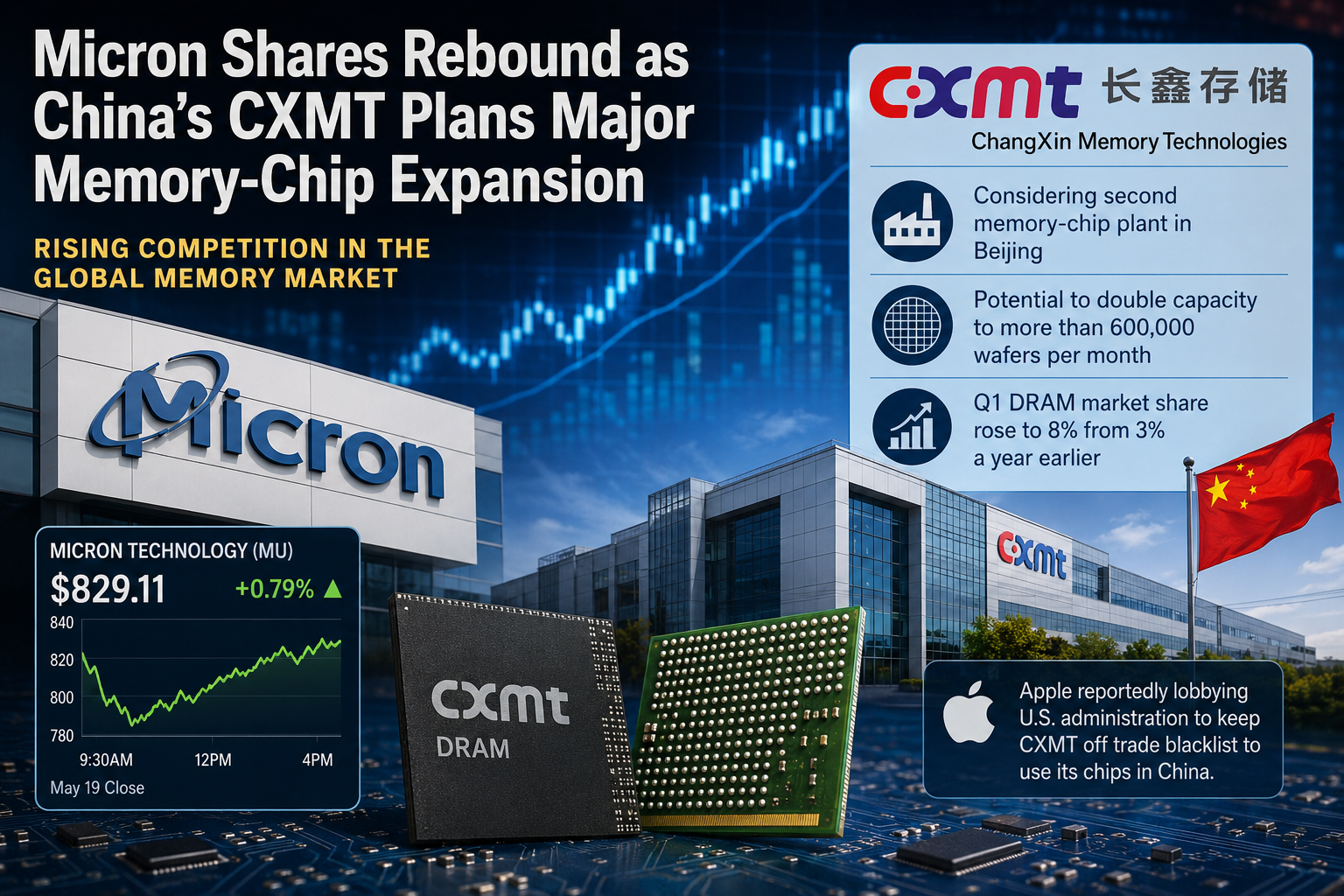
Micron Technology traded as low as $795.02 during the morning session, a decline of approximately 3.4%, before rebounding to close 0.7% higher at $829.11. The recovery came alongside a broader bounce in semiconductor stocks, with the PHLX Semiconductor Index gaining slightly more than 1%.
Despite the positive close, investors are beginning to pay closer attention to Micron CXMT competition as Chinese memory-chip manufacturer ChangXin Memory Technologies considers a major expansion of its production capacity.
CXMT Considers Second Beijing Memory-Chip Plant
ChangXin Memory Technologies, commonly known as CXMT, is reportedly considering construction of a second memory-chip fabrication plant in Beijing. The potential project follows the company’s recent initial public offering, which reportedly pushed its market valuation close to $500 billion.
The additional facility could help CXMT substantially increase its production of dynamic random-access memory, or DRAM, one of the most important components used in computers, smartphones, servers, artificial-intelligence systems, and other electronic devices.
According to reports, CXMT could eventually double its production capacity to more than 600,000 semiconductor wafers per month. That expansion would give the company more flexibility to compete for customers both inside China and across international markets.
China’s DRAM Market Share Is Growing
CXMT is currently the world’s fourth-largest DRAM manufacturer. Its share of the global DRAM market increased to approximately 8% during the first quarter, compared with roughly 3% during the same period one year earlier, according to Counterpoint Research.
The company remains considerably smaller than the industry’s three established leaders. Micron controls approximately 22% of the DRAM market, while South Korean manufacturers SK Hynix and Samsung Electronics hold even larger positions.
However, CXMT’s rapid market-share growth and access to additional capital could increase pricing pressure throughout the memory industry. The developing Micron CXMT competition may become particularly important if CXMT uses its IPO proceeds to accelerate production faster than global demand expands.
Apple Reportedly Wants Access to CXMT Chips
Apple has also emerged as an important player in the developing situation.
The company has reportedly been lobbying the Trump administration to prevent CXMT from being added to a U.S. trade blacklist. Apple is believed to be interested in using CXMT memory chips in devices manufactured or sold within China.
Using a Chinese supplier could help Apple manage costs, strengthen its domestic supply chain, and comply with local sourcing expectations. At the same time, allowing a major American technology company to purchase CXMT products could provide the Chinese chipmaker with greater credibility, scale, and financial support.
For Micron, Apple’s interest highlights how the competitive landscape could extend beyond semiconductor manufacturing. The battle may also involve trade policy, national security concerns, government subsidies, and access to the world’s largest technology customers.
Memory-Chip Stocks Remain Volatile
Other major memory-chip stocks experienced sharp swings Monday.
SK Hynix’s American depositary receipts fell as much as 4.4% during the session before recovering to close down less than 1%. In South Korean trading, SK Hynix and Samsung Electronics each dropped approximately 8.8%.
Mizuho Securities trading-desk analyst Jordan Klein suggested that the weakness in Asian memory stocks may have reflected positioning and broader market rotation rather than a sudden deterioration in industry fundamentals.
That distinction matters for traders. A stock can decline because investors are reducing exposure to an entire sector even when the underlying company’s earnings outlook has not materially changed. The subsequent recovery in Micron and SK Hynix indicates that at least some investors viewed the initial selling as excessive.
What Micron Traders Should Watch
Micron remains one of the primary beneficiaries of strong demand for memory used in artificial-intelligence infrastructure. High-bandwidth memory, data-center investment, and expanding AI workloads have helped support pricing and profitability across the industry.
However, several developments could affect the stock’s longer-term trajectory:
- The speed at which CXMT expands its manufacturing capacity
- Whether CXMT gains additional global customers
- Potential U.S. trade restrictions involving Chinese semiconductor companies
- Apple’s ability to source CXMT chips for products sold in China
- DRAM pricing as new industry capacity comes online
- Continued demand for high-bandwidth memory used in AI systems
The immediate market reaction suggests investors are not yet treating CXMT as an existential threat to Micron. Micron’s scale, technology, customer relationships, and position in advanced memory products remain meaningful advantages.
Still, semiconductor markets often price future supply changes well before new factories reach full production. Traders should therefore monitor not only Micron’s earnings and guidance, but also capacity announcements from CXMT, Samsung, and SK Hynix.
The TraderInsight Perspective
Monday’s reversal in Micron illustrates why traders should avoid relying solely on an opening move or an overseas market reaction. Micron initially followed weakness in Asian memory stocks, but the early decline failed to hold as buyers returned to the broader semiconductor sector.
Rather than automatically shorting Micron because Korean chip stocks fell sharply, a disciplined trader would wait for confirmation through price structure, liquidity, relative strength, and the behavior of the semiconductor index.
The larger issue is that Micron CXMT competition is becoming a developing fundamental theme rather than a one-day headline. CXMT’s expansion could eventually influence global memory supply, pricing, and market share. In the near term, however, AI demand, sector rotation, and overall semiconductor sentiment may continue to have a greater influence on Micron’s daily price action.
For traders, the opportunity will come from tracking how the market responds as these competing forces develop—not from predicting the outcome before the price confirms it.